
 Apple Podcasts
 Spotify
 RSS Feed
 Castro
 Amazon Music
 PocketCasts
 Private Investing Is Not What You Think with Victoria Watkins of Inrichmint
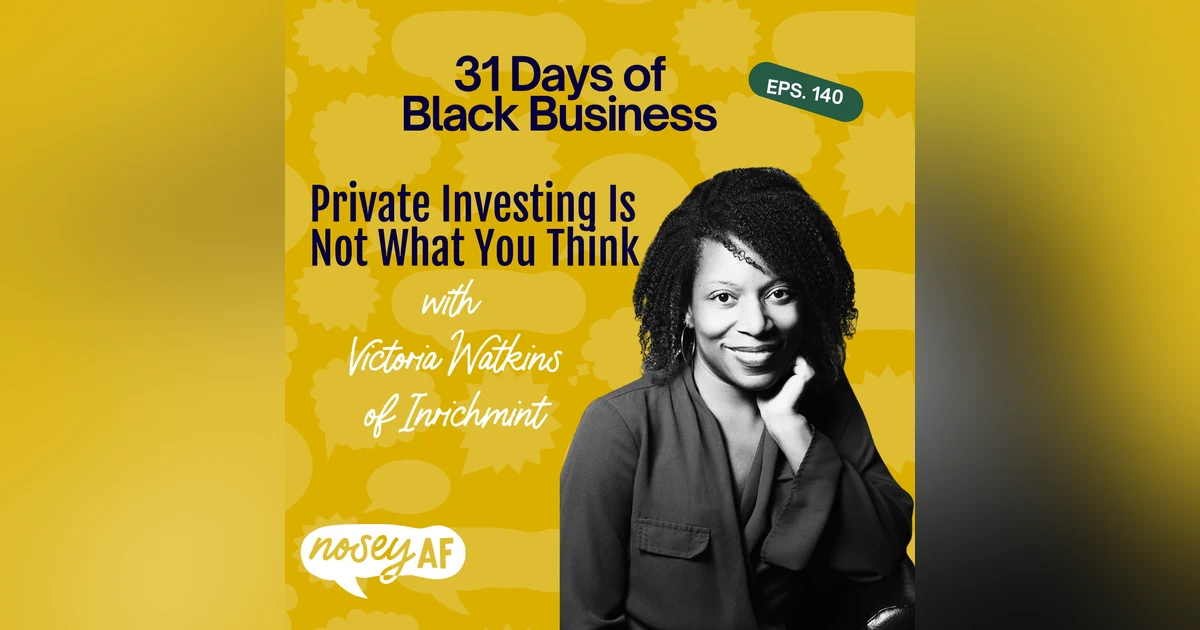
Ep 140: Private Investing Is Not What You Think with Victoria Watkins of Inrichmint
Part of noseyAF's 31 Days of Black Business series 🖤
I learned a new term recording this one: family office. I was today years old.
Victoria Watkins is a lawyer and the founder of inrichmint, where she helps people invest in companies that aren't on the stock market. She'll tell you private investing is not the gated thing you think it is, and that your friend's flower shop counts. She's also the author of Little Valarie and Her Big World of Options and runs Joy and Magic Tea.
What We Talk About
- Private investing explained from the beginning, including what a friends and family round is and what "sweat equity" actually means
- What a family office is, why the structures are attainable for way more people than think they qualify, and who should have one
- Why she watches American Greed as informal due diligence training
- The unexpected turn: she went to law school to become a fashion lawyer, ended up in the mayor's office, then became chief of staff at a mutual fund company
If you love a conversation that hands you the keys, this episode is for you.
All about Victoria Watkins
You're gonna love Victoria. She's a multi-hyphenate who has always had more than one thing going, and she'll tell you why: we should all have more than one source of income, and she doesn't want to get to the end having left anything in her. Founder of inrichmint, where she and her business partner bridge investors and privately held companies, she came up through the Illinois House Democrats legal team, the Emanuel administration, and four years as chief of staff at Ariel Investments. She still writes, which is how Little Valarie and Her Big World of Options happened, named for her mother and inspired by watching the 2016 Olympics.
Things We Mentioned
- Inrichmint
- Little Valarie and Her Big World of Options (afflliate link)
- Joy and Magic Tea
- Rachel Gadson of ILA Creative Studio, her illustrator
- American Greed, her informal due diligence education
- Pastor Mike Todd and "I'm going to die empty"
Chapters:
- 00:07 - Introduction to Black Entrepreneurship
- 00:59 - Transitioning to Private Investing
- 23:22 - Understanding Family Offices and Their Importance
- 34:20 - The Importance of Networking in Entrepreneurship
- 39:15 - Introducing Little Valarie and Her Journey
This series is supported by Off the Grid, a podcast for small business owners who want to leave social media without losing their clients. Find them at offthegrid.fun 🖤
Connect with Victoria Watkins
- Website: https://inrichmint.com/
- Her blog, which has tutorials on family office structures
- Tiktok
- YouTube
Stay Connected
📬 Get the noseyAF Dispatch → Subscribe here
🏡 Grab the Good Neighbor Playbook → Download it free
More ways to connect
- Email: stephanie@missgraham.com
- Follow on IG: @stephaniegraham
- Listen to more episodes: noseyaf.com
Support & Feedback
noseyAF is listener-supported; thank you for being here. 💛🫶🏾
📣 Share noseyAF with a friend who needs to hear this
Episode Credits
Produced, Hosted, and Edited by Stephanie Graham
Lyrics: Queen Lex
Instrumental: Freddie Bam Fam
Cover Art: Emma McGoldrick
00:00 - Untitled
00:07 - Introduction to Black Entrepreneurship
00:59 - Transitioning to Private Investing
23:22 - Understanding Family Offices and Their Importance
34:20 - The Importance of Networking in Entrepreneurship
39:15 - Introducing Little Valarie and Her Journey
Stephanie Graham
Hey, friends, welcome. And welcome back to nosey AF conversations about art, activism, and social change.I'm your host and friend, Stephanie Graham, and all month long, we are celebrating black entrepreneurship with our 31 Days of Black Business series. So today's guest is Victoria Watkins. And, y', all, this conversation I'm so excited about because Victoria is dropping nothing but gems, okay?She has the keys. All right? In fact, Victoria. Victoria put me on to a new term, family office. Did you know about this whole family office watch?Like, everybody always knows everything, and then I'm always like, what? So Victoria is a lawyer and founder of Inrichmint, and she says family office structures are for more people than they might think.She also explains private investing in a way that finally made it click for me, and I hope you. So, friends, get your pen and paper ready, because, gang, we are going in today.And another thing that I love about Victoria is she is definitely a girl after my own heart because she is a multidisciplinary businesswoman. Okay? You know, here at noseyAF, we love multi hyphenates, okay? She has a whole suite of things going on.So alongside Inrichmint, she writes a children's book, she has a series called Little Valarie, and she runs a loose leaf tea company as well. So, of course, we get into how she decides where all her attention goes. So happy.Let's play the theme song, and then let's get into our conversation with Victoria Watkins. Welcome to nosey af.Gotta get up, get up to the whole world. You a winner, winner vision of a star with a mission in the cause what you doing? How you doing?What you're doing and who you are Flex yourself and press yourself Check yourself, don't wreck yourself if you know me then you know that I be knowing what's up. Hey, Stephanie Graham is nosy as Victoria. Welcome to nosey af.
Victoria Watkins
Thank you for having me. I'm so excited.
Stephanie Graham
I'm really excited to talk to you. You know, before we get into all of the great things you have going on, can you just define what is private investing?
Victoria Watkins
I'm really glad you asked that. Private investing, although obviously, emphasis on the word private.Private investing means putting money into a business that is not publicly traded on the stock market. So it is still owned by maybe the people who founded it, potentially, you know, someone else who they have had the opportunity to sell it to.But it is not publicly traded on any of the stock market. So it's not on the, you know, New York Stock Exchange or NASDAQ or anything like that, but it's privately held.And all companies are privately held when they first get started.So sometimes privately held companies are early stage, but people can hold their companies for many, many years or decades and never put them on the stock market. And so private investing is being able to liter invest in a company that is privately held and have a piece of equity in that business.So to start off, maybe a person or a family or a group owns a business 100% amongst themselves. Let's say it's four people and they each own a quarter of it.Well then maybe they decide like we need more funding so that we can add a new product or we can open a new location or we can get into a new market or something like that. So they will raise money for that and they will then basically reduce their ownership stake so that new people can have a portion of the ownership.So let's say again with the same example, if there's four people and they each own 25% to get to the hundred. Well, if they each, let's say reduce their portion to 20% each. So between the four of them, that gets them to 80%. The original group owns 80%.Now there's 20% of the company available that they are offering to people.Usually they start like within their network and then from there it goes into, you know, people tell others and tell others and bring them in and they are able to invest in that 20%. So that could be one person puts up whatever the amount Is for that 20%.And that amount is based on the company's valuation, how much they need to raise at that time. So there's a few different ways to determine the company's valuation and the amount of money that they need in the moment.And that's how they will determine what they raise. So like I said, it could be one person who comes in for that 20, it could be 10 people who come in and they now own that 20% with the original four.It depends.And not to get too far into the weeds, there's SEC regulations as far as like how many people can be in a private offering group and things like that. But in general, that's. Private investing is trading money for an ownership stake in a privately held company.
Stephanie Graham
I see. It sounds like it's for big companies. Could the local flower shop, could this apply for like the local flower shop?
Victoria Watkins
Yes.
Stephanie Graham
Okay.
Victoria Watkins
For sure. This is for companies of any size.And I think that's where a lot of the myths come in and a lot of the gatekeeping comes in because people think like, oh, I can't do private investing, I got to write a seven or eight figure check or I got to, you know, be able to be in this like exclusive network.But all of these companies that we know about today, these, you know, the companies that are on all of the device that own all of the devices that created rather all the devices that we're using and that we purchase all the time, they started off as little companies and they were asking people to put, can you put 5,000 in for my company? He put in 10,000, 20, you know, something like that.And when people realize that one, I can do that, you know, or maybe you can do, Maybe it is $100,000 investment. But they're going to take the capital calls as they over four years. So then you're like, oh well, yeah, that I can do.Or again, some folks are taking like 5,000 and that is very helpful. If you get, you know, like 10 checks of 5,000, that makes a big difference in your company.So like mentioned with the local flower shop, a lot of times on the other side, business owners don't think about the fact that they can raise capital. So there are things like Kickstarter and other like crowdfunding opportunities and those are great options too.But the next step from that is what is called a friends and family round, where you literally ask your friends and family, like, will you invest in my company? And they can do it as angel investors where it's like, I'm helping, I will make this investment.Maybe they do it for what is called a safe, a simple agreement for future equity where in the shortest term it's kind of sort of like a loan. But then once you reach the amount you're raising, it becomes equity in the company.So there's different ways to do it right early on for smaller companies, but then as you grow your company and then you're starting to raise like, oh, I'm raising $2 million, I'm raising seven, $8 million or something like that, or even more. Then the structures, you know, can begin to change.But yeah, a lot of times, like you said, the local flower shops, the cafes, they don't always think like, I can raise money to do this next step in my business and start with the people that are like right around me.
Stephanie Graham
Thank you so much for that 101. Because it makes me think private investing is for everyone.Like even, you know, your friend who wants to start the hair salon or the nail shop, we could put in to like help your business. Like maybe we're doing private investing without even knowing we're Private investing.
Victoria Watkins
Right? Yes. Yes. And now, I mean, obviously, like, putting on my lawyer hat. You should have some paperwork and all paperwork isn't the same.Like, it's, you know, for more complex structures, that's going to be more pages, but you can still have at least some sort of simple agreement that memorializes what you're doing. I'm putting in this for that. This is what it, you know, equates to, et cetera, just to always be safe. I always have a contract.
Stephanie Graham
Always. Yeah.
Victoria Watkins
But it still is not as complex and is not the hurdle that so many people think that it is. We got to break those gates down.
Stephanie Graham
Well, thank you so much for explaining that you originally thought you'd become a fashion lawyer.
Victoria Watkins
I did.
Stephanie Graham
So, yeah,.
Victoria Watkins
Man, it's just amazing how, you know, life turns and, you know, when you should be listening to people and then you're like, nah, I know what I'm doing. And you're like, you really don't. So actually, in undergrad, my dad encouraged me to major in finance, like, purely in finance.And I was like, no, I'm good. You know, I'm like, I'm going to law school.I'm not even really, you know, I'm here to, like, get my good grades and, you know, you know, become an AKA and enjoy undergrad. And then I, like, that's on his law school.And so I did major in consumer economics and finance, which was, in my mind, kind of like a compromise, but I realized later was kind of like my own internal consolation prize because I don't. I didn't really believe I belonged in finance.
Stephanie Graham
Okay.
Victoria Watkins
No good reason. I was actually really good at math. I love algebra. Like, I had no reason to think.And a lot of the other thing, too, is, like, finance and math are not necessarily equal. Sure. But, like, finance way more like strategy and other stuff. So. So, yeah.So I got to law school, though, and my first year, I was like, oh, dang, girl, this was a bad idea. Oh, no. But once I took property and we started doing intellectual property, toward the end of the semester, I was like, I'm good.This is what I'm doing. I love copyrights and trademarks. I started taking business law and entertainment law and law en masse, media, theater law, all that kind of stuff.And so I'm like, cool, this is what I'm going to do. And the, like, fashion law niche was really starting to, like, bubble up at that time. And we had, like, a community through old Twitter.And, you know, I had started my fashion law blog and all that. I'm like, yeah, this is what I'm doing. But the economy at the time was like, girl, pick something else.
Stephanie Graham
Wow.
Victoria Watkins
So I still was working on my blog. Cause I knew there was something there from the fashion law perspective.So I'm like, if I do research and writing and, like, keep my name, like, in the space, I'll still be able to do this. So I picked something else, but not instead, just in addition to. And I ended up going to.I started off as a volunteer in a state representative's office. Karen Abro, she was a state representative at the time. And I. After a little while, that volunteer opportunity turned into an internship.And then she encouraged me to go to Springfield with her for a veto session and.
Stephanie Graham
Okay. Something to do. Something to do.
Victoria Watkins
So, like, whatever you say, I'm for it, you know, so. Yeah. But that just like, totally changed the trajectory of my career.
Stephanie Graham
Yeah, because I was going to say, like, yeah, because it did lead you into private investing and launching in Richmond. Right? Is that like.
Victoria Watkins
Almost. So I had a step in government. First I worked for the Illinois House Democrats legal team.And then I worked for the city of Chicago in the mayor's office. But remember I said, find something else. I was still doing fashion law when and however I could.I would sit on panels and I would, you know, consult folks sometimes, you know, whenever I could do that. Just because I still wanted to stay in a space like that still meant something to me.
Stephanie Graham
Yeah.
Victoria Watkins
And I, Like I said, I was working in the mayor's office by that time. Back and forth between Chicago and Springfield as the state government lobbyist. I love, love, loved that job.And then the last year and a half of the administration, I was senior advisor, so I didn't have to go to Springfield, But I was still very much involved in all. All things Chicago.And when the Emanuel administration was over, I was thinking that I was going to be selling my children's book and getting that series started, which I did. And then I also was launching my loose leaf tea company. So I'm like, I'm gonna do that and I'll do some other consulting.But because I, you know, parents know things. Okay. I ended up having a conversation with John Rogers, the founder of Aerial Investments.And that conversation, you know, continued over some time and ended up changing from what I was thinking as far as what I was thinking about consulting into an opportunity to be his chief of staff. And so fast forward from undergrad to through working in government to being a chief of staff at a mutual fund company.So yeah, you just never know how your twists and turns are gonna go. Yeah, yeah. I was there for four years and then, yes, started Inrichmint. Three years.
Stephanie Graham
Love this how it came from, you know, fashion law, which is that just like being a lawyer for fashion designers.
Victoria Watkins
Yes. And there's.I'm glad you mentioned that because so many people think like this is just lawyers who, you know, like fashion, you know, clothes, stilettos and all that kind of stuff. And that's true. But that is true. But I mean, there's a lot of issues in the fashion industry and the related industries.So it's not just like fashion from an apparel perspective. There's beauty, there's wellness lifestyle, et cetera.And so what got me into it and interested was the intellectual property aspect, certainly from a copyright and trademark perspective. But also there's labor issues, there's contract issues.Any kind of issue that you can think of from any other business where the product could be like, as we call it in law school, a widget or technology or. And technology is major in, you know, in fashion and beauty industry.Except, you know, the product, it happens to be apparel, clothing, makeup, things like that. But all of the business issues in this multi billion dollar industry are the same as in other industries. So it's not as frivolous as people think.And goodness, we all wear clothes, so.
Stephanie Graham
Yeah, seriously. Yeah, right. Yeah, that's. I love that you have like these three businesses going on it at once.You have the children's book series, you have the tea company and then you have Inrichmint. How do they. Do you feel that they intertwine with each other or do you feel that they're separate?
Victoria Watkins
They are, they are separate. But I learn a lot in being a founder, in working on behalf of investors, with founders. So for Inrichmint, we work on behalf of investors.And so we are that bridge between people who want to invest in private businesses and the privately held companies. And so people will tell us what they're interested in investing in. Oh, I want to invest in professional sports or media or healthcare AI.Sometimes what they're doing telling us they were interested in is very, very general. And we kind of got to like narrow that down or sometimes it's really specific.I want to invest in like this type of company that does this thing or whatever.And so we find those opportunities for them and then we do the due diligence in like vetting the company to help them determine if they should invest or not. You know, we give them a few options. Like this is what you told us. Here's Some of those kind of options.But also we're listening to hear what they tell us without telling us. So, you know, if you tell us, oh, I want to invest in, like, fintech, health tech and underrepresented founders, cool.But then you tell us that you go to, you know, a professional sports game in every city you go to. You go to a play in every city you go to. You said those other three.But when we hear about something else in those other areas, we're like, well, we think this might interest you too. So in doing that, it helps us to know what to present in front of investors.But we are also doing our work on the other side as far as talking to business owners, executive management teams, and really digging into their business, their financials, legal aspects, you know, intellectual property that they have, their market strategy, all of those things to help determine if this is something we would suggest that our client invest in. So we are consultants in that way, and it ends up also being helpful to the business owners.And it helps me then, as a business owner, of Inrichmint as well. Definitely for joy and magic.Because I'm like, I'm thinking about, you know, what would I. I ask someone else, you know, or, oh, they mentioned that they're doing this. So this is something that I need to be thinking about maybe for one business or. Or another, or. Let me table this. That was good. I'm not there now.I don't need it now, but I may come back to this. So they help each other kind of like a little bit in the background, but not necessarily directly.
Stephanie Graham
Yeah. So you're like a curator for investing opportunities. Yes. You, like, bring them. That's really cool.How would I determine, like, oh, to come to you for help in finding where I should invest versus just doing it myself or, like, approaching a company myself?
Victoria Watkins
Yeah. So.Well, sometimes it's great, I think, if you can approach a company yourself, because sometimes a lot of times people don't think that they can do that or don't, like, just don't even have that option in their mind.But even if you can do that, knowing how to do due diligence and knowing what questions to ask, what information you want to check, you want one thing, another way that I kind of do due diligence informally.I love watching the TV show American Greed, and so that helped me know kind of some things to look for, because, you know, it's a TV show, but, you know, in the first few minutes, you are you. A lot of times I already know, like, oh, this is gonna go this is not gonna go well. So. So that helps.And of course, you know, like, that's the thing with investing. In any kind of investment, whether it's a public investment or private investment, you can always lose 100% of your money.So that's something that we all have to know and understand.But definitely a good reason to work with us in Inrichmint is if you are looking for something specific or I guess kind of the opposite of that, if you're not sure what you're looking for or how you should be looking or you have something. So sometimes there are opportunities that people bring to us and say, hey, this came up through my network.Can you help me do the due diligence and vet this to know, like, if I should invest or not? And we've had people tell us, like, thank you for helping me say no.You know, thankfully there haven't been any situations that are like candidates for American greed. But there could be other reasons why people, why certain people shouldn't invest.We're not, not saying that nobody should invest in somebody's business. But it could also be just maybe not this round or, you know, just a bunch of reasons, but we want to help people find those things.So we can definitely help with like digging in and getting more information. And again, knowing like, what to ask, what to consider and why.And again, a good investment for me may not be a good investment for you and vice versa for a bunch of reasons.
Stephanie Graham
Yeah, it's really personal.
Victoria Watkins
Yeah. Yeah.And sometimes there could be an opportunity to like be on this company's board, either their governance board or like an advisory board if they have it, or something like that. Or like maybe what they are doing with the money for this current round is improving their staffing. So they need like some HR expertise.Oh, well, if someone, if someone is going to be investing in it and they happen to be an HR expert or maybe their sibling or spouse is an HR expert, they can leverage that and say, hey, I'm going to make this investment. I want to do this. But I also want to bring what we call, like sweat equity into it.I'm bringing the financial part for my, you know, equity stake in ownership. But also I'm willing to do some work here too to help move the company forward.So it's not just like I'm dropping the money off and, you know, send me a quarterly update sometime, but. But it could be more than that too.
Stephanie Graham
Wow. So I guess my next question is like, who's the ideal person to come to you for help?Could it Be somebody that needs like, that has like, hey, I have $5,000, I have $500. Or do they need to say have $5 million?
Victoria Watkins
Um, no. So on 500 would be a little hard, but, but 5,000 is not hard. It's not as hard as people think.5 Million is not as easy as people think either, but not because we can't find people to invest 5 million in, but the right investments. So I feel like at, we'll, we'll go with 5,005 million same, but the substance would be different.Um, because of course with that 5 million, do you want to do 2.5 in one thing and 2.5 in another? Do you want to do five 1 millions, do you want to do one 5 million?Different options with 5,000, that's probably just like one placement, which is totally fine. And then from there we would have to figure out where that placement would be.So in general, our client focus areas are family offices, which come in a bunch of different forms. There's some major family office names that we know nationally.The Rockefellers are the first ones who had the, the kind of current form of a family office that we know today.Your family office could be like the Rockefeller family office, where you have like, you know, a beautiful office in some high rise with good snacks and a nice view and a full time team that does all the different things that family offices do for you. So investing and taxes and legal, cybersecurity, a bunch of lists that won't go down.But your family office can also be you, the family, your lawyer and your accountant. And what makes it a family office is the structures that you have set up. So you have an LLC that you are doing investing through you.Maybe you have a nonprofit for charitable work, depending on what kind of tax advantages you're seeking. Or maybe you have a trust or maybe you have all three. You have only one, you have two or other things as well.So family offices, generally speaking, and family offices are attainable for more people than they think they're attainable for. A lot of times you hear that, you know, 250 million is when you should start having a family office.But just because you have a hundred million or even 1 million or less doesn't mean that you shouldn't have the structures that the family offices do. And you may not get to that nine figure number if you don't have these structures set up.So I give that long and kind of detailed definition of a family office because sometimes when people hear it, they blank out and think like oh, that's not me. And it's like it probably needs to be you. You need to get some family office structure set up. So.So family offices, generally speaking, we also think that our service is very helpful for current and retired professional athletes who definitely should be having family office structures and who are, as we can tell now, especially with like nil and just so much more opportunity in like media and partnership opportunities for them that this is a service that they should be thinking about too.And also people who have just gotten to a point in their careers where they have all of their, you know, they have retirement savings set up, they have probably their portfolio has some public equities through a brokerage account or something like that.And they may not realize, like, I could be investing, like my friend has a business, I should be, you know, I can invest in that to help them grow it or I can tap into my network in a different way because again, all of these devices that were using these billion and trillion dollar companies, that's what those folks did early on was like, let me get $10,000 for my business, I'll pitch it to you at dinner and I'll give you however much equity at this point in time. So those are kind of the three areas, generally speaking, family offices, established professionals, and current and retired professional athletes.
Stephanie Graham
Wow. Okay. I didn't even know the term family office until just now. I was eight years old.
Victoria Watkins
I got some little tutorials on my, on my blog and also short clips on my Instagram and TikTok page if folks want more details on family offices. But that's the thing, like we all gotta know about it.
Stephanie Graham
Yeah. How do you decide where your attention goes with your businesses?
Victoria Watkins
I was about to give the law school answer of it depends. And that's actually not true because Inrichmint, that is my, that is my full time plus job.
Stephanie Graham
Okay.
Victoria Watkins
Okay. In the sense of the, of joy and magic being something I absolutely care about and you know, wanting placements. That's the tea.I certainly give that time. I could argue I owe it more time, but that and the children's book series, those are things that I always think that it's. Well, two things.One, we should have more than one source of income. So that's part of that. Those are all also things too, like I said that I care very much about.And this pastor that I really enjoy, Pastor Mike Todd, he said, I'm gonna die empty. He was like, anything that God puts in me, I'm getting it out.And so those things have been placed in my heart to Do I am gonna do them as long and however God tells me to do them, I'm doing them. If he would have said yesterday, we're done with whatever, okay, I may be wanting that for a while.And if he gives me some new idea tomorrow, I'm like, okay, well, now I gotta figure out when to launch that or how to do that or whatever. Not necessarily only a business, but whatever it is. Because I had to think about it, certainly even with starting Inrichmint.Because now for me to be 100% entrepreneurial, quite honestly, it's scary on many days, but as I thought about it, I'm like, if I were in the future, five years, how would I feel if I did not do this? And I know that I'll be like, I could have at least tried it. So that's how I kind of approach all of them.But like I said, Inrichmint, that is my number one. That's my full time thing. But I've always done different things.So even growing up, I was in school, but I played basketball, I did gymnastics, I did tap dance swimming, and not all of those at the same time. But I always had more than one thing. I was doing school and at least one other thing. So, yeah, I figured out calendar. That's why I have reminders.
Stephanie Graham
Yeah, it's second nature for you to just do. It's like, duh, this is. This is just you.
Victoria Watkins
Yeah. Yep.
Stephanie Graham
Yeah, I remember. I'm always thinking about what pastor I found this from, but I heard something similar of like, who God made you to be.You need to like respond to that because you don't want to get to heaven. And he's like, hey, yeah, did I not give you a voice? Why didn't you make an album?You know, like, you don't have to be like Janet Jackson on tour here, but like, you could have been like a wedding singer, you know, like, or, you know, venues or whatever. Like, I have a cousin who will do that for different weddings. You don't ever want to get to heaven. And it's like, I told you to pray, right?
Victoria Watkins
I had all these things for you and you were too scared and you loved comfort too much to even try any of these things. So I'm like, that can't be me. I can't. I don't want to do that.
Stephanie Graham
So I know it's scary. Like, yeah, that's scary too. To not try.
Victoria Watkins
Yeah. Yeah, why not try? And I mean, yes. Like, life is short and long.I think don't realize sometimes how much time we have because time does move very quickly. But you know, if we, we can slow the minutes down and do what we're supposed to do.
Stephanie Graham
Yeah. If I'm a business that is looking for more investors, can I come to you also?
Victoria Watkins
Yes, for sure. We work on behalf of investors, but we need things to show them.And so as my business partner Josh puts it, we're 100, 100, 100% looking for deals, 100% looking for clients.And now it's most ideal for us when someone says, oh, I want to invest in 1, 2, 3, and we're like, oh, here, here's some options and we'll get you some more options. But here's some stuff we already have. And so yes, we're always looking to keep our deal flow warm and know what's going on.We also engage with founders, business owners, cause they could have purchased it from a founder or whatever so that enough before we will put them in front of a client too. So we definitely need those connections so that we can, you know, like I said, have opportunities to present and share.
Stephanie Graham
Yeah. Why is it important for minority investors and minority owned businesses to have stronger pathways to capital?
Victoria Watkins
It is really important because that is how we not only build wealth, period, but it's how we build generational wealth. And so often, which I think is right, in some way, we are trying to bootstrap businesses.And like I will, I'm just gonna, you know, put all my money in, I'll then use the revenue from the business to put back into the business. And that's fine and good because investors should want to see that you have some skin in the game. But that does not have to be your only path.And in wanting to grow your business and take it to the next level in whatever way, like I said, whether that's new market geographically or from an industry perspective, or if that is new products or more products to be able to just like increase production.Whatever it is, however you want to take your business to the next level one, certainly you will need money and you might need more money than what you can put in and you will be limiting yourself if you don't take on outside capital. I absolutely think you should get all the free money you can from. There are grant opportunities out there.Definitely, you know, take advantage of that. There's different programs.There are a lot of ways to get money without giving up part of your cap table which make the ownership picture of your business. You should definitely like take advantage of those things first and consistently.Like just because you've raised money doesn't mean you can't still get a grant of some sort later.But you definitely want to be thoughtful about when you take on external ownership because when other people have a stake in something, that means they also have a voice of some sort. And maybe it's not a majority voice, but they do then have a bit of a voice depending on how much of the cap table they're taking up.But that also, like I mentioned sweat equity earlier, that gives you more voices and more insights and broadens your network. So something that we always ask founders or business owners is who are their ideal investors.And that's like from a profile perspective, some people are like, I want you know, this person in invest, that person. They know exactly like people who they will want to invest in their company.But a lot of times that reason is whether it's the specific person or like a profile is because those people can help to grow their business.If I can get this person to, if they have a specific person, if I get this person to do some posts, I know that's going to make people want to buy my product or my service. If I can get someone like this, whatever the profile is in my network work, they are an expert in that industry.So they can make more connections for me. They can help me with production, they can help me with marketing, they can help me like I said earlier with HR or whatever.So seeking not only outside capital but outside voices and outside insights is really helpful because it's not only growing the cap table and the bottom line, but also the network which is really important because sometimes like if you keep yourself in a box, your company will only go so far. Especially as right now, as quickly as things are changing and elevating, you need more insights to be able to take your company into the future.
Stephanie Graham
Yeah.As we are currently recording this next week, I'm going to a conference where it's a bunch of artists who also run like spaces like they might have their own galleries or like not for profits, things like that. And, and last year I went to the same conference and there was discussion about like becoming a not for profit or not.You know, usually folks are just sort of self funded just doing this thing themselves. One of the fears were if you became a not for profit, you know, different types of people can come in and like they're like they could ruin it.Like there's that fear that it can go left and even listening to you speak it reminded me of like the Ray Charles movie he had. That friend was stealing from him and then they brought that New guy in who realized it, who caught it.And it's like, well, that was a good thing that they brought that outside businessman in to look at the books.
Victoria Watkins
Yeah.
Stephanie Graham
But, yeah, I think you, there is always just this fear and like, you bring up like American greed. It's just like we always see all these like, true crime things that just, that just show the extreme.
Victoria Watkins
Right. Yes. But that's why networking is so important, because sometimes we don't realize that what we need is already right here.
Stephanie Graham
Yeah.
Victoria Watkins
Who is in your network, who does what type of job, who. Who is in this different career sector or even like I say, like, as a lawyer, I don't do all types of law.So, you know, if I'm looking for something in anything, I certainly don't do patents. But I know who to call about that if I, if something comes up. Somebody asked me something about bankruptcy last week, I know who to call for that.And so even like taxes, I got like three or four good tax pro tips for you. But that's not my, that's not my jam. I'm not a cpa, but I know who to call for that.And so a lot of times we have to think, really, in our own network, who do we already have that's close? And maybe it's not one call away, but it might be two calls away. I know, like, we all got a couple group chats to be. Be like, who do we know who?Blah, blah, blah, blah. And the messages start coming like, oh, this person, that person. Oh, let me call such and such.So I would definitely say start close and then, you know, stretch out.But also just in building your own network over time, you may meet someone and then like fast forward, you know, a year later, like, oh, now here's a reason for us to work together, you know. Yeah, let me that. Now I have a reason to ask that person if they know somebody else. So a lot of times what we have is like, right in front of us.Yeah.
Stephanie Graham
Do you have any tips, like, maybe just in your own personal networking strategy? Like, do you make sure you remember birthdays? Do you have like a fun flower arrangement you send out to folks?
Victoria Watkins
It's funny you mentioned birthdays because it's hard for me to like, forget a birthday. Like, just even in the sense of like, is there some people, like, I don't need to know that birthday no more.But that's just, I guess, like how my memory works. But, but in that same regard, I love my calendar and my reminders.They help me stay on track and so if it is someone who's like, oh, maybe, you know, I don't know, my brain might have room for another birthday. But let me put this in my calendar.And now my calendar will ask, like, if I send a birthday text and it's not in there, like, do you wanna add this to their contact? Yes, I do.
Stephanie Graham
Yes.
Victoria Watkins
Just in case transactions have to happen in life, because they do. But you can also not be a transactional person. And I'm very much like a relational person. I'm not salesy. I don't like to be sold.Like, I actually like very organic and genuine, you know, connections with people. So, like, I'm totally that person. Like, send a text like, oh, hey, just saying hi, you know, hope you're doing well.Just, you know, hopefully we can catch up sometime or whatever. I will send that text or send that email. If I see something that reminds me of someone, I will do that.I feel like just being kind of more random about it and letting it come up as it goes versus structured. Like, like you're not getting a message from me in some obvious sequence because then that's not. That's not like, genuine. Right.But yeah, and I, I mean, I. I like to check on people and, you know, whatever, so.And like I said, if I see something that reminds me of someone, especially if it's like something funny or whatever, like, I just definitely send it, like, oh, hey, you know, whatever. And I try very hard to, like, when I think about someone to reach out, and I feel like that pays off.People know when something is genuine and when it isn't.
Stephanie Graham
Yeah. What's a myth about entrepreneurship that you've stopped believing?
Victoria Watkins
I hope that myth out there is not that it's easy because it's not even in, like, a lot of times people say, well, you're your own boss. Yeah, yeah, that's true. But I guess depending on what kind of standards you have, that determines what kind of boss you are to yourself.So, like, even one of my friends, she'll ask me sometimes when holidays are coming up, like, is Inrichmint closed for the holiday? And sometimes the answer is yes. And sometimes it's like, well, we might have to work a half day. Yeah.And usually, like, that just means me, like, my business partner can do whatever he wants, but. And our associate, like, we figure it without whatever. But. But that part is, I think, a myth in, like, yes, you are your own, blah, blah, blah.That fact is true. But that doesn't mean you don't have standards or responsibilities in almost a greater way, because it all falls on you.So you will feel way more responsibility than not that you should be, you know, negligent or truant with working for somebody else by any means. But it's very different. There's, you know, a little bit of a gap there when you work for someone else versus being your own personal boss.There is no net. So. So I think that's the thing. I'm like, I, I, that myth should not be out there that like, you know, I just party all day and do whatever I want.I mean, you can, and then you won't have anything.
Stephanie Graham
You have to tell us about Little Valarie, your book series.
Victoria Watkins
Yes. So Little Valarie is named after my mom. Okay. And that's why I spelled V A L A R I E because that's how my nana spelled it. So.So my mom, I would say is an educator because she's fake retired, which I actually, I love that for her.But 40 plus years in the classroom as reading coach, as a director of literacy for school district and leading grants and special assessments and now consulting. Like I said, fake retired. But she has always, you know, encouraged reading and literacy, like literally as her job.And also just, you know, when she's giving out gifts to kids, it may be a toy, but books are gonna be included. And so that is definitely like probably the main seed. But also, I have always loved writing.It's kind of one of the reasons that I went to law school is cause I like, I love writing and interesting. We write a lot. So. Yeah, okay. I've always loved writing. I used to write poetry growing up. English classes. I loved, loved, loved English classes.And even like, like I've not given the bar exam any kind of love. But like the essay part, I was like, I got this. It's kind of like, oh, wow, there's an essay part.
Stephanie Graham
Wow.
Victoria Watkins
Oh, girl. Yeah, it's a two day exam.
Stephanie Graham
It's.
Victoria Watkins
Ugh.
Stephanie Graham
Oh my God. Had no idea.
Victoria Watkins
Multiple choice all day one day. And there's essays. The other day, I think the first day is. I'm glad I can't remember this. The first day I think is writing.And then the second day is multiple choice, if I'm not mistaken. Yes, I think that's, I'm pretty sure that's how at least when I did it. Maybe they remixed it.But yeah, I'm like the writing part, I'm good that multiple choice. I had to study harder for that. But I just love writing.And that's also why I have my blog, because that's one of the ways that I communicate is through words.And I remember having the idea watching the 2016 Summer Olympics and seeing so many women with what seemed to be unlikely stories of how things started. And all of a sudden, now you're in the Olympics and most of these women won gold med. And so that's what, like, seeded the format of the story.And so in the series, Valarie either goes to school or she goes to some activity, and then she finds out that it's something that she enjoys. And so she is then trying to figure out how she can make the connection between her personal interests and career options.Now, granted, I feel like Valarie's maybe like seven is what I call her. Like, she's seven.So at seven, your determination is probably gonna change a bunch of times, but it really is to also just get little ones to think about, like, hey, I'm interested in this, so then I can be such and such when I grow up.And, you know, I think sometimes they have a limited list of, you know, like doctor, lawyer, fireman, police officer, and like, I feel like astronaut is like, always in there.
Stephanie Graham
Yeah.
Victoria Watkins
But there's so many more things. So that's part of the motivation too. So we got two books now, and the gap between book two and three will be shorter than it was between one and two.
Stephanie Graham
How long does it take you to write one?
Victoria Watkins
So I actually already have book three written, and I have an amazing, amazing illustrator here in Chicago, Rachel Gadson. She is so, so remarkable. I love, love working with her. And she's the founder of ILA Creative Studio. So she does a lot of other art.She has some art therapy things and other like, graphic design. And she is my illustrator. Okay. So in that sense, now I just have to. I think she. Yeah, she already has the third story.It's just more of like, when we're gonna, like, press that button. Book two came out last late summer or fall, I think is when we did that. So maybe for the holiday. I gotta start thinking about that now.But it was between book one and two was a little long. And again, her namesake was like, people keep asking me when the next book is coming out. And, you know, I'm trying to give updates.So I have some motivation in my ear often too, on that. So hopefully it won't be long.
Stephanie Graham
Where can we buy it?
Victoria Watkins
So you can definitely buy it on the website. Little Valley, big world dot com. And again, Valarie V A L A R I E. Little Valarie World dot com.
Stephanie Graham
Cute. Okay, I'll make sure. I'll make sure all the Things that you're doing is in the show notes. Even the tea company.
Victoria Watkins
Right.
Stephanie Graham
Do you vend or anything with the tea? Like, are you at like farmer's markets or anything? No.
Victoria Watkins
Early on I had like a little time to do. I've done that maybe a couple times. Not a farmer's market, but I've done a couple other, like indoor markets here and there earlier on.Not as much recently, but it's on my radar.
Stephanie Graham
I feel like I could talk to you about everything. Victoria, I have so many questions. I think the last thing as we round out is what's next for you? And Inrichmint.
Victoria Watkins
Just growing our network. Like I said, as my business Partner said, We're 100. 100. Always looking for deals, Always looking for clients. Clients.We really want to be able to grow our network in a way that investors can continue to meet each other and, you know, tell their stories amongst each other and even be able to share deals and things like that. And I would say for sure on the family office aspect, really for us to be trusted advisors to family offices.
Stephanie Graham
Yeah.
Victoria Watkins
Like I said, however, for your family offices, structured.
Stephanie Graham
Yeah. And what's some ways that we could support you outside of coming to you for our family office structure Setups?
Victoria Watkins
Definitely. Yes. Family office structures.If you're looking to invest in private businesses, if you are trying to just figure out like, okay, you say I can do this, but like, what are some examples? That would definitely be a way because like I said, we're always keeping our deal flow on.If you have a business that you are looking to have some investors be included in, that's great too. Like I said, always looking for opportunities to be able to share within our network and yeah. Buy some tea, buy some books.
Stephanie Graham
Yes. I love it. Maybe we can collaborate on like a reading event or something. That would be really fun.
Victoria Watkins
That would be great. Let's definitely do it. Yeah.
Stephanie Graham
Okay. Cool.
Victoria Watkins
Yeah.
Stephanie Graham
Victoria, thank you so much for being on nosey af.
Victoria Watkins
Thank you for having me. This was so fun. I really enjoyed it.
Stephanie Graham
Yeah. And I'm going to put all of Victoria's details with Inrichmint, with joy and magic, with little Valarie, all in our show notes.So you guys will definitely be able to check that out and support.
Victoria Watkins
Great. Thank you so much. I really enjoyed this.
Stephanie Graham
That concludes another episode of nosy AF31 Days of Black Business. I'm your host and friend, Stephanie Graham. I hope you took something away from today's conversation and had a good time hanging with us.Be sure to check out the show notes to learn more about today's. Guest and consider supporting their work. You know how it goes whether you're making a purchase, hiring them or simply spreading the word.Listen, who doesn't love a referral? It truly all makes the difference.Quick thank yous go out to Queen Lex and Freddie Bam Bam for the nosy AF theme music and Emma McGorick who hooked me up with the COVID art and branding. Shout out to the the part of partners and supporters for this series. You could check them out in the show notes as well. Super grateful for a partner.Hello, that's the show Friends until tomorrow. Stay curious and take care.
Victoria Watkins
Bye.