
 Apple Podcasts
 Spotify
 RSS Feed
 Castro
 Amazon Music
 PocketCasts
 Not Everybody's Life Is a Movie Scene with Adrienne Randle of Evryday Blk Magazine
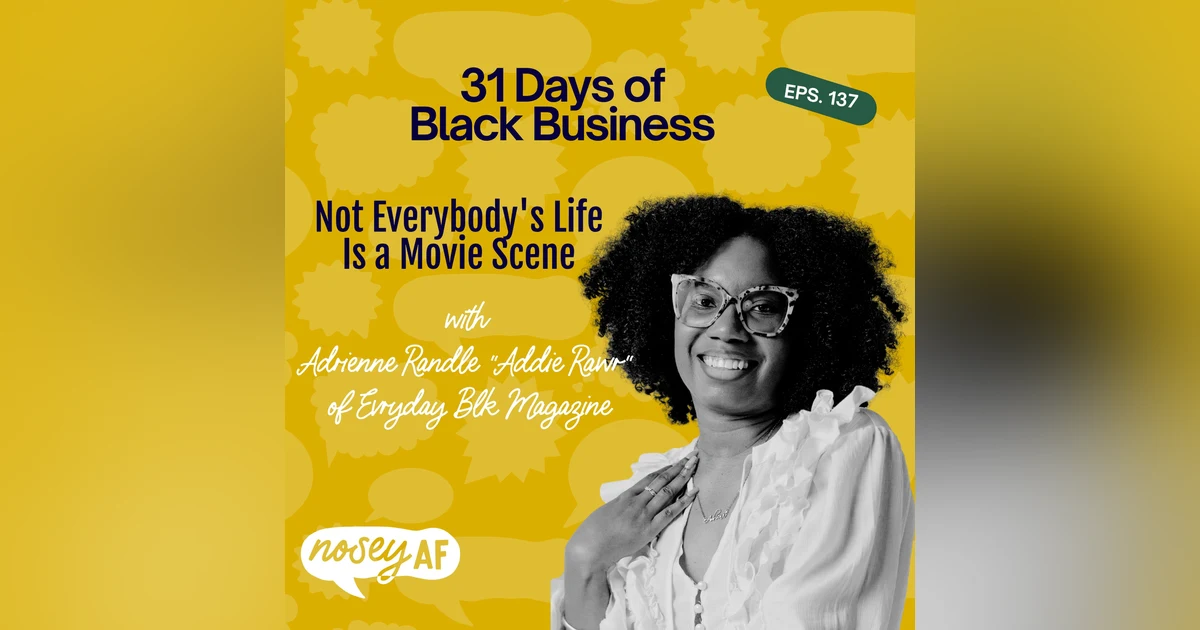
Ep 137: Not Everybody's Life Is a Movie Scene with Adrienne Randle of Evryday Blk Magazine
Part of noseyAF's 31 Days of Black Business series 🖤
Not everybody's life is a movie scene. That's the whole idea.
Adrienne Randle founded Evryday Blk Magazine, a bi-monthly publication in digital and print, because she wanted something that felt good to read. No gossip, no trauma, no celebrity culture. Just four-generation Black farms, a man who chases waterfalls, and the small local film festivals nobody's covering. It's the next chapter of her Black Owned Business Shopping Guide, which ran from 2023 to 2025, featured 1,175 businesses, and pulled over 3 million views.
What We Talk About
- Why she's a boundary queen: no work on weekends, no work at night, period, and how burnout at year five taught her that
- How she collaborates with other Black-owned businesses, why she pays them, and why "if you don't ask, the answer is no" is her whole approach
- Digital blackfacing, what it is, and how she verifies that every business in the magazine is actually Black-owned
- The unexpected turn: her doomsday case for physical media, and why she wants Black books, CDs, and magazines in the house for when the grid pops
If you love a conversation about building something on your own terms, this episode is for you.
All about Adrienne Randle
You're gonna love Adrienne. She's a whole ball of joy, and she'll tell you if she doesn't have a smile on her face she's not leaving the house. A creative advertising grad and product-based business owner since 2014, she built Addy Rawr into a brand that sold over 100,000 products, including 10,000 journals. Her design mantra: people don't know how it was supposed to look at the end. Now she's putting that same energy into a magazine that goes straight to the source instead of the celebrity.
Things We Mentioned
- Evryday Blk Magazine, free digital subscription and print available for purchase
- The Black Owned Business Shopping Guide, 2023 to 2025, 1,175 businesses
- Addy Rawr, her artist name and previous brand
- The magazine is self-funded, and there's a donation button on the site. A $10 monthly or $50 one-time contribution goes toward stock photos, software, printing, and eventually paying writers.
Chapters:
- 00:07 - Introduction to Black Business
- 00:33 - Introducing Adrienne Randall and Evryday Blk Magazine
- 05:42 - The Journey of Creativity and Business
- 13:05 - The Importance of Collaboration in Entrepreneurship
- 16:36 - The Importance of Work-Life Balance for Entrepreneurs
- 26:51 - Highlighting Everyday Stories
- 32:00 - The Importance of Representation and Transparency in Media
- 37:46 - The Importance of Authentic Representation in Black Media
- 41:44 - Future of Evryday Blk Magazine
This series is supported by Off the Grid, a podcast for small business owners who want to leave social media without losing their clients. Find them at offthegrid.fun 🖤
Connect with Adrienne Randle
Stay Connected
📬 Get the noseyAF Dispatch → Subscribe here
🏡 Grab the Good Neighbor Playbook → Download it free
More ways to connect
- Email: stephanie@missgraham.com
- Follow on IG: @stephaniegraham
- Listen to more episodes: noseyaf.com
Support & Feedback
noseyAF is listener-supported; thank you for being here. 💛🫶🏾
📣 Share noseyAF with a friend who needs to hear this
Episode Credits
Produced, Hosted, and Edited by Stephanie Graham
Lyrics: Queen Lex
Instrumental: Freddie Bam Fam
Cover Art: Emma McGoldrick
00:00 - Untitled
00:07 - Introduction to Black Business
00:33 - Introducing Adrienne Randall and Evryday Blk Magazine
05:42 - The Journey of Creativity and Business
13:05 - The Importance of Collaboration in Entrepreneurship
16:36 - The Importance of Work-Life Balance for Entrepreneurs
26:51 - Highlighting Everyday Stories
32:00 - The Importance of Representation and Transparency in Media
37:46 - The Importance of Authentic Representation in Black Media
41:44 - Future of Evryday Blk Magazine
Stephanie Graham
Hey, friends.
Adrienne Randle
Welcome.
Stephanie Graham
And welcome back to nosey AF conversations about art, activism and social change.I'm your host and friend Stephanie Graham, and we are in the mix with 31 Days of Black business, and we are talking to black folks who are building businesses who've had businesses for a long time. You know, these people are making things happen and creating something of their own. So not everybody's life is a reality show or movie scene.
Adrienne Randle
But.
Stephanie Graham
But that doesn't mean those everyday stories aren't worth documenting. And that's exactly what today's conversation with our guest Adrienne Randall is doing.Adrienne is the founder of Everyday Black magazine, available in both print and digital.And she's creating space that puts the spotlight on everyday black life instead of just celebrities, because the regular stuff deserves to be documented, too. And I got to tell you, that is an idea of value that I very much align with. And I really think you're going to love Adrienne.She's a whole ball of joy and creativity, and I really admire what she's building. So we're going to play our theme music, and then let's talk with Adrienne. Welcome to nosey AF.
Adrienne Randle
And who you are. Flex yourself and press yourself Check yourself, don't wreck yourself. If you know me, then you know that I be knowing what's up.Hey, Stephanie Graham is nosy as Adrienne.
Stephanie Graham
Welcome to nosey af.
Adrienne Randle
Hi, Stephanie.
Stephanie Graham
I am so excited to speak with you today. So, Adrienne, you studied creative advertising at Virginia Commonwealth University, right?
Adrienne Randle
Yes. Yeah.
Stephanie Graham
Yeah. And you've spent years as a designer and entrepreneur. So what originally drew you to creative, creative work?
Adrienne Randle
It's one of those things, like, I just always been a creative kid. Like, I was in elementary school, like, drawn on folders and notebooks and doing, like, cool little designs.Like, I just have done that my entire life. When I got into middle school, I started taking more, like, computer classes. So really kind of learning.This was back when we had, like, paint and make us Microsoft publisher. So very, like, basic level skills. And I just. It is kind of something I just really naturally came to me. I didn't have a hard time learning it.I had a hard time picking up anything when it comes to the programs, and it just kind of stuck with me.
Stephanie Graham
And as you look back, like, what lessons from your early creative journey still sort of guide you today in the work you're doing?
Adrienne Randle
So one of the big things that's like a lesson that has now become, like, a mantra in a way, is, like, people don't know how it's supposed to look at the end. And that's kind of what I live by. Like, they don't actually know that you made a mistake.They don't know that it wasn't supposed to come out that way. So it allows me a freedom to. To just kind of do what I feel, do what I like.I'm not a perfectionist, honestly, when it comes to my design work, I aim to do things great, and I aim things to do things, like, correctly. But if it's not perfect per se, I still will publish it because, again, they don't know how the end results were supposed to be.It just takes a little bit of stress off my back, and I feel like that's very creative of myself to be like, oh, this is it. This is going to be the end result. And it looks amazing. It looks great.And let people interpret it for how it is, but I'm not going to think too hard on it.
Stephanie Graham
Oh, that's so good. How did you. Like how. How do you do that?
Adrienne Randle
I just. I just do it. Like, I am. I'm such a go with the flow person. Like, I really am. Just in my regular day life, I'm very go with the flow. Like, I.Even though I run on a schedule, I have things that I do on certain days. I'm still okay with hiccups. Like, if a hiccup happened, it doesn't send me into this spiral. It's just kind of like, okay, push it to the next day.Then.
Stephanie Graham
You're just such a joyful person with your whole, like, joyful personality and the work that you're doing, it seems like you're always looking to add light to your world. What does that mean in practice to you, adding light to your world?
Adrienne Randle
Just always one. I'm a person who always have a smile on my face. Like, I. If I don't have a smile on my face, I'm just not going to go out the house.I'm just not going to interact with someone. But I'm always aiming to have a smile on my face, and it makes me feel good to make other people smile. So I am.That girl that's walking down the street is like, oh, my God, I love your hair. Like, I'm that person.Like, I'm just that no matter where I am, whether you're like a server at a restaurant, I'm just like, oh, my goodness, your nails are so cute. Like, I just love bringing joy everywhere I am, and it doesn't diminish my Light in any way.
Stephanie Graham
I love that. That's so sweet, too. Have you ever given somebody a compliment and they're just like, thanks?
Adrienne Randle
No. I think it's maybe it's like, my approach and how, like, bubbly I am is most people are just always kind of like, oh, thank you.Like, they're just very kind of caught off gu. Oh, my goodness. Thank you. So no one's ever been kind of, like, cold to me. At least if they did, I kind of didn't pay attention. I was like, okay.
Stephanie Graham
Yeah, like, all right. Weirdo. No. You know, before the magazine, many people knew you through Addie Rawr.
Adrienne Randle
Yes.
Stephanie Graham
Okay. Was it like Addie Rawr?
Adrienne Randle
It actually is, like, so it's, like, raw, like the dinosaur, so.
Stephanie Graham
Oh, I love it.
Adrienne Randle
But, like, dinosaur language, quote unquote. Raw means I love you. So that's like, how.
Stephanie Graham
Oh, really?
Adrienne Randle
Yeah. And like, dinosaur talk.
Stephanie Graham
So in Jurassic park, these dinosaurs are just saying they love you. So why are you guys trying to hurt them?
Adrienne Randle
They're just saying I love you.
Stephanie Graham
Wow. Okay. Now I see that movie in a completely different way. How did that business begin?
Adrienne Randle
Oh, Addy Ross started. It's a lot of moving parts, but, like, as simple as I can explain it is, I guess I went to school for advertising.I have a creative advertising degree, which is like this random degree that most people. People don't have. And it's a degree of, like, all the.When you think of, like, an ad or an advertising industry, you think of, like, buildings and people, like, going to meetings. But my degree is focused on l. The creation part of it, the creative part of the fun part of it.So the drawing, the painting, the writing the scripts, writing the radio spots, writing the taglines, creating the billboards, creating the magazine ads. Like, that's what I really got a degree in. So I studied that. And it just brings out a side of creativity in you that I can't even explain.Like, I was just creative every day in college when I. When I was studying. And then after I graduate college, real world hits you and can't find a job. You can't find a job. So I'm like.But I got this creativity still bubbling in me. I can't really find a job in the advertising world. It's kind of hard to find those type of jobs.People aren't hiring all the time for someone creative to come in. And I just started kind of, like, freelancing. So I started, like, designing T shirts for, like, organizations.I started doing, like, logo designs, business card designs, flyers. Just all These type of things with my creativity. And that turned into creating like Addie Rawr, which was like my. That's actually my artist name.So it's like the brand name, but my actual artist name. I didn't want to go by Adrienne, even though I love my name.So Addie Raw is like my artist name that I was going by when I'm creating and I'm designing. And that turned into just me like painting more, drawing more, just doing collages, just doing so much different work.Which turned into me doing like art shows and pop up shows and I'm selling my art prints and that turned into creating. I created my first card collection in 2015, which was a black card collection of Christmas cards.So it went from like black Christmas cards I created till I started doing birthday cards and then graduation cards and then Mother's Day cards. And then that turned into mugs and stickers and coloring books and all these other great things and it just kind of kept going.
Stephanie Graham
Yeah, because I feel like you sold like, is it like a hundred thousand products or something like that?
Adrienne Randle
Oh yeah, it's a hundred thousand plus just by itself. At one point I remember like doing my tick off of like selling 10,000 journals.
Stephanie Graham
So that is such a huge accomplishment. Like, what did that teach you? Just about like serving community.
Adrienne Randle
When it taught me that, it taught me that if you put yourself out there. So when I say put yourself out there, I actually mean like physically putting yourself out there.When I started and most of my business has been like in the field, so going to events, going to festival, going up to pop up shops, I know for sure that helped when it comes to like my community and creating for black men and women, specifically black women at the time with Addie Robert.And I know that being present and people seeing me and people seeing my face and I'm smiling and I'm showing things off, that not only it made them feel like they're represented, but they also saw someone who enjoys doing this and loves it. And it's not just for money. And I can be honest that nothing I did was just for money. Absolutely. Money is a bonus, is a plus.But it was actually more so like I wanted representation when it came to the products I was creating. And I also want people to see me too, as representation, not just the work.
Stephanie Graham
Were you ever scared of like putting yourself out there?
Adrienne Randle
I'm always scared. Like it's no matter what. Like when I.Anytime I used to drop like a new product line or anything like that, I would be like, oh, my God, are people gonna like it? And then it's like, yeah, they love me. I sold out. And I'm like, okay. But I'm always still like, oh, my goodness. What if this time is the wrong.Like, the. The one time I do it wrong and people are like, no, what if this one time, I guess you cancel? You know, like, oh, my goodness. Like that?
Stephanie Graham
Yeah.Cause I've definitely gone to, like, farmer's markets, and you see folks standing by their table, you know, just like, smiling, and I'm just like, wow, this is just so bold for them to put their product out here and just stand by and smile and just hope that someone comes up or, you know, or if you have that personality, be like, hey, come check out my product. Like, oh, my God. It just is giving me tingles in my stomach just because it's like, oh, it's just so visible. It's like, you can't hide.You can't be like, come see me and run off.
Adrienne Randle
No, you have to just. You just have to take it. But I feel like it's like an adrenaline rush. Like, I. I love it, like, kind of how.I guess, like performers and musicians stage. I'm sure they. Most people in, like, interviews say, like, they're so nervous and. But they've done it hundreds of times, but still they're nervous.And so they go out there and they're like, oh, once they hear the claps and everything, it kind of just like goes down. That's how it is. Like, I'm always nervous. I'm always like, oh, my goodness. All it takes is, like, one person to be like, oh, my God.And I'm like, I feel better now.
Stephanie Graham
Yeah.
Adrienne Randle
Yeah.
Stephanie Graham
That's like, yeah, that's really good to know. You've spent years helping other black owned businesses gain visibility. Why has that become such an important.
Adrienne Randle
Part of your work? I have spent my entire.The entirety of, like, Addie Raw up until now, with the magazine supporting and making sure I am putting other black women businesses to the forefront.Even when I think that's like my very first art show that, like, I curated myself, I reached out to other black artists and designers to be part of it. This was before a following on social media or anything at all.It was like, I want to not only spotlight myself, but spotlight other black owned businesses. And it's just one of those things where it's like you just want to pull people up. You know, you want to pull people up as you go up.And I don't feel like I Have to be at the top to start pulling people up. Like you can even just kind of be like a little bit ways there and you can still reach down and just pull people up.So even from the beginning, and I say that because I feel like sometimes I talk to people a lot and they feel like, well, I'm not there yet. Like I need to wait till I get maybe more followers or more subscribers or whatever is before I can pull other people up.Like I did it from the beginning. Like I. Before I even had anything.It's like, let's get together and let's do this show together because I can help you, but I'm sure you can help me too. So it's just always been part of like my business DNA. It feels good. I make a lot of great connections.I make a lot of great products and events and just great things when I work with black owned businesses. I did a candle line back in 2020 during the pandemic because I was just, I was just doing stuff during the pandemic, just testing out stuff.But I had, I did like a candle collection. But again, I don't make candles. Like I was like, I'm not about to buy all the supplies to make candles. What can I do?Like I call up a black company who makes candle and be like, can you make the candles? Like, like I want you to make the candles. I'm make the artwork for the labels but you make the candles. Because I don't. That' my specialty.But that's how I like work with other black owned businesses and, and bring them up just as much. Like I said, they help me too.
Stephanie Graham
Yeah, I love that idea because I think, yeah, I think your first thought would be not yours, but I think like mine or maybe even the listeners might be like, okay, how do I make candles? Like you think you have to do the whole thing yourself. When you collaborate with other folks, do you use contracts?Like how what does that system look like?
Adrienne Randle
Oh, they've all been pretty different a lot of times. Like with the candles it was more of I purchased from them. So it was like a wholesale type of collaboration.So it wasn't like they, I hate to say work for free, but it was like I actually paid them. I paid them to make the candles and everything and then my artwork was on it.But part of the kind of like deal was I also had their name on it as well. It was like an addywire candle but like made by and it had the name of the black owned candle company.So I kind of Made sure people knew that this is who I use. It wasn't like a private thing where it's like, oh, I don't want to talk about the black company I use.The point of using the black company was so that I can tell people I use a black candle company majority of the time. When I am quote unquote, collaborating with black owned business, I'm paying them.Whether it's like a discounted price or a bulk a price, you know, like a volume discount. Because I may have ordered a lot. My goal is to try to pay them as much as possible.But then there's times when I do collaborate or I work with, you know, these other black owned business and it may not be a form of exchange when it comes to paying them, but it may be a case where it is like promotion and sharing and things as well.So, yeah, you know, contracts are normally signed, invoices are normally sent in some form, or sometimes it's just like more of an informal agreement. I'm one of the those people who if you don't ask, the answer is going to be no. So I'm one of those people who, like, I'm gonna ask like that.It wasn't like the candle company was promoting that they did this type of work. Like, I just asked them like, hey, would you do this for me?
Stephanie Graham
Right, Right.
Adrienne Randle
I think that also goes back to like my just kind of like courageous personality where I'm like, I'm not scared. I mean, the most thing, the worst they can say is no.Like, they can just say no, I don't want to do that, but I get a yes out of it and it can work out. I didn't need to, like, go find someone who I knew had already did it before and was doing it for hundreds of companies.I literally was just like, I like candles. I purchased them before. I like how they smell.
Stephanie Graham
Hey, like, yeah, that really makes a lot of sense. Yeah, like, there's no need to get together with somebody before you and have a coffee, talk and get a format. Just ask and see what happens.And you seem like you're approaching them with pretty much the idea. So it's like you don't have to do a lot of the heavy lifting because you're like, this is the idea I have. Yes or no, you know?
Adrienne Randle
Yeah, like, I already have it. I already have it planned out. I just need. I don't know how to make it. Like, I just need to.
Stephanie Graham
Yeah. What's something that you think folks misunderstand about entrepreneurship especially, you know, in our community, black folks,.
Adrienne Randle
I guess, like, it could be a misunderstanding. I think I'm going to use it as a misunderstanding, is that you have to be. You have to, like, work 24 7. I think that's like, a misunderstanding.I think that is something we been fed, especially in the black community. We've been fed that we have to work 247 as an entrepreneur is no turning it off. It's like that sleep when you.When you die type of mentality as an entrepreneur. And I think that's a. I think that's a misunderstanding.I think when people say, you know, kind of constantly working your business, I think it's about, like, maybe be thinking about it.Like, if you're out and about thinking about opportunities or networking, but actually working 24 7, I think that 24 out 7 mindset is a misunderstanding. And you should not be working 24 7. There should be a off switch. There should be a time where the door closes.But I think just mentally, because I don't work 247 at all, but I am constantly thinking about how things can connect back. I might circle back on it on a Monday because I'm like, I'm not working over the weekends, but I am thinking about it.But I don't go into spring into action, you know, 247 or anything.
Stephanie Graham
Yeah, I think that that's a really great thing to amplify that.That thought, because even, like, some of the conversation I've had for this series, people have said, like, I'm always working, you know, and it's like, yikes. How'd you say that?Cause even myself, like, I, you know, I sometimes I just like to play, like, with my spreadsheets at night, but I have to be like, stephanie, knock it off. Like, you could play with this tomorrow. Like, you're gonna have to literally use the spreadsheet tomorrow. So you make things pretty colors.Then, like, get off the computer.
Adrienne Randle
No, Stephanie, I am a, like, a boundary queen. Like, I have. I have perfected boundaries when it comes to business. Like, I do not work on the weekends, and I do not work at night.And, like, when I say that, it's like a period at the end. He's like, yeah, I do not work. Again, my mind might be thinking of ideas, but I am literally not. I'm not sending the email.I'm not even opening the computer. I'm looking at it because I. I have. I think I got burnt out pretty early on.So I have been technically, like, a business owner entrepreneur for what, 14 years? Ish. So in the first like five years, that was like that 24 7. Like, it was like boom, boom, boom, boom, boom, boom.By the time I hit year five, I'm like, I can't do this no more. I'm not gonna be able to as a person survive if I working 24 7. So once I figured that out very early on it was like, I'm, hey you, you can't.When I'm on the weekends and you see me out, don't ask me about no business. I'd be like, I don't even know what Addy Raw is. Who is that?
Stephanie Graham
Yeah,.
Adrienne Randle
That has nothing to do with me today. Maybe we'll talk on Monday or Tuesday or whatever.
Stephanie Graham
Yeah, yeah. That's such a good reminder. Even as you're talking, I'm like, okay, what is my time for turning off the computer going to be?So I'm going to think about that. What was your vision behind launching Everyday Black magazine?
Adrienne Randle
It was to launch a magazine that felt good. I think that's like the biggest thing I wanted. A magazine that felt good.I think that especially right now in the climate of the world and the climate of the black community and black owned businesses and entertainment, there's a lot of negativity, there's a lot of gossip. We have like, even like I, I was, I forgot who I was talking to. Might have been like my fiance or something.But like, even when it comes to like TV programming and what we're watching, I remember 10 years ago, so we had so much more like positive, just black TV we could watch. Let's. Whether it's like sitcoms and just like game shows.Even the dating shows were still a little bit like fun and like, you know, just like a little more light hearted now it's like everything is so like not dark but you know, it's so negative and the.I'm not even saying like fighting because everything has fighting in it, but you know, it's just so much negative and gossip and just so much going on that I'm like, I just want this magazine to not have any of that kind of trauma or negative feel to it. I want it to be joy, I want it to be fun and I'm gonna figure out how to make sure every single issue has some type of joy and fun to it.
Stephanie Graham
Yeah. Thank God for everyday black magazine because it is so dark out here.How would you describe the difference between Everyday Black magazine and many mainstream publications?
Adrienne Randle
The biggest thing is this is a community magazine. A community magazine means that the content inside of the magazine comes directly from the community, not indirectly.So it's not me reporting on something I read on threads or me reporting something that I saw in the blogs. It's me going directly to the source and talking to that person in the community, whether it's a therapist, whether it's a farmer.I'm going directly to the source, and we're talking to them, and they're contributing to the magazine with their information or their resources and everything in the future. Everyday magazine, I want it to have, like, formal writers.Right now, it's not any formal writers because, again, I want the people in the community to contribute the way that they want to.Now, I ask questions, and I do like interviews, but it's still kind of feels like they're giving the magazine what they want to make sure the magazine knows and to have. And I'm not gonna say it doesn't exist because I know that there's so many magazines and things, especially for our community.I'm not gonna say it's the only one that's community focused. But it's a little bit different than the magazines we know of, where they're not actually truly in the community.They're more so talking to someone who's already celebrity or someone's always famous, someone who's already has the limelight on them, and they're not talking directly the person on the ground, unlike the community.
Stephanie Graham
Yeah, you've said the magazine focuses on everyday black people rather than the celebrity culture. Why was that distinction important to you?
Adrienne Randle
It's a lot going on when it comes to, like, celebrities. Like, there's just a lot going on. And. And let me be honest. I don't feel like that's the real world of, quote, unquote, everyday black person.I consider myself like an everyday black person. Like, forget social media followers, forget makeup and like that. Like, I am regular, you know, Like, I'm. I'm.And I'm not saying regular as in, like, basic living life, you know, like, I make my lattes and stuff like that, period, like. But I mean, regular as in, my life is not a movie scene every single day. My life is not an episode of Housewives every single day.That's not my reality.And I feel like that's most of our lives, men or women, no matter our age, where it's just way more regular, everyday things that's happening than these big, glamorous things.And I feel like we have got to the point where only the big, glamorous things are getting highlighted instead of the smaller, just Everyday things like what are you. Like just an everyday thing of whether it's going. Going out to lunch or cooking dinner with your family or spending time with your friends.Like, those are just, eh, whatever. It doesn't have to always be the wedding. It doesn't have to always be this big gala or anything like that.It's still smaller things that are happening in the community that we can connect to.And like one of the big things, like, even with the events and everything, I wanted to make sure I highlighted not just the big festivals, you know, not just the big concerts that's happening, but what about the small ones that's happening? What about the small local film showings that's going on? What about the small local fashion shows that are happening too? We can't.We don't have to just talk about Fashion Week. We have the smaller ones that are happening in different season activities like HBCUs and things as well that are just not getting highlighted.When I feel like that connects more with a regular everyday black person than New York Fashion Week does, like it does everybody. But I just feel like, you know.
Stephanie Graham
Yeah, well, you need both. You know, I think like, it's good to consume both things.You know, I remember I had worked on a film that had went to a film festival in Gary, Indiana, and when I went to see the film, you know, that film festival had been there for over 10 years and that was my first time attending. And I'm like, I had no idea this was here. It's in the next. It like took me like maybe just under an hour to get there. I'm like, I had no idea.And if I hadn't been a part of that film that was screening there, I might never have known. So I do think that you are right to also highlight these things that folks just might not know about. You know what I mean? It's not Sundance.Like, everybody knows about. About Sundance Film Festival, but here's another popular film festival that was going on. Like everything was packed out.So there's so many things like that that are happening that do deserve to be highlighted.
Adrienne Randle
And that's. That is what I want and what I've been doing with Everyday Black is to make sure we're. Make sure we're spotlight.Like I said, I think both can exist and I think both should exist, but I feel like we've already have enough of the other one. We already have. Well, I'm not gonna say enough. Let me. Well, let me not say that.I think we have a lot already of the other Ones where, like, the sun dances. Like I said, the more I know, like, the Black American Film Festival happened. Like, those big ones.Not saying we should stop talking about those or highlighting those, but we also need to make sure we're spending time highlighting the other ones as well. Because if we don't, it's going to get lost.And if something happens to the big one, which is, I hate to say, like, my fear, but if something happens to the big one, it's like nothing exists. Right. Like, if that big one goes away or funding or whatever it might be, people are gonna be like, oh, we don't have anything anymore.And it's like, yes, we do. We have these over here as well.
Stephanie Graham
Yeah. Do you have any favorite stories that you've told in your magazine so far?
Adrienne Randle
Uh, they're all pretty cool. I don't know if I don't feel like I have a favorite. Okay. And I.In the next issue of the magazine, it's like, I did an interview with someone who chases waterfalls, you know, as a black person.
Stephanie Graham
Oh, fun.
Adrienne Randle
Like, that's so cool.So I am very intentional with making sure that the stories I am telling, the people I am talking to, it's intentional that they're the ones that have not been highlighted before, that we're talking about things that's not talked about already.Again, the point of everyday Black magazine is to be more fresh, is to bring joy and positivity, but also not just repeating the same thing we've heard over and over and over again. Not because we should stop talking about those things.I just want to bring a fresh perspective and bring some more fresh stories about things that is not talked about enough or a lot in the black community.
Stephanie Graham
Yeah. Are there any specific communities or stories that you feel are still being overlooked that you are looking to spotlight?
Adrienne Randle
Yeah, absolutely. Like, I. First of all, men. Black men. Let me first say I love black men. I love the black men who have supported the magazine.I kind of did like, a, like, a call for black men. Like, hey, where y' all at? Like, I need some representation for y' all in the magazine is it's hard for me to find y'.
Stephanie Graham
All.
Adrienne Randle
Not because y' all don't exist. It's because what I've learned, Black men are on social media, but they don't be, like, commenting, and they don't be, like, interacting a lot.So, like, even when I made the post, there was a lot of, like, women talking about their husbands. Like, oh, my husband knew this. I can give you his contact, but it still wasn't like the black men.It's himself like, yeah, yeah, we're like, we're screaming it to like everyone. Like, I want you to know I just started crocheting.I want you like, black men are like, they're doing something really cool, but they're just not talking about it a lot. So I want to make sure that I continue to highlight definitely black men.I have talked to already, some black men doing cool things, run clubs and opening gyms and chefs and fishing and all these kind of things. I want to continue to make sure I make sure that black men are being represented and all the cool everyday things that they're doing as well.Also, the older. I'm older, I'm in my mid-30s, but I say older, I mean like the 40, 50 and even 60 year old black men and women too. I want to represent them more.So I want to make sure I'm telling their stories.Whether it's about finances, whether it's about their second marriage, whether it's about, you know, adopting kids, whether it's about starting that business at 50. I want to make sure I'm representing them as well too.Because I do also feel that in general, mainstream media focuses on like the age group of like 20s to like early 40s. Yeah, I wouldn't say 20s. I would say like late 20s. Late 20s to early 40s.And then the 50 plus or 60 plus who are still very active, who are on social media, who are actually reading magazines, who are actually buying, they're not seeing themselves.
Stephanie Graham
So how does the subscription model work? You have a print magazine, which I love, because print isn't dead, you know, it's still alive and well. So how does it work? How do we support.
Adrienne Randle
So the magazine is actually completely free to subscribe to the digital magazine. Okay. All you have to do is to subscribe with your email. Email address that'll get you access to getting the digital copy.Like the way you do it, you go to the website, you put your email address in, it'll take you to the page. You can download the digital magazine. Okay.Digital magazine means that it's a digital file that you can save on your computer or your phone or your tablet. You can view it too, but you can also, like save it. It's a PDF file, so you can save it.It's also an interactive PDF, which means you can click the links inside of it. Oh, yes. So if there's a, like a website for the business or someone's Instagram, everything is like hyperlinked.So you see like a Instagram in the magazine and the digital version, you can just click on it. It'll take you to the Instagram page. If you see www.you know, anything, that means you can click on it and it'll take you to that webpage.That makes it easier so you don't. You're not looking at the digital magazine like, oh, I like this business. Now let me hop over here and go to their website.You can just click it from the magazine.
Stephanie Graham
Yeah, that's nice.
Adrienne Randle
Yeah. And it's a digit magazine. It's completely free. If you want the print version, there is no subscription.For the print version, you can just purchase a one off of the print copy.
Stephanie Graham
Oh, got it. Okay. That is simple enough.
Adrienne Randle
Yep, that's an option. Just want to purchase it. I will say this, the cost of print is not what you think.When you walk into the bookstores and you see these magazines in there, 5.99, 6.99, it costs a lot more. I don't mind explaining, but when the cost of print is there, this is a full color magazine, it's on magazine paper.So it's not like on this regular type of printer paper for the cost of it. It's a lot. It's a lot to print a magazine. And I'm not ordering them in like books, I'm ordering a million.Like our popular favorite magazines are ordering a million copies at a time. So they're getting them for $2, $3. So that's not works. This is a small, brand new magazine and it's funded by me.So because of that, if you want a magazine that's print, you're paying how much it costs for it to get printed and everything, which is going to be 15, 16, 17, 18, $19 depending on how many pages are in it. But again, it's because of, I'm just not able to order millions at a time and to sell them for 5.99.
Stephanie Graham
Yeah, no, that makes sense. That makes sense. You know, there's tons of magazines that are still out there even in the bookstores that are still like, you know, 25, $30.
Adrienne Randle
Because printing is.
Stephanie Graham
Yeah, yeah, it's not dead, but it comes with a cost.
Adrienne Randle
Yeah, I get it off, but it cost.
Stephanie Graham
Thinking about the legacy of the work that you're doing, you know, community, cultural respect, legacy, economic empowerment, integrity and transparency are the core values of the magazine. Which of those feels most important to you right now?
Adrienne Randle
I'm gonna say transparency is going to be. And representation. Again, I, I created this magazine for multiple reasons. But one of the things that sat on my heart for like I.It was like a year of thinking of this magazine before I put it into the world. And one of the biggest things was representation. Because again, I want to see black people represented in every aspect.I wanted to see someone who is from like a small town feeling like they see themselves in this magazine as well. I wanted to see someone who may not have the high end corporate job to see themselves in this magazine as well.I want to see one who doesn't have the budget to buy a Louboutin bag to see themselves in this magazine. I wanted someone who can't afford the five star resort to see themselves in this magazine and representation.We always say like being black is not monolithic. Right? There's not just one way to be, to be black in being like luxury. Black is not the only way to be black as well.And it's not the only way to be seen as being black and not, not broke, you know. Yeah, it doesn't have to be luxury, but I just wanted for people to feel represented and seen in this magazine. And I also wanted transparency.And what the transparency means is that anything and everything that's happened with the magazine I will be open about, I will talk about, I will let you know how many subscribers are to the magazine. If it's doing well, if it's not doing well, hey, we need help here, we need help here. And just being very open. It is me.I'm not front facing as far as like always being on social media and showing my face when it comes to magazine. However, I want people to know the person behind the magazine. That's a big part of the transparency as well.Like I want you to know me being the actual person who created this magazine. I want you to see me. I also want you to know the business owners who are in the magazine.I want you to know that they are truly black owned businesses. A big part of that unfortunately comes from we are now in a place where like AI and people are doing digital black facing, which is being.The digital black facing is basically creating like a whole page, an Instagram page. And it's all black people. But the person who's running the account is not black. Like that is like digital black facing.
Stephanie Graham
That is so bizarre. Like, yeah, like that. Who does that?
Adrienne Randle
People who just want. Because they, because people love our culture, they love us, they love how we look, they love our style, they love our fashion.So it's like someone might create a everyday black magazine, but them Themselves are not black at all. You know, the writers are not black. You know, no one is black.But they wanted to create a black magazine because they see that that's what people will gravitate towards.And it's kind of like even like our hair products, you know, like, I'm not tangent, but like we know these hair products is like, this is called something, something black this or African this. And the person behind it is not black African or anything at all. But they do that. Black people will gravitate towards it.So again, part of the transparency is one, you can see me. You can see that you know me and my motives and what I want from the magazine, but also the people who are in it too.I am very much checking and making sure you know who they are, if they are who they say they are, if their business actually is their business and everything as well too. So making sure that if somebody has any questions, anything I'm open to talk about.We're not gonna talk about it openly, but if you ask, I don't mind talking about it. If someone reaches out and say like, oh, I wanna know. This isn't this.I don't mind explaining or talking to you, but like, I was just talking about the cost of the print. Like, this is how much the print magazines cost because of this.I don't mind telling you, if you want me to show you all the figures, I can show you that too. Because I don't want you to think it I'm scamming or anything like that, but it's just being very transparent and open.
Stephanie Graham
Yeah. My last quick thing about this tangent, I'm very leery when I see like black T shirt companies.When like those, like Rosa park said this, I'm like, you have to show your face on those. I'm like, I need you talking about them. I do not. Yeah, I'm like, some of those. I'm like, I don't know if that's a black owned company.
Adrienne Randle
Actually, it's gotten bad. AI has so much worse because now it's like they can kind of create even like a fake black person, you know, Bizarre. Yeah.Like to even be the face of it and everything. So it's gotten kind of crazy.
Stephanie Graham
Yeah. Yeah. There was a sponsor that was considering like sponsoring the series that was AI and I'm just like, I don't think so.You know, it's like, especially for stuff like that.It's one thing if you're like, hey, we can help you, like, organize your day, you know, like, if it's like something like administrative, but like, I don't know if I want to like highlight these types of licenses where you're like making like an AI podcast or I just like. No, you could talk to me and I'll help you make a podcast, you know, or like whatever you want to do. Like. No, but, yeah, sorry.But I just wanted to tell you that just like, yeah, this is, that's just so, it's so gross. Like I can't imagine like starting like a Instagram with just like all like Asian mothers.Like, hey guys, I'm a Chinese mother and this is how I take care of my baby. You would be like, stephanie, what are you doing?
Adrienne Randle
Yeah, but it happens and it happens the most. Like it happens to the black owned businesses the most. So I be having to research, I be having to over here, like, let me see your LinkedIn page.Let me see.
Stephanie Graham
Yeah, yeah. You know what gives you hope when you think about the future of black business creators and storytellers,.
Adrienne Randle
Gives me hope, is that I feel like as a whole black community, we absolutely are craving to see our black businesses and black creators and black entertainers thrive. Like, we are craving it.I have not had a conversation with someone, whether it is in person or online, where they don't feel like I am craving that again. I feel like we had it so well at one point and it kind of got really weird and everything. And I feel like we're back to craving it.Like we're craving, we can't wait for a black TV show to come out. We can't wait for a black movie to come out. Like, we can't wait for a, for us to learn about a new black owned business.It's more so about, of course, the marketing, the funding and getting in front of the faces. But I feel like right now more than ever, like I am confident and feels good that we are craving that black media entertainment and creativity again.And it feels great.And I think that's what gives me hope that as we continue to continue to crave that black excellent in all ways that we'll get there, we'll get to the point where we can catch up, where it's like we're craving it and it's there and it's available and they'll kind of be matched together at the same time.
Stephanie Graham
Yeah.One of the last things I'll say about that I really love about your magazine is that just as, you know, an artist myself, when thinking about ways to sort of share the work that I'm doing, you Know, social media is there, but it's just like one tool.And I feel like we need so many other vehicles, you know, outside of just like, maybe, you know, dropping flyers in the coffee shop or, you know, sending text messages. So I really love that the magazine is available. It's just another avenue for folks to be able to share their story that is away from social media.
Adrienne Randle
Yeah, I am a big, like, physical media person. Magazine. We have like, DVDs and CDs.
Stephanie Graham
Yeah, yeah.
Adrienne Randle
So my doomsday reason for doing it is because I'm just like, if social media goes away, we need to make sure we have the physical black books in the house. We need to make sure we have the physical black CDs.Like, if Spotify gets shut down, we need to make sure we can still visit that black album we want. So I am. That's like my. On this side, I'm kind of like,.
Stephanie Graham
Yeah, that's so real. When.
Adrienne Randle
When the grid pops. So when the grid breaks, like, what. Make sure you have those. So I have. We have black books in our house.We have black cookbooks and historical books and entertainment. Fictional books as well. We have, like I said, CDs and vinyls and DVDs. Because there's like a little part of me that's like, man, when this, when the.When the digital grid pops, I want to make sure I can still hold on to our black things. And then also we know that, like, they're trying to erase a lot of. Of black culture and history in schools and everything.And it's kind of like in 10 years, how can you tell this young person this happened in the black community? If all we're relying on is a social media post, you know, all we're relying on is, you know, like a video you post on a reel.We're trying to rely on that 10 years later. And then our phones don't even allow us to view the video anymore or anything like that. But we'll have things like physical magazines still.We'll have things like books still as well. And people love collecting physical medias.I know some people like their collection of their JET magazines and the collections of their ebbing magazines and everything.
Stephanie Graham
So, yeah, what's next for you And Everyday Black Magazine?
Adrienne Randle
Just. Just to continue growing. Just, just growing. The. The biggest future. And I don't have a number on them. Have a year. Year, 1, 2, 3, 4.But the goal is also to just get out there to start going to physically see people in person to do the interview and to go to the event and do, you know, do coverage at the events and everything. That's like the, the big future of it is to be a media outlet that actually is like on the ground right now.It's not physically on the ground at the events that's happening and going to people's homes, interview them, but that is like the future. I want to make sure that it continues to be a community magazine.And community magazine meaning on the ground going to these community events or functions or meeting people directly in their community to tell their story as well.
Stephanie Graham
Yeah. Adrienne, it's been so lovely speaking to you. Is there anything else that we should bring up before we call our conversation complete?
Adrienne Randle
Um, just subscribe to Everyday Black magazine. Again, it's completely free to subscribe. I always say that because I know people get kind of scary. Say subscribe.No, it's just like an email subscription. You just got to sign up. Make sure you subscribe to the magazine. Be on the lookout. There's three more issues to come out this year's bi monthly.So three more pending issues to come out. Donate to the magazine. As I kind of mentioned a little bit like this is all funded by me.I put my own personal money that I made to the side to help keep the magazine going and everything. So funding helps with me printing more magazines to send out because I send them to different places. I am looking to pay writers in the future.So helping donating to the magazine helps with that. I gotta have certain programs, license websites. All that kind of stuff needs to be paid for, stock photos and everything.So there is a donation button on the website. So if you have anything to give, $5, it doesn't matter. It just helps out with paying for the back end of keeping the magazine up and running.Because it costs a lot. It costs a lot to keep the magazine running. But yeah, I'm excited for people to continue to read and enjoy the magazine.I've gotten so much great feedback from the magazine. So much great feedback from the magazine that it just keeps me fueled to keep this going.
Stephanie Graham
Yeah, I really love what you're doing and really appreciate what you're doing. I think really like my last question is like monthly, like what is the ideal contribution that you would love somebody to make?
Adrienne Randle
Ideal contribution. If someone's going to do this like a one time donation, a 50 donation helps a lot.That can like help pay for just like the programs that I have to use to design it. Like I said the website fee. But if you like on a monthly like a $10 a month donation can help help go a long way.We're keeping up with all the fees that has to go into it and helping me bank up money again to pay for writers I have to pay A lot of the a lot of the money I have to use goes to again paying for stock photos since since I'm not like on the ground taking pictures and everything, I have to purchase stock photos. And black stock photos cost a lot more so that's like a lot of a cost. I got Adobe Creative Suites like oh.
Stephanie Graham
My gosh, they don't even get me started on Adobe Creative Suite someone.
Adrienne Randle
So like it's like a $10 a month donation if it's like on a reoccurring would do wonders to just help pay for things behind the scenes to keep the magazine going so that it can come out on time so that it can get in the hands of the people that it's supposed to be in the hands of.
Stephanie Graham
Yeah, I love it. Thank you so much for talking to me.
Adrienne Randle
Thank you Stephanie for having me.
Stephanie Graham
That concludes another episode of nosy AF31. Days of Black Business.I'm your host and friend Stephanie Graham. I hope you took something away from today's conversation and had a good time hanging with us.Be sure to check out the show notes to learn more about today's guest and consider supporting their work. You know how it goes, whether you're making a purchase, hiring them, or simply spreading the word. Listen, who doesn't love a referral?It truly all makes a difference.Quick thank yous go out to Queen Lex and Freddie Bamba for the nosy AF theme music and Emma McGolrick who hooked me up with the COVID art and branding. Shout out to the partners and supporters for this series. You could check them out in the show notes as well. Super grateful for a partner. Hello. That's the show Friends until tomorrow. Stay curious and take care. Bye.