

 Apple Podcasts
 Spotify
 RSS Feed
 Castro
 Amazon Music
 PocketCasts
 Explaining Investing Through a TJ Maxx Run with Nadia C. Vanderhall of Brands + Bands
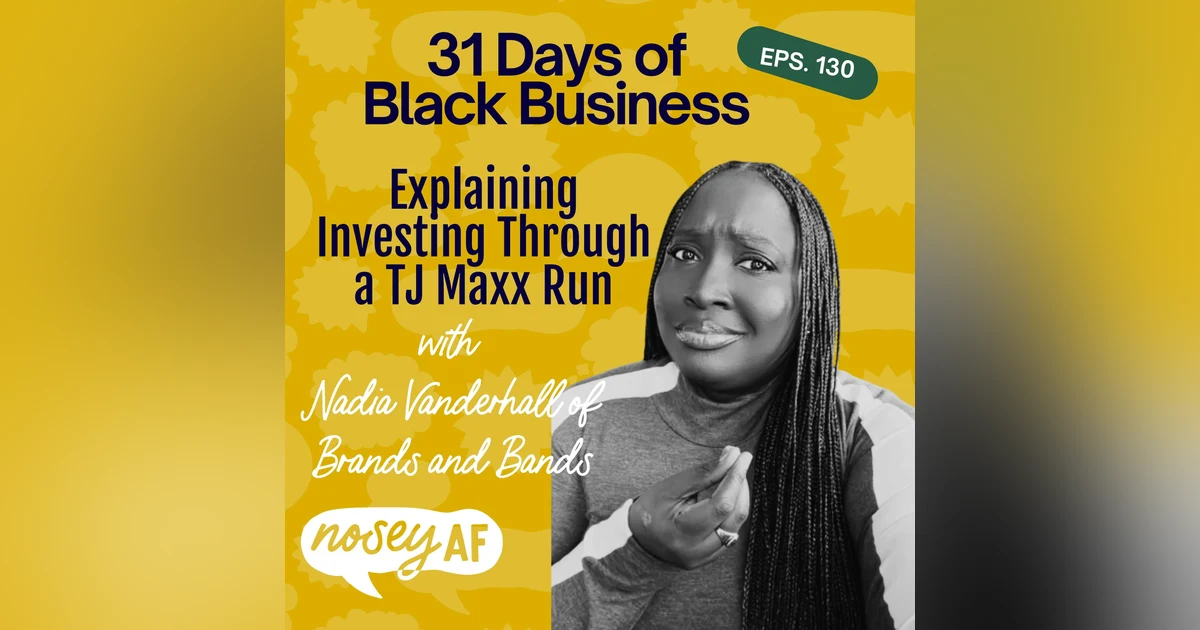
Ep 130: Day 13 Explaining Investing Through a TJ Maxx Run with Nadia C. Vanderhall of Brands + Bands
Part of noseyAF's 31 Days of Black Business series 🖤
She lost her job in the Great Recession and drained her 401(k) before she knew the first thing about money.
Nadia C. Vanderhall learned it the hard way, then learned it the real way working in product marketing at a bank, where she kept noticing the products weren't built for the people who needed them most. She started posting what she was learning on Facebook. The first big one explained how to invest by walking through building a wig. Now she runs The Brands + Bands Strategy Group and calls herself the girl in the finance bro lane.
What We Talk About
- Why the 50/30/20 budgeting rule doesn't work when housing eats your whole budget, and what to do instead
- The Dash: the roadmap between the wallet you have now and the wealth on your vision board, and why financial planning should really be life planning
- Why she says stop calling money hard, and how to reframe budgeting as expense planning
- The unexpected turn: she was an overdraft queen too, and she breaks down exactly how to stop — push notifications, splitting your accounts, and money dates with your own app
If you love a good analogy and a plan you can actually follow, this episode is for you.
All about Nadia C. Vanderhall
You're gonna love Nadia — she's a marketer's brain in a financial planner's chair. Founder of The Brands + Bands Strategy Group, she's been featured in Good Morning America, The Wall Street Journal, and Essence, and she's gone from working in financial services to becoming one herself. She builds budgets for people who hate building them, audits the ones that aren't budgeting, and answers your one-off money questions without shaming you. She was making $10.71 an hour when she got laid off, so when she says she's been there, she means it.
Things We Mentioned
- The Brands + Bands Strategy Group
- The wig video that started it all
- Her budgeting workshop, active now, and her budgeting workbook
- The Dash method, available through her retainer service
- Her budget build, budget audit, and Ask Me Anything services
- Her emergency fund plan and guide workbook
- Her newsletter, which she describes as a voice memo in written form
- Her YouTube video on her own money fumbles
Chapters:
• 00:10 - Introduction to Black Business Month
• 00:57 - Navigating the Financial Landscape: A New Perspective
• 15:42 - Navigating the Birthday Dinner Trend
• 21:53 - The Importance of Financial Planning
• 33:11 - Navigating Overdrafts and Financial Awareness
This series is supported by Off the Grid, a podcast for small business owners who want to leave social media without losing their clients. Find them at offthegrid.fun 🖤
Connect with Nadia C. Vanderhall
Stay Connected
📬 Get the noseyAF Dispatch → Subscribe here
🏡 Grab the Good Neighbor Playbook → Download it free
More ways to connect
- Email: stephanie@missgraham.com
- Follow on IG: @stephaniegraham
- Listen to more episodes: noseyaf.com
Support & Feedback
noseyAF is listener-supported; thank you for being here. 💛🫶🏾
📣 Share noseyAF with a friend who needs to hear this
Episode Credits
Produced, Hosted, and Edited by Stephanie Graham
Lyrics: Queen Lex
Instrumental: Freddie Bam Fam
Cover Art: Emma McGoldrick
00:00 - Untitled
00:10 - Introduction to Black Business Month
00:57 - Navigating the Financial Landscape: A New Perspective
15:42 - Navigating the Birthday Dinner Trend
21:53 - The Importance of Financial Planning
33:11 - Navigating Overdrafts and Financial Awareness
Hey, friends. Welcome. And welcome back to noseyAF
Stephanie Grahamconversations about art, activism and social change. I'm your host and friend, Stephanie Graham.And it's August, it's Black Business month. And these next 31 days, we have been hanging out with the black business owner that we think you should know every single day of the month.So today's guest once explained building an investment portfolio by comparing it to building a wig. And that post is how this whole thing started.Nadia Vanderhall is a financial planner who spent years in product marketing at banks before deciding to translate all of it for the rest of us.
Stephanie GrahamThank God for that.
Stephanie GrahamShe calls herself the girl in the finance bro Lane.And I am so excited to introduce Nadia to you, but as always, we have to play our loving theme song and then we're going to get into our conversation with Nadia Vanderhall.
Stephanie GrahamGotta get up, get up to the whole world you will win a winner Vision of a star with a mission in the cause what you doing, how you're doing, what you're doing and who you are. Flex yourself and press yourself Check yourself, don't wreck yourself if you know me then you know that I be knowing what's up.Hey, Stephanie Graham is nosey.
Stephanie GrahamNadia. Welcome to noseyAF
Nadia VanderhallThank you for having me.
Stephanie GrahamI think like you are really doing the Lord's work, teaching us all about how to get our money together. Cuz why is money so hard?
Nadia VanderhallMoney, it can seem hard, especially in an economy like this because when we're recording this, inflation just hit 4.2. If you see someone says this inflation rate is 4.2, that means that's how much more things have gone up in around space.So if you think money is hard, it's most of the time due to the fact that people are earning less and things are costing more. But then also too, our origin story when it comes to money can make money hard to concept as well as to to keep per se things too.
Stephanie GrahamYou often say that you're the girl in the finance bro Lane.
Nadia VanderhallI am.
Stephanie GrahamWhat does that mean to you? And why is it so important to carve out your own space in this industry? Is it the financial industry? Is that the right.
Nadia VanderhallOkay, yeah.
Nadia VanderhallYeah.So I started off working in financial services and gotten a lay of the land while my money was disappearing from my hand, meaning I was fumbling my own money before I started talking about money. And I think one of the things that I learned in financial services is how products are not positioned for certain people.And I started asking the hard questions and what that means to me is that like what you just asked is that why is money so hard? Why can't I find money to save? Why can't I budget?And having a different voice to hearing talking heads that say, oh, you need to save $500 a month or you need to do. People can't find the $500.So if you don't have someone who speaks your language most of the time, if you don't have a Google translator or Apple translator to translate stuff for you that it's going to be hard for you to see and know it can be. So I think it's important because I needed that eons ago. My parents taught me about money within the concept of money that they had.That is a key thing is that my parents did the best with what they got in their Mariah Carey thing. But the way that they showed me how to budget was how I had to budget when I was on my own because of all the little elements.But to land the plane, the reason why it's so important is because women are oftentimes left out when it comes to talking about money. They oftentimes are those who don't make enough money. And then when it comes to my skin, that again, I left out those conversations.But if people see that money can be within their wallet, what they have, they can see that wealth and things are possible. And I hope to be that person that not only helps train, but also see is how things can become tactical and show up in the way that they want.
Stephanie GrahamLike, are we doomed if we don't save? I guess I'm sort of coming from the sense of like, get it?
Nadia VanderhallI get it.
Stephanie GrahamYeah.
Stephanie GrahamI think I'm like coming from the sense of like, in the film industry, you know, it's been like so taxing with like all the layoffs and, you know, everybody's being laid off. You know, I know like a piece of your story is being laid off.And I know folks are like trying to hurry up with this inflation and everything going on. Like, how are we gonna still be millionaires? Like, is this, like, are we going crazy? Is this possible? Is this such a. Is this a ridiculous question?
Nadia VanderhallI heard this question. I laugh because I see reels and short form content.And one of the things that made me laugh recently was someone's going to a refrigerator and their refrigerator wouldn't open. And it said it in the sense of that it's a subscription back in 2035, it's going to be the subscription.And one of the things I Said on threads the other day is America is one big subscription model. Tell me I'm wrong. But the thing is that we're not doomed. The marketing theme around the American Dream is someone that has worked in marketing.I can see a marketing campaign from a mile away and that is it. The American Dream is. But the thing is that how do you get clarity through the chaos?Is that what we tend to focus on and finding the small ways to do certain things? Yes.We still have capacity to be millionaires, but our pathway and roadmap is going to look a lot different than what some people's highlight reel will show. So it's just being able to see the hard but picking your heart.So it's going to be the pick your heart, meaning I'm just going to have to say I just can't. I just can't do it to. Okay, how can I do it? And can I pay off all my credit cards today? No. Can I make an interest payment towards anything?Because I'm able to go through my budget and find some money. Yes. It's like not only picking your heart, but positioning and pivoting your heart.So I mean, yeah, it can seem like we all do them because sometimes I feel that way that we are. But how do you find prosperity or prosperity within the doom?And maybe it's not going to look as what we thought about when we were three years old, but how can we still find comfort and freedom within our own capacity?
Stephanie GrahamOkay. Yeah. Taking a little bit at a time.
Nadia VanderhallI guess it is that. It's always that. Being also repositioning that little at a time.
Stephanie GrahamYeah. When you say you worked in financial services, what does that mean exactly? Like, were you like a bank teller, a financial planner?
Nadia VanderhallI worked in product marketing. So all the products that you will see from small business banking, like the checking and saving, and I did the marketing for all of those.
Stephanie GrahamOh, that's so interesting. I didn't even know that was a job.
Nadia VanderhallYeah.So if you see where you get things in the mail about a credit card, anything like that, the concept around it, the design, the banners that you see on social media, stuff like that. Yeah.
Nadia VanderhallOh, cool.
Stephanie GrahamSo it's like sort of creative too. It is very creative.
Nadia VanderhallYeah, it is.And there was a lot of rage against the machine moments that I had depending on the company and the capacity I was working because I would say this product doesn't really fit what people think about when it comes to checking or people look for when it comes to their checking account.And that made me as I was working in those products day to day, learning about different elements of it, saying, hey, on Facebook, this if you have a savings account that's giving 0.01%, that's half of a penny that you're getting on the quarter of the year, versus if you put it in a high yield savings account, you're going to get more money. So it was me working in those products and being able to reposition people to learn about those products.And it kind of just kept going to me creating content to now me creating a company. So, yeah.
Stephanie GrahamWow. And so at what point were you like, okay, I need to teach other people this?
Nadia VanderhallWhen I made a Facebook post talking about how to see building your investment portfolio. Like building a wig, right?
Stephanie GrahamYes. Which we'll put that video in the show notes. Very, very smart. And I was like, oh, yeah, that makes sense.
Nadia VanderhallYeah, building a wig. And I think the way I repurposed that, because I repurposed that was the first Facebook post that I made was around that.And I was like, how can I reimage that? Because right now people are asking questions and that's how I did it.And another way that I do it now in the same way is saying, hey, if you want to invest, think of it like going to TJ Maxx, thinking about how you want to buy the products and things within your dilly dally and making the dollars hit.But it's me taking those concepts came from being creative in a space that is regulatory and showing people how to help regulate their nervous system through their money.
Stephanie GrahamYeah, but your first time doing this was to put yourself on camera. Like, what was that like?
Nadia VanderhallDuring the pandemic, I started off doing content, just posting, posting. And then I just noticed that a lot of stuff was going video and I did not like that. I fought against that a lot.And now that's my medium of choice when it comes to talking about money. So it's just like me picking my heart. Is it gonna be me just still doing carousels and hoping they hit or me reaching more people with video?Because most people will sit there and watch a video and oh, okay, save and then go. But I mean, carousels still do good. But I think that me, people able to hear my voice, hear my enunciations, hear my puns.I love to use puns in wordplay that they're able to grasp it a little bit better too.
Stephanie GrahamYeah.It just made me think, like, I know, like, you know, like, usually, like in my show, I talk to like so many artists and all behind the Scenes we're talking about like, oh, now we have to be like content creators on top of our practice. And so it's like, I feel like you, like, you are helping people and making content. It's like, oh, my gosh.
Nadia VanderhallYeah.And the question that I had to ask myself, and funny that you should say that, Stephanie, is that this morning I had to ask myself, are you an influencer, content creator or. Or heavy on the. Or.
Stephanie GrahamYeah.
Nadia VanderhallSouthern that or country that. Are you a business owner who is also a thought leader who creates education content? It's about doing that whole repackaging on.Yeah, you talk and educate, but you don't necessarily have to be in that lane. And owning the lane that you're in is that you see now that you have to have all these different hats. So how do I reposition the hat?Like, is it going to be tilted like ti, or is it going to be serious? So it's just. That's the thing. It's like, do I have to do all this? And then how my reach has gone in different capacities. It was worth it.And I remember the times where you had to do reels in 30 seconds and now I don't know how to stop. But it gets tough because you're like, do I have to? Sometimes, yeah.
Stephanie GrahamYeah. I feel like our people, black folks, eat up video content. I mean, we just love it. Anytime I hear people being like, oh, no, you don't have to leave.I'm like, I don't know about that.
Nadia VanderhallI don't know about that, friend.Yeah, we do it so well because we're able to tell the story and able to connect and able to understand what people are going through that's viewing it. So I love us.
Stephanie GrahamYeah, I love us, too. And I just. I have to even ask just how do you even come up with your analogies?I mean, just now, even making your TI reference and the TJ Maxx, like, how do you. Is this. Like, how do this come from just the way God made you? I love it.
Nadia VanderhallI'm not wired too tight. I laugh at dark humor, so I'll tell you that. So that is probably why is that I just stayed quick and. But the thing I had to.To take it back to what you were asking. How do I feel about doing video content? Yeah. I had to trust myself along the way and understanding what my voice sounds like.And sometimes it's like, well, I said the TI reference. If I would have been like five, six years ago, I wouldn't have said that now. Cause if I Said it. You understood what I meant?Because I know who I'm talking to.
Stephanie GrahamYes, yes. You know, it's funny, one of my mentors in film, he's always like, after a film job ends, he's always like, let me walk back to the corner.Meaning he's like back for hire. And he's always like relating stuff to like this pimp, prostitute sort of analogy.But it's like every time he says it, I immediately know what he's talking about. Even if. Yeah, no, exactly. In that area. No shade to those who do. But all the references he makes, I'm like, oh, yeah, I get it.He's like, I gotta get picked up by another John. It's like, he needs to get hired. Walk into the corner. It's like, yeah. And then he has me saying it too now.So I imagine that there are, you know, Nadia fans out there that are making references like you now.
Nadia VanderhallSo what? Now I see now that the people. There's some people say life is life and math is not math in.And that is one of the things that I love to say is like, stop saying that things are hard. But it's not hard for you to have an Amazon cart that you. That sit there for 30 days and you don't use it.
Stephanie GrahamYeah.
Nadia VanderhallDownload a budgeting app and you don't use it. So you technically waste some money that you supposed to be saving money. So it's like the certain wordplay and stuff. Yeah, yeah, yeah.
Nadia VanderhallI love it.
Nadia VanderhallOh, like my group chat friends, someone said recession indicator and Nadia voice Yesterday when I was doing something and I hollered recession indicator. Everything's a recession indicator.So yeah, my friends reference me as well as certain people in my comments or in my DMs, will say something that I say and I'll holler, yeah.
Stephanie GrahamWhat's the most common money myth you find yourself correcting?
Nadia VanderhallOne of the biggest. Well, I always say this. I'm like two chains and I always have more than one.But the first one is that people feel that they have to do the 50, 30, 20 budgeting method. And I'm like 50% plus equal to housing. But housing is eaten up your budget, so how can it be 50%?
Nadia VanderhallYeah.
Nadia VanderhallSo it's retooling to understanding and seeing how budgeting is more. So understanding the factual of how much your life costs versus the I figure, I think the figure out or yeah. Feeling of this is how much things cost.Because 50, 30, 20 sound cool. Back in 2006, when Elizabeth Warren with it as someone that graduated college during that time.And now seeing things get the same that now that I see how people budget. You can't budget that way if you can piece to you. But if you can't, if you're trying to piecemeal your budget together.And that's what makes people get caught up, is that they're budgeting off a ratio versus budgeting off of the reality of how much your life costs. Yeah, that is a big one that I see a lot.
Stephanie GrahamGeez.
Stephanie GrahamAnd how do you feel with the whole birthday dinner trend? You know, where are you at with that?
Nadia VanderhallOh, so many ways.The birthday dinner trend blew up so much that now Apple and Siri have it or Siri have it where you can split the bill now, I don't know, but I saw that. I was like, oh, that's it. What if somebody does a hap?Anyway, the birthday dinner trend, it depends on the which one that I've seen one is that, oh, everybody's supposed to chip in. But when we come to having that split happen, everybody forget what they had. Everybody forgets what they had.And then nobody walked in looking at the me, I'm such a millennial looking at the menu, looking to see how much it costs and cost, comparing it to what I got. But they want to just. No, I think having a plan before you go out and party is the key. But yeah, seeing that blow up and become viral is hilarious.And every time I see it and then the fallout that happens after it. Fallouts usually happen when people have birthday parties or go to Miami with their friends.
Stephanie GrahamIt's tough out here.
Nadia VanderhallIt is tough, but it's just understanding that if I go to a dinner, I know what I have. But the thing that also pain points me is that people want you to birthday or want the person that's the birthday to pay for stuff.I never understood that.
Stephanie GrahamYeah, yeah, I know. I've gotten in the habit now of just sort of asking like what the plan is for my birthday. I ended up like paying for everybody.But that's just something I had saved up and wanted to do as like a thank you.
Nadia VanderhallYeah, see, that's cool.
Stephanie GrahamThat's cool. But I've been in situations where people are like, oh, just cash at me money. Cause I want to pay with my credit card points and all this.And it's just like, no, like I have a credit card. Like, you know, it's like it's all these different things that aren't thought about that just makes going out to dinner.
Nadia VanderhallA pain so terrible.
Nadia VanderhallYeah, it makes it a pain. You're supposed to be partying or being happy, but I gotta have this pain.Point is that we gotta have a chat before we go into making reservations on who's doing what, how things are going. And then, you know, the one friend that will forget the plan that we had, that this is who he's supposed to do. Oh, no, I changed my. No friend.It's so chaotic. It can be so chaotic.
Nadia VanderhallYeah.
Stephanie GrahamIt's terrible. Even thinking, talking to you, I'm like, oh, I probably should change my language. I've said stuff. We're doomed. I said, things are terrible.It's really bad.
Nadia VanderhallBut no, what you're saying is what a lot of people are feeling, though.
Stephanie GrahamYeah.
Nadia VanderhallWhile you say, oh, it sounds bad, people are feeling that way. I see it every freaking day on social media because someone asked me, how do I come up with stuff. Stuff. Social media has been my market research.I learned that as being a marketeer, is that social media gives me everything that I need. The data, decisions and everything like that. The Persona. So what you're saying right now is what people are feeling.
Stephanie GrahamI love your idea of the dash, right. The between where you are financially and where you want to be again. Where did this concept come about?
Nadia VanderhallI was. I was strolling and I this. Here we go.But when you hear about someone transitioning away that you oftentimes hear about the day that they were born, the day that they die, and what you do in between is what it is. And I don't know what I was listening to. Probably a podcast of some sort. And that is when I was like, it's always about the vision board or the.The goal post.But what is it from where you are owning and honing in on where you are and connecting the roadmap to where you want to be when it comes to your wallet or your wallet and your wealth, because everyone says, oh, I want to sa $5,000. Okay, so where you are right now, within the wallet that you have. And that's usually what I work through with my clients.And it's showing them a blueprint on where they are right now.What are three to four goals you have and what are you doing in this wallet right now to actually build the roadmap to get to the what the wallet and wealth that you want for later. So I came up with that was just random thinking. And the fact this.And I didn't say this, and I probably should have said it, and it makes sense now that I have ADHD and all the time. It's probably why I didn't stand out in corporate, but that is how I was just randomly thinking and I heard that that person passed and I heard.So it was something that someone said.Oh, by the moments between the day I'm like, well what if somebody really noticed and built out a roadmap from where the wallet that they are have now and what their wallet looks like on their vision board? What does money look like to you? What is a regulated nervous system look like to you?You being able to wake up randomly on a Wednesday at whenever you want to. You being able to work at a coffee shop. Okay, so what does it look like for your day to day in the wallet that you have now?And what roadmap and building blocks do we have to build to that?
Stephanie GrahamYeah, so it's like really like building like a full life plan, not this like in 5 years stuff.
Nadia VanderhallInterestingly enough that what financial planning needs to be more of is life planning because say for instance, you want to go on vacation. Just like a goal in a that you want to have in the near future.So how are you reverting that back to saying okay, this is how much it would cost for me to go to this place. This is all the things that I need. Okay, so what sinking fund can I create that will match that and build that backwards or reverse engineer it?So if I know that I need to have $500 by let's just say November. Yeah, November. What does it look like? Where do I need to save? How much do I need to actually to book it? Certain things like that.And then building out my automations from okay for my budget I could put $50 per paycheck, $100 per paycheck, high yield savings account.So by the time I get to this date I have the money to do that and I won't have to back out of the group chat of saying oh, I can go on this trip or I can go to Act 3 do you have your money?
Nadia VanderhallLife planning should be a part of your money management and financial planning. Financial planning is not really talked about openly, but that's technically how the Richie people do it.But you plan your life like if you know in the group chat that you're supposed to go on vacation, how much is your portion? Reverse engineering it and saying okay, this is when I need to have the money by.But then going back into the wallet that you have now of saying okay, if I need to have 500 by November or a certain day, when is do I need to Send it. Then how much can I pull from my paycheck or what cash flow I have?And put it to a high yield savings account to build up toward to support that goal. So you're not necessarily in a group chat to go on a trip and then you say, I don't have it. You can find it within your wallet now.Or you might just need to reposition some things a little bit differently so you can balance yourself and budget yourself within it. So that's what the dash looks like based upon the wallet that they have, the goals they have, and then what roadmap do we build towards it?
Stephanie GrahamI feel like that makes me think of, like, when folks plan, like, I have a cousin like this who's like, when I am 32, I need to be pregnant, married, you know, by 45, I need to be done with my master's, my PhD. It's like, I guess it sort of like makes me think like, wow, like, financial planning is really, like, about what your life is.But when you're thinking about those numbers, what if you don't get there?Like, what if you decide in your savings, you know, hey, I plan to go to, like, to a master's program, and then something happens where it doesn't happen, or you're not, you know, you don't have that kid by like 36 or anything, but you have, like, maybe planned it in your money, like, what would you do?
Nadia VanderhallAlways find your always have an alternative. So if I know that if I had a plan to go, or someone had a plan to go into their master's program, what.And I was going to say towards that, but I don't have enough money, what is going to be that gap filler? Meaning, what alternatives do I have? Can I go find a grant? Can I go see if I can apply to an internship or something like that?Is being able to not only have that plan, understanding your paycheck or your paper, but being able to pivot and saying, okay, maybe that I can't get into it for the fall, maybe the spring is being better.And the thing of it though, to add an undertone, is that if you don't get to that, it's okay, yeah, the damning of our goals or being able to hit certain things is what holds people back a lot of times. And being able to say, hey, how can I reframe this situation? Or how can I pivot?And having alternatives is what's going to allow you to be like, hey, this didn't happen. But maybe this is repositioning Me for something better.Maybe you get into a better program because you didn't have the money in time and you waited until spring because you wanted to source some more avenues for getting grants and things like that.And it'll allow you to be in a better program than you even imagine or to connect with somebody who could probably get you in the program because they found some more money. It's about being affirm in your actions, but flexible in your implementations.
Stephanie GrahamOh, okay. I really love that.And I feel like it also will, like, puts a little, like, fire under your belt, too, to be like, a little bit more of a hustle when you know what you're working towards.
Nadia VanderhallYeah.
Stephanie GrahamInstead of just being like, oh, I want to go on vacation, I want to vacation more.
Nadia VanderhallAnd what happens? A hustler can't get to that. Like, okay, I was supposed to have this amount of stuff for the hustle that I'm trying to do.If I don't, okay, so how can I go about it? What you said about being a hustler, it's about that Rubik's Cube of saying, okay, this is what I'm not doing.So what do I need to dial and tame up to actually hit and build out the Rubik's for what I want? Yeah.
Stephanie GrahamYou know, you have your content that's like, free and available to all of us. What are some other ways that we can work with you?
Nadia VanderhallSome other ways that you could work with me is through 101. I have services that deal with something that. That stuff that are not necessarily financial planning, meaning I'm managing your portfolio.No, the foundation of your money is oftentimes in not only how much money you make, but how much money you build from, meaning your budget. And one of the services that I have is people hate building their budgets. And I actually build people's budgets. So that is a budget done for you.I also have a budget audit. So if you already have a plan, but you're noticing that the budget is not budgeting. So I go through, look through it, pull out some suggestions.I might overdo it when it comes to suggestions, it seems like, but it'll get you on post because you already have the plan, a platform. You just need the plan to match it. So that's what that budget service is.And another one that I have been leaning heavy on is that people just have one off questions, which is to ask me anything.I've had people ask me about bankruptcy, People ask me about credit card losses, people asking me about how to start positioning for Saving for a child or when I have children, my rich best friends, how to do it. And then I also offer building out a financial plan one time, as well as a retainer service.So that DASH method lives within the retaining service, meaning we build out that financial plan, but we build and meet throughout the year to actually hit those core goals that you have within your plan. And by the time you finish, you can renew. But that's the main thing, is where the DASH lives at.
Stephanie GrahamI love it. So we could be like 75 years old still working with you when you're 75.
Nadia VanderhallAnd.But the thing is, I love about me and my clients is that when I come on, it's not me being stern because people hear about financial planning, they think about someone who looks like the back of me and old. I'm not that. So I'm going to have a capital with you. I'm going to be like, what happened? Why did you overspend? I mean, what did you buy? Was it.I'm going to add that element to it. But also too, I think when people love working with me, it's because I add some element to. It's okay.I've been there and I tell you my spills, and I have even a YouTube video that talked about my money fumbles. And I think being transparent helps people trust me and help people want.And want people to work with me because they're not seeing someone that's going to shame them, but actually give them strategy because they see. I see the vision.
Stephanie GrahamYeah. Do you ever have anybody that, even after they've been with you and we understand, like, confidentiality, but it's just. That's just like, I'm not.No, you can't tell me what to do. No. Have you ever had that happen? I have a friend who, like, is always. She's always yelling at her trainer and I'm like, why you.Like, why are you telling him you're not gonna do this stuff? That's why he's here.
Nadia VanderhallI let you yell. I let you get it out. Yeah. I let you run with that play for a while.But when you notice that play is not playing out, that's when they're like, okay, I had a client just like that on my phone texting, texting, texting. This is not what happened. And I didn't do that. And I just let her get that out for like a couple weeks.And then I was like, I just randomly seen the text. Like, are you ready now? Yeah, proceed. So. And then.But the reason why she was like that was probably the position where the previous financial planner that she worked with who put all of her stuff in all of her 401k, her solo 401k, which entrepreneurs should have into junk stock.And it wasn't performing and they didn't sell her that they were putting it in junk stock until she looked at it after she left and noticed the fees that he was charging her as well as didn't explain everything. But also too had it in junk stock and she didn't trust. So I had to be transparent, let her get that out.Let her, you know, do a little rage baiting in the text and the email. But also at the end, I'm like, okay, are we ready now?
Stephanie GrahamYeah.
Nadia VanderhallYeah.
Stephanie GrahamSheesh. Yeah. I feel like probably folks have so much trauma around money and it's so like so much. It's like attached to being like so personal.Like if you get paid a certain amount, it's like that's what the job pays. It's not anything to do with me, but it's easy to internalize it that it is you.
Nadia VanderhallAnd when you internalize it, it shows up in how you implement things.So say for instance, and I talk about this quite a bit, is that when I was making $10.71 an hour and I got laid off, what you saw that whenever I had a pay bump, I still was operating in that mode of survival. I can't have it. I don't have enough. And even when I was making probably about 4 exit, I still was operating.And then when I got over it, then I went and started thinking I was Rick Ross and just being met in. So I had to dial back from that time. But I also created another monster which then I had to find balance in the two.Is that sometimes it is good to have a strict program, but you have to have some servitude within it. Meaning I have to make sure I'm straight. I'm not gonna sit here and deprive myself.And that's another thing that people get when it comes to doing budgets, doing any kind of money things, is that I gotta be strict. I gotta be strict. I gotta be strict.No, if you look at your cash flow and you notice that you got an extra $10, so you have something of a list I call a treat yourself fund or treat yourself tax. Meaning you make a list of things and you say, this is how much costs if you have different price points of everything.So whenever you do your budget and look at your plan for the month, you got extra $10. I had to find some way to balance myself. Goes back to that list, pick that $10 thing, and you do it. So you have a little bit of balance.So it's about figuring out what does that look like for you?
Stephanie GrahamOkay. What's like, one thing that you've learned that, like, that has sort of surprised you in being a business owner.
Nadia VanderhallSo that surprised me. Okay. You probably understand when I'm gonna say this. I am the biggest headache when I am my own biggest headache when it comes to being a client.Because technically I have to be my own client when it comes to creating sales strategies and things like that. It's like, come on, girl, we gotta do this. Come on, we gotta do that. We can't always be the their how to.But I think within that is allowing me to trust myself and to not lean so much on the corporate Nadia to actually be on. Become my own corporate.But I think the thing that surprised me is that I'm better than I think at marketing, but I'm also better at very dang on good at copyright. And I didn't understand.I didn't see that until I started building my newsletter out and noticed how I started talking about things or writing in my scripts for stuff or writing up reports and financial plans and stuff. Because I have a way with words. I love to put puns together and I love to craft. Craft stories.So that was one of the things that really surprised me with being on a company. Because you think a financial planner. I don't have to storytell. You do.When you have to talk to people, you have to understand what's going on with that situation. And you have to articulate that in plan but also in positioning when it comes to social media. So that is a very big one for me.
Stephanie GrahamYeah, I think you're really good at. I love your stories.
Nadia VanderhallThank you.
Stephanie GrahamI think they're so relatable and like, again, like, your analogies and stuff. I think, you know, it's so wonderful.
Nadia VanderhallThank you.
Stephanie GrahamI do have a question around overdrafts.
Nadia VanderhallOh, yeah.
Stephanie GrahamSo that I have you here.So I feel like, okay, one thing is that I was at a party once and I saw a girl whose T shirt says, like, overdrafts, like ruined community or it was some sort of, like, political style statement. But it was when I was with my walking club and I told them, you know, today I was meeting with you.And then they came into the whole, like, oh, ask them about overdrafts and stuff, which is something I've totally struggled with. Myself with in the past I've been like a freaking overdraft king giving my paycheck to overdrafts.My question to you is for people who keep finding themselves overdrafted, what are some of the most common reasons that it happens and like what's the first thing they could do to start breaking that cycle? What's going on in their dash with the overdrafts?
Nadia VanderhallAs someone who too used to be an overdraft queen, okay, I understand but when I got into working at financial services, it's this thing that most banks should have is that when you have a this should be a push notification meaning the app or whatever will show up on your phone or show up in your email that it will tell you that you have hit this threshold that you have exceeded. It will give you a heads up if you're getting close.That is one of the things that has hit helped me is that I to look at your open your bank app looking to see where do you usually find yourself as far as the available balance.If you find yourself at I'm just keeping honest a hundred dollars that when you notice that you have a push notification you could set the threshold that you want to get alert for. If you usually have $100 set to be and when you're getting to 115 the notice that hey, they're going to send you a notification.So whenever you like oh tap. Yay. Oh oh, I'm getting close, I'm getting close. But also doing this separating your money like people do bad kids.Meaning okay, a lot of people have one account. Everything goes in, everything goes out.But having a checking account that is a yielded checking account that is not attached to that checking account that will allow you to have a set amount of money that goes into that. So when you get paid and you're like I typically want to spend $100 on eating out or $100 on fun money, I'm going to move $100 over on there.So that will allow you to tap to do to be still put a threshold on there but then that will not allow you to mess up the church's money. So it's like splitting your money but also knowing beyond just opening your app and not getting anxiety from that there's money trauma there.But when you open your app every so often most people just open their apps when they know what check is going in or they're getting ready to go to checkout. I used to do it but being comfortable with checking and doing money dates with your money to see what do I typically spend?How much do I usually typically spend? When does this usually happen? And they allow you to say, okay, for this month, I got this right here. For this paycheck, I got this right here.And being able to move that, but also being able to budget that budget. I know it sounds like too much, but it won't be budgeting.And I think a thing that I want to add in there is don't see budgeting as budgeting, but see it as expense planning. Meaning I'm planning my. I'm planning my allowance. I'm planning my money.
Stephanie GrahamSo yeah, I love it. That's like such a good idea. And especially like looking at it before you head to the friend dinner. Right. So you're not at the table.
Nadia VanderhallLike, you're not at the table and you're not doing. Let's turn down the brightness. So you want.
Stephanie GrahamYeah.
Nadia VanderhallYou want to see it? Yeah. So you're able to have it up and you're like, okay, I know I can only have and then being comfortable. Oh, girl, let's just get this.Nah, I'm fine with that. But yeah, that was a while ago called loud budgeting.Sometimes allowed budgeting has to be within yourself because sometimes the fire is coming inside the house that you have to tell that person is that, hey, that curve mat that you saw that was. Went live. That you don't need it because you have 5,000 other bags that you don't even take outside.
Stephanie GrahamYeah, yeah, for sure. Oh, my God. What would you do if your notification comes on at the birthday dinner?
Nadia VanderhallIt has.
Stephanie GrahamAnd what did you do?
Nadia VanderhallIt has eons ago. Poor child.
Nadia VanderhallWhat did I do?
Nadia VanderhallI have something.
Nadia VanderhallI have a bank of sister. Meaning either I call my sister or.
Nadia VanderhallMy sister calls me.
Nadia VanderhallI that after that, when I had, I got more money conscious and obviously that I've gotten better with that. But back in college, my sister probably.
Nadia VanderhallWas like, girl, really? Really?
Stephanie GrahamI know.
Nadia VanderhallIt's just like if you have to find your alternative, like, okay, if this happens, this is what I will do. Which is why it's keen for you to split your money.So, okay, if you do find that you short in certain account, you can pull from another one, but you don't co mingle your money, per se.
Stephanie GrahamYeah, don't co mingle your money. I feel like it would be fun to have like a brands and bands bank of sister hotline.
Nadia VanderhallOoh, I would love that.
Stephanie GrahamThat like we could like have like a certain amount. It's like, where are you at? What is the need of the money.
Nadia VanderhallLike, we could just send it to them.
Stephanie GrahamWouldn't it be amazing?
Nadia VanderhallIt's like, amazing. Like mutual aid. And that's honestly the fact that you said that. Something that I would love to do in the future.
Stephanie GrahamYeah, I would love to do it too. Even if it's just like. I mean, for like, things like that.Like, man, I'm out with this, like, on this date, she just ordered a freaking espresso martini. I need, like, $30.
Nadia VanderhallLike, yeah, that would be something cool.
Stephanie GrahamYeah. One of my last questions as you round out, what are you working on right now that you'd love for people to support?
Nadia VanderhallIs my newsletter. Another thing is, of course, my services coming up within the next couple of months. I'm relaunching my work.
Nadia VanderhallWorkbook.
Nadia VanderhallBudgeting workbook as well is my workshops.
Stephanie GrahamOh, signing up for your email list. That's how we would know about the workshop.
Nadia VanderhallOr I'll talk about it on social media. Also, I have a a workbook out right now that's a for emergency fund plan and guide. Right now, people are laying off, so layoffs are not laying off.And most people here for you to say three to six months of whatever. And you like, girl, I really just say $30. So that actually gets you for real.It actually gives you a plan on how to build up your emergency fund within the money in your hand. Meaning even if you're on a limited budget, if you don't have a full month of savings, what could you do? In my Keanu Reeves, what would you do?So giving you not only how to build an actual emergency fund, but a plan as well.
Stephanie GrahamOh, my gosh, that is excellent. And Nadia, thank you so much. I feel like I could talk to you all day.I feel like I definitely will be signing up for these ask me anything offerings, because I'm like, as I'm talking to you, learning about your business, I'm like, okay, Stephanie, remember, this is not a personal session. This is about Nadia. Thank you so much for talking with us today.
Nadia VanderhallThank you for having me.
Stephanie GrahamThat concludes another episode of nosey AF31 Days of Black Business. I'm your host and friend, Stephanie Graham. I hope you took something away from today's conversation and had a good time hanging with us.Be sure to check out the show notes to learn more about today's guest and consider supporting their work. You know how it goes. Whether you're making a purchase, hiring them, or simply spreading the word. Listen, who doesn't love a referral?It truly all makes a difference.Quick thank yous go out to Queen Lex and Freddie Bam Bam for the nosey AF theme music and Emma McGorick who hooked me up with the COVID art and branding. Shout out to the part partners and supporters for this series. You could check them out in the show notes as well. Super grateful for a partner. Hello.That's the show Friends until tomorrow. Stay curious and take care. Bye.

