
 Apple Podcasts
 Spotify
 RSS Feed
 Castro
 Amazon Music
 PocketCasts
 Your Customers Are Doing Economics Whether You Are or Not with Dr. Kristi-Warren Scott Bishop of Verity Consulting
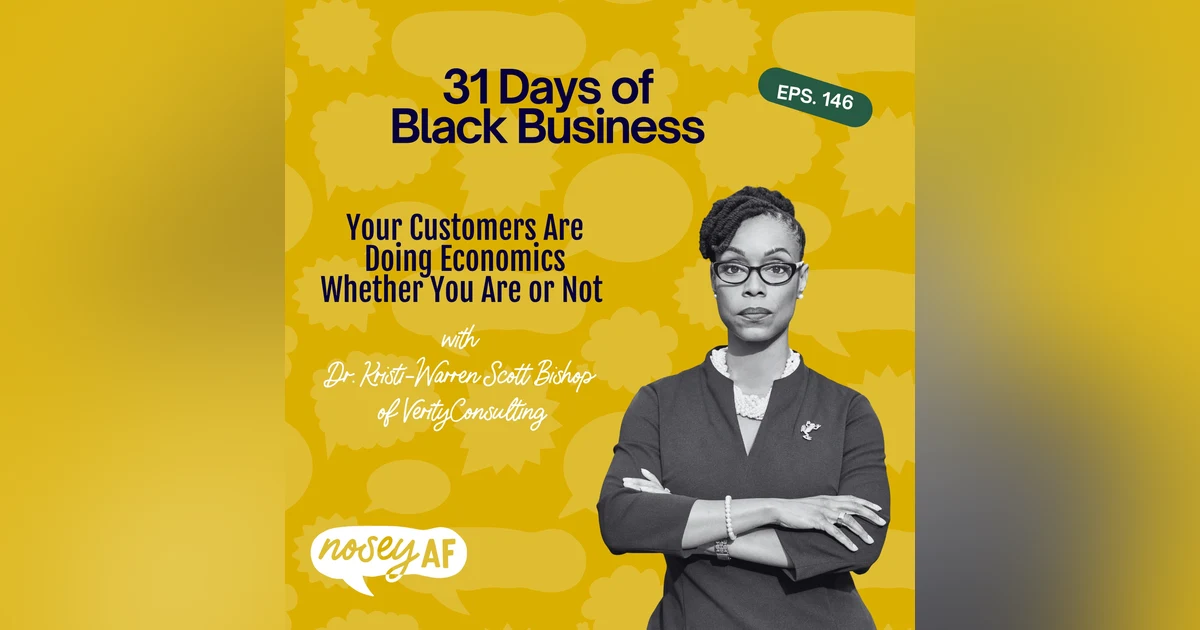
Ep 146: Your Customers Are Doing Economics Whether You Are or Not with Dr. Kristi-Warren Scott Bishop of Verity Consulting
Part of noseyAF's 31 Days of Black Business series 🖤
She was going to call herself the corniest economist. Her friend said no, you're the baddest economist I know. She was terrified to use it. Her friend said do it scared.
Dr. Kristi-Warren Scott Bishop is a PhD economist and the founder of Verity Consulting, which she launched in fall of 2025 after spending over a decade doing economics across the federal government. She started it because she was tired of watching businesses make what she could plainly see were bad decisions.
What We Talk About
- What an economist actually does for a business, and why there's no wrong time to bring one in, whether you're just starting or something just feels off
- What supporting Black business actually looks like from an economic perspective, at both the micro and macro level
- How Hump Day Economics started, and why she couldn't find a credentialed economist explaining why the eggs cost what they cost
- The unexpected turn: she's not a subject matter expert in your field and doesn't try to be. She brings the tool. You bring the business.
If you love a conversation that makes something big feel usable, this episode is for you.
Chapters:
- 00:07 - Celebrating Black Business Month
- 05:08 - Understanding Consumer Economics
- 13:20 - Understanding the Role of Data in Consumer Behavior
- 23:31 - Engaging Economists: Timing and Strategies for Entrepreneurs
- 32:21 - Understanding Consumer Values in the Black Community
- 46:34 - Transitioning to Business Insights
All about Kristi Bishop
You're gonna love Kristi. Dr. Kristi-Warren Scott Bishop translates how economics shows up in ordinary decisions, from why the gas tank waits until morning to why grocery prices feel different than the receipt says. Under the banner The Baddest Economist You Know, she turns ideas like present bias and revealed preference into weekly conversations her audience actually finishes watching. She's spent over a decade in federal economics work, including at the CDC and the Social Security Administration, and now runs Verity Consulting, a boutique economic consultancy helping consumer-facing organizations understand the economics driving their customers' behavior. Verity offers two tiers of monthly subscription with a three-month minimum, plus larger project engagements. Their first big one wrapped in April for a Black-owned spirits brand in Prince George's County.
Things We Mentioned
- Verity Consulting → verityconsultingllc.com · insights@verityconsultingllc.com
- Hump Day Economics, her weekly Instagram series
- Courtney Walden of Chicago Massage, her best friend and one of her clients
- The K-shaped economy, and what it explains about the airlines
This series is supported by Off the Grid, a podcast for small business owners who want to leave social media without losing their clients. Find them at offthegrid.fun 🖤
Connect with Kristi Bishop
- Website: verityconsultingllc.com
- Email: insights@verityconsultingllc.com
- IG: @verityecon
Stay Connected
📬 Get the noseyAF Dispatch → Subscribe here
🏡 Grab the Good Neighbor Playbook → Download it free
More ways to connect
- Email: stephanie@missgraham.com
- Follow on IG: @stephaniegraham
- Listen to more episodes: noseyaf.com
Support & Feedback
noseyAF is listener-supported; thank you for being here. 💛🫶🏾
📣 Share noseyAF with a friend who needs to hear this
Episode Credits
Produced, Hosted, and Edited by Stephanie Graham
Lyrics: Queen Lex
Instrumental: Freddie Bam Fam
Cover Art: Emma McGoldrick
00:00 - Untitled
00:07 - Celebrating Black Business Month
05:08 - Understanding Consumer Economics
13:20 - Understanding the Role of Data in Consumer Behavior
23:31 - Engaging Economists: Timing and Strategies for Entrepreneurs
32:21 - Understanding Consumer Values in the Black Community
46:34 - Transitioning to Business Insights
Stephanie Graham
Hey, friends. Welcome. And welcome back to nosey AF conversations about art, activism and social change.I'm your host and friend, Stephanie Graham, and it is Black Business Month, and we are celebrating it all month long with our series, 31 Days of Black Business. So I went looking for a black economist who could speak to the bigger picture of black business in America.But in that search, I discover so much more about economists and all the different lanes that they can be found. And that's where I discovered Kristi Bishop, who really is all that in a bag of Chip Shaw. I'm so excited that I found her.Which actually somebody on threads found her and tagged her, which, by the way, whoever you are out there, thank you. Christie's friends describe her as the baddest economist they know who you will know who I know.Now, Kristi bishop is a PhD economist and the founder of Verity Consulting. And she'll tell you there's not a wrong time to bring an economist into your business.She also makes Hump Day Economics, an Instagram series explaining topics that apply to our everyday lives, like why the eggs cost the way they cost, and why concert tickets keep rising in price. This is the stuff we need to nerd out on because it actually applies to our everyday lives.I'm so excited to bring this conversation to you, but of course, we have to play our theme song and then we'll talk to Kristi. Welcome to nosey AF.
Kristi Bishop
Gotta get up, get up to the whole world you will win a winner Vision of a star with a mission in the cause what you're doing, how you doing what you're doing and who you are. Flex yourself and press yourself Check yourself, don't wreck yourself if you know me then you know that I be knowing what's up. Hey, Stephanie.
Stephanie Graham
Graham is noseyAF Kristi. Welcome to nosey af.
Kristi Bishop
Thank you, Stephanie. I'm so glad to be here.
Stephanie Graham
Yes, me too. So you're known as the baddest economist that we know. You have to tell us, where did that come from?
Kristi Bishop
Yeah. Okay.So when I started Verity Consulting, which is my economic consultancy, last fall, fall of 2025, I was chatting with some good girlfriends of mine who really just kind of helped me, you know, do some deep thinking about it and, you know, kind of what kind of services I wanted to offer and what my branding would be. I started to think about the adjectives that my friends and loved ones have used to describe me in the past.And I came up with the corniest economist you know. Cause I'm. I'm mad corny. I am Ultra, ultra corny.Okay, so, so I came up with the corniest economist, you know, And I'm running these by two of my really good girlfriends. I call them the Caucus here in dc.
Stephanie Graham
I love that.
Kristi Bishop
Shout out to them.
Stephanie Graham
Yeah, I love that.
Kristi Bishop
Um, and one of them was like, yeah, but you're a baddie. And I was like, no, I'm not. I ain't. Ain't no, you're crazy. What? I ain't. No, I'm a geek. What's happening? And she was like.She was like, no, like, you're the baddest economist I know. And I was like, you know, just kind of ingest. Ooh, I should use that. She was like, you should. Yeah, very seriously. And I was like, no, that's scary.I don't want to. I don't want to. I don't want to use that. And she goes, there it is. If you're scared, do it anyway. And so that's how it came about.
Stephanie Graham
Oh, my gosh, I love this. And I love the Caucus. And I love how serious she was. Like, I'm actually not joking.
Kristi Bishop
So she was, she was not joking. She was not joking. 70. I was. And I'm still scared.Every time I, you know, put that hashtag on any of my weekly hump day economics posts, I mean, my fingers would just be. Just be shaking.
Stephanie Graham
And she's like, yes.
Kristi Bishop
Yeah. When there's a scary thing in front of us, do it scared. It's okay to be scared and do it anyway.
Stephanie Graham
Yeah, that's so true. And I also love this whole, like, you know, claiming of the baddie title.It reminds me of, like, there's been these conversations about, like, debunking the cool girl myth of, like, people think you're cool, but, like, meanwhile you love to go to lectures and stuff like that, which also is cool. I'm like, I wanna go to a lecture.
Kristi Bishop
In my world, that's the cool stuff. But me too, in school, you know, I was not a cool kid. I was the kid that loved math. So, you know.
Stephanie Graham
Yeah, I love all the baddest, like the baddest in the land kind of thing. So, yeah, shout out to you for being the baddest elements that we will all know after this conversation.
Kristi Bishop
Yeah, I'm excited about it.
Stephanie Graham
Yeah, me too. So for people who don't know what a consumer economist does, what do you actually study?
Kristi Bishop
Yeah, yeah, thank you for that question. You know, it's a lot of stuff.Honestly, one of the things that I love about econ and about the Study of econ is that I say that it's all around us all the time and we're living it and we often don't know. And there's so much that, you know, points in the direction of economics being really, really intimidating and difficult to understand and complex.And there are parts of econ that are complex, don't get me wrong.But what I did was conducting research on consumer food behaviors, you know, what kind of food choices we make and the outcome that has on our health. You know, a consumer economist will study the behaviors of consumers and given, you know, a series of constraints.And honestly, I like to think of it as a study in the way that we all live because I believe that economics really is all around us all the time. And so that was really my training. Right. I decided to. And I may be getting ahead of myself, so stop me if I am.I decided to go get my PhD in 2010 or attempt to go get my PhD because I was just applying to programs. But when I was looking for programs, you know, I didn't know that consumer economics was the program that I would pursue.I really just wanted to do this thing that's really indicative or represented by the Japanese concept of ikigai. I don't. Are you familiar with this?
Stephanie Graham
I'm not.
Kristi Bishop
Okay.
Stephanie Graham
I think I feel like I've seen it spelled out.
Kristi Bishop
You've probably seen it. I, K I G A I.And it is essentially a Venn diagram where, you know, there's an intersection at the center of the thing you're really good at, the thing you really enjoy, the thing the world needs and the thing you can get paid for.
Stephanie Graham
Okay.
Kristi Bishop
And when I decided to go get my PhD, I was like, okay, well, I need to figure out what that thing is. Because, you know, I wanted to do some terminal degree work. And for me, the thing ended up being, you know, I'm good enough at math.I am a self proclaimed mathlete.
Stephanie Graham
Nice.
Kristi Bishop
I really did enjoy economics in school. I'm also a foodie. I love some food.And I wanted to help try and solve the problem that I saw happening around me in my community at the time on the south side of Chicago, which was that I saw black people who were relatively young passing away for a plethora of health reasons. Right. Like, it was. It just kind of kept going and going and going.And I really wanted to try and understand that using the thing that I loved, the thing that I was good at, and using those tools. So just, you know, a couple of really good Google searches led me to understand what consumer economics was.I read more about it and I was like, wow, that. That's it. That is the thing. And I applied to, to school, but consumer economists, like I said, they don't all work in health.So some work in the financial space, some work in the health space, some, you know, do research on labor. I mean, it's kind of everything that we, you know, engage in as consumers. So it's all across the board. Yeah, yeah.
Stephanie Graham
That's really insightful to hear you say. Cause, yeah, I'll speak for myself.When you think of econ, you just feel of like folks in like a white lab coat with a clipboard, like writing down a bunch of numbers that you don't really know where the, what the data is coming from versus like, oh, no, I'm looking at how you guys, like, like why everybody's going through a drive through or how you decide. Like.
Kristi Bishop
That's right.
Stephanie Graham
Just like any sort of. I'm trying to think of other examples.
Kristi Bishop
Yeah. And sometimes the data are collected. Right. And we, I mean, we get surveys in the mail all the time.Yeah, I'm sure if you look in your mail, there's like a little survey someone has sent you. Now, whether we fill them out or not is a different question. But data are collected from us. Yeah, that's really the source of it.Now it's different whether we offer the data. Right. In a survey or when we use our credit cards.Like the financial institutions that own, that distribute our credit cards, they also collect data on our spending, right?
Stephanie Graham
Yeah.
Kristi Bishop
So the data are collected from us in one way or another, by one entity or another. The federal government is also a really good one. They collect data quite often.One of the surveys that we're most familiar with is the census, the decennial census. Right. And so it's collected from us. And so economists will use those data to help understand consumer behavior.Consumer economists will use those data to help understand or explain or even predict consumer behaviors. And we rely on that evidence to help us do that. But essentially it comes from all of us.
Stephanie Graham
Yeah, it's like that whole phrase when these people say, like, the numbers don't lie. Like when the budgeting class. And they're like, pull your receipts off the.
Kristi Bishop
Yep.
Stephanie Graham
Off your data from the bank.
Kristi Bishop
Yep. Pull the receipts. They do not lie. Another, you know, really good example of kind of where the data come from.And I'm sure we, we all get this, but I don't know the extent to which we all actually participate in it. Stephanie, have you ever called Like a bank or a business. And at the end they're like, stay on the line to complete a brief survey. Right.Do you complete the survey?
Stephanie Graham
Sometimes, if the person's really nice, yeah.
Kristi Bishop
Right, right. Sometimes you complete the survey. That survey is data collection. Yeah, that's essentially what that is.And so these are happening, like, it's all around us.
Stephanie Graham
All around us.
Kristi Bishop
Right. And so as a researcher, you know, when I was in graduate school and I was. I had all these amazing ideas for, you know, for research.Ooh, I want to do this. Oh, I want to learn that. I want to understand this. I want to, you know, I could. I had two options.I could either collect my own data, which takes a lot of money and a lot of time, for which I did not have my funding was only. It was limited, but. Or you can.Or you can conduct research using data that already exists, and the federal government collects data that already exists, and it's also free. Right. So you could use that. But the challenge is you can only ask questions that the data will answer. You cannot. Right.You can't ask a question about one topic or a certain population if the data do not exist for that topic or the population. So you just kind of limit it. Right. And so I learned that really quickly.And as frustrating as it was, what it later taught me was, you know, I'm gonna fill out every survey, then, like, moving forward, like, I now empathize with the researchers who are like, just trying to collect data. You know, of course not giving away my private information, but like, you know, like, I'm gonna go ahead and do the survey at the end of the call.Why not?
Stephanie Graham
Yeah, yeah. Why not?
Kristi Bishop
Because I now understand the benefit of doing so. Yeah.
Stephanie Graham
What's one thing about consumer behavior that most business owners misunderstand?
Kristi Bishop
I think one of the biggest things that business owners misunderstand about consumers is that in my opinion as an economist, I really do believe that consumers will always act rationally. And that's a debate amongst economists whether consumers will behave rationally.But I believe that consumers will always make rational decisions that's aimed at maximizing their utility.And so essentially what that means is consumers are going to do what they think is best for them in the moment, and they're going to do it with a short term view. We're not going to do it with a long term view.I think a lot of times business owners are trying to guess at what consumers are going to do, and sometimes they often rely on what consumers have done in the past, but it is not Always safe to assume that past behaviors will predict future behaviors because we are impacted by so many other external things. So honestly, you know, I wish they would understand that really, you kind of need an economist at the end of the day. Yeah, you need an economist.You need me. You need Verity. Doesn't have to be me, but.
Stephanie Graham
Yes, it does.
Kristi Bishop
But to really understand, you know, based on evidence. Based on evidence. Right.And understanding what the consumer theory is and using those tools to help predict consumer behavior, I think that, you know, there are a lot of times where, like I said, businesses are kind of grappling with kind of guessing what their consumers are going to do. And then also they have their own perspective because they're, you know, unless they're a nonprofit, they're trying to maximize their profits.And then that may be like a hard line to kind of straddle, if you will.But, yeah, like, you know, consumers, in my very humble opinion, are always aiming for the thing that's going to maximize their utility that they're going to get the best satisfaction out of. When I was in grad school, a professor called it Chasing Heaven. He called it the big hobby.And he's like, you know, folks are always going for the big H. And he wrote this H on the. On the dry erase board and left it up there the whole semester. Whole semester.Stephanie, like to kind of drive home this idea that at the end of the day, we're all trying to get to this level of satisfaction. That's essentially it.And I think if businesses understood that consumers are always trying to do that and then also understood the mechanisms that kind of precluded like, adjustment, consumers adjustment in chasing the big age and chasing that satisfaction, I think they'd be much more well off, which is essentially why I started Verity. Honestly, I was over kind of watching businesses make what, in my opinion, as a PhD economist was just a bad decision.I was like, baby, what you doing? What are we. Oh, no, baby, what are we doing? Why would you do that?And so understanding if businesses had economists on staff that they could essentially help to inform them to make different business decisions that I think would ultimately serve them and consumers.
Stephanie Graham
Yeah. You know, with Verdi and with just the thought of, like, working with economists, is there a business that is too small to involve an economist?I think that's, like, where I also think where I was like, coming with the white lab coat and all that, because it just seems like I also, like, picture it in like, some sort of, like, big business. Maybe it's government.I'm trying to think you know, during this whole series, some of the businesses, there's like event spaces, you know, handyman services, you know, beauty lines. What is it? Financial planning. You know, is there any business that's too small to involve your service?
Kristi Bishop
Yeah. No, I mean, not in size. Right.
Stephanie Graham
Yeah.
Kristi Bishop
Verity, Verity offers a number of services.We offer everything from a, like a monthly subscription service where there is a minimum three months, but you could just employ Verity for three months and you know, and get some of the information that you need, all the way to a larger project engagement which we just finished our very first large project engagement at the end of April for a black owned spirits brand here in Prince George's County, Maryland. We're really proud of that work, honestly.
Stephanie Graham
Yeah, that's awesome.
Kristi Bishop
I mean, and that was, you know, that was the data stuff that was using large data and doing some very deep analysis on the data and handing off to my clients strategic recommendations based on what the evidence said, you know, and how I thought spirits consumption was going to move in the future. And so, you know, we, we, we've got a, we've got a breath.But it isn't just me, you know, there are, there are plenty of, honestly having been there in grad school, there are plenty of grad students who, in the econ space who could possibly offer, you know, those kinds of services. But like I said, Verity, we, we've tried to create kind of a breadth of services.Like I said, you could do the monthly subscription for a minimum of three months and there are actually two subscription types. So there's a, there's a more, I call it a skinnier version.Right, where you, you'll get access to me, you'll get access to my brain, you'll get access to my ability to like quickly analyze data, find some data for you. It is not a deep data analysis so we can't, you know, lead with a research question.But if you want to bend an economist's ear, we do have services like that and then we have a higher tier subscription service again still the minimum is three months. But yeah, a small business could absolutely hire Verity to do some subscription work.I'm actually in conversation with, we've not yet started, but an entrepreneur in the beauty space and she does hair.
Stephanie Graham
Yeah.
Kristi Bishop
And she works for herself. Right.
Stephanie Graham
Yeah.
Kristi Bishop
And so, you know, I fairly recently I sent over to her a proposal with a quote. But yeah, like, you know, she's wanting to know I'd like to expand in a way that works for me but also works for my consumer base.And so there are perspectives that I am providing to her as an economist that she's like, wow, why didn't I ever think of that? And I did the same for my best good girlfriend in Chicago. I'm gonna shout her out, please.Her name is Courtney, Courtney Walden, and she is the proprietor of Chicago Massage. So she does post op massage therapy. And you know, this was right before Verity launched, but we were having a normal yap on FaceTime.I mean, yeah, we've been besties since eighth grade.
Stephanie Graham
Okay.
Kristi Bishop
Yeah. And I was just saying to her, I was like, oh, you know, this is what vertical integration is. The concept of vertical integration.And this is how I think vertical integration could serve you. Let's talk through how that might work. And as she's talking through it, she's like, oh my God, that's brilliant. That's genius.I'm definitely gonna do right. And so the subscription service is kind of like that. Like, you get access to my brain.You get access to these many, many years of econ theory and know that I have built and honed and still continue to hone in my full time day job for, you know, for pricing, you can do it for a minimum of three months. And at the end of the three months, if that's at the end of your budget, there's no obligation to move on.If you want to circle back six months after that, you know, to the extent that we are, you know, we have the capacity. Of course, of course. I mean, I love yapping about this stuff. I do. Yeah. To anyone who will listen.So thank you and your audience for listening, honestly.
Stephanie Graham
Yeah, we love it. What, when do you find that folks even come to you? Is it right at the beginning when they have an idea for a business, when they might feel stuck?Like, when should we get an economist involved in what we're doing?
Kristi Bishop
Yeah, honestly, at any point. So it varies because for my first project engagement client, who, it's Arthur Wheeler Spirits company.So that is the black owned spirits brand here in Prince George's County, Maryland. I actually approached them. Yeah, I did, because I said, hey, do you have any questions about, you know, what's happening in the spirits world?And the owner and CEO, Beau Wheeler, said, yeah, actually I do have some questions. You know, can data help answer these? And I was like, I'm so glad you asked. And yes, it can.It can answer those questions and a few more that I think you would find helpful.So I approached him for, like I said, for the conversation with Courtney Walden at Chicago Massage that just came up in dialogue Again, she is my best friend, so she, she got the services that she got the best friend discount.
Stephanie Graham
That's very nice, $0.
Kristi Bishop
But this other.This last client here in Prince George's County, Maryland, potential client, she actually approached me and said, hey, like, I'm wanting to do a thing, but it feels like I'm not able to. I can't quite think through how to get there without, you know, maybe hiring somebody else or putting in more resources on my end or.And so we launched a few preliminary conversations. We did have an exploratory call to explore what we could probably do for her.I shared with her some of the services that Verity offers as she figured out which one fit for her. Right. So. And she. And she's already established. Right. All of these people are already established, so there is no bad time, in my very humble opinion.You can engage an economist when you first start, you can engage an economist if you happen to come up against an obstacle that, you know, is kind of vexing you a little bit.You can engage an economist when you, you don't necessarily have an obstacle, but you're like, something don't feel right, or I'm wondering what's going to happen in the world. Right. Like, you might feel like, oh, the, the, the consumer climate is kind of iffy right now.Like, you can engage an economist if we are ever in a space where we are facing something like Covid again, that I'm sure that was really, really impactful for business owners, particularly those who are consumer facing. Yeah, Right. You can engage and say, you know, what can we expect? And not that the economist is going to have a crystal ball. Right.That's not what we do.But like I said, we do rely on the evidence to help explain, you know, describe, predict, you know, what's happening with consumers and what can potentially happen in the future with some kind of level of not certainty, but confidence.
Stephanie Graham
Yeah. It makes me think, like, do I need any. Do I need to talk to you about this podcast?
Kristi Bishop
We can yap about the podcast.
Stephanie Graham
Yeah. Right. No, it's just like, it just. I think it just goes to show, like, you know, that there's data in research, in. In everything.
Kristi Bishop
In everything.
Stephanie Graham
Yeah.
Kristi Bishop
I love that for me and the nerds. I do.
Stephanie Graham
Yes, me too.
Kristi Bishop
I'm really grateful because if people didn't offer the data, then we couldn't. We couldn't conduct the research.
Stephanie Graham
Yeah. You know, I've been doing this whole series with, like, black businesses, and we often hear people say, support black business.Support black business. And I'm so curious, from an economist's perspective, what does meaningful support actually look like?
Kristi Bishop
Yeah, yeah. You know, I think it depends on. I think of it like a, a game board, right? What part are you playing?Because you could support black businesses in a myriad of ways that I think would help move black businesses forward either at the microeconomic level or the macro level. Right?
Stephanie Graham
Yeah.
Kristi Bishop
You might be a consumer, right. And maybe your support is by spending your disposable income with this, you know, black owned business, you could be an investor, right.And maybe your support is offering capital, right. Investment resources so that you, so that this black owned business can continue to do its work, can also potentially grow, right.Because the other thing is, you know, we, what black owned businesses are, are. Can be really good for the entrepreneur in developing and creating wealth, right.In a way that is really, really useful for that person or their family. But also how can that expand to other people and their families, right? It's if one of the ways is maybe that black owned businesses can now.Business can now hire staff, right. That comes from, you know, investment.If you are an investor and you've got the resources to, you know, to put into an organization, perhaps they can expand and they can hire, they can employ people. Right. And they can impact people the, the employment rate in a positive way.
Stephanie Graham
Yeah.
Kristi Bishop
I mean there are so many kind of ripple effects. It's like, you know, where, where are you on the, on the, on the game board to support black owned businesses?For me, for Verity Consulting, like I said, one of the things that I aim to do and you know, we definitely support black owned businesses. Not exclusively.
Stephanie Graham
Yeah.
Kristi Bishop
But we definitely support black owned businesses is, you know, I want to help business owners deeply understand business owners for consumer facing businesses, of course, deeply understand who their consumers are. Right. Maybe the profile of your consumer evolves over time.But I think with deep understanding of who your consumer is and what product or service you're offering, I think that helps you make better business decisions. And I think, you know, that is how Verity is supporting black owned businesses.So I think it, you know, it just depends on where you are on the, on the game board. And it can be in a myriad of ways and it isn't just as a consumer, but there could be additional ways that you could support black owned businesses.For sure.
Stephanie Graham
What do you think black consumers value today that maybe we didn't 10 or 20 years ago?
Kristi Bishop
Yeah, I think, I'd say not that we didn't, but I think what's.
Stephanie Graham
The.
Kristi Bishop
Expansion of this value? I think is patronizing with our dollars, other black owned businesses. Okay, that's a thing, that's. That I would hear a lot, particularly growing up.Right.And you know, depending on where you were, who, who you overheard, sometimes there would be, you know, echoes of support for that notion or it would be, you know, this kind of stigma that a black owned product or service was either of lower quality or was somehow unreliable or, you know, just kind of all these, all these other things that would like, dampen the perspective.I think today that has declined significantly such that I think people are a lot more supportive of black owned businesses and a lot more thoughtful about where their money goes. Right. And because I think, you know, I think people want to feel good about where their money goes.
Stephanie Graham
Yeah, of course.
Kristi Bishop
I think it's so easy to, to just kind of spend. And I know for me, if I have cash, I don't have cash. If I have cash, I don't have cash. I can't follow it. I'm like, I done lost the 20 somewh. Right.And so I think people are paying closer attention to like where their dollar goes. And I think people want to feel good.Maybe there's a sense of like, altruism or like an added level of utility or satisfaction that people get from knowing that, you know, their dollar has supported, you know, a black owned business or, and, or continues to circulate within a community of their choosing. Right, yeah. And so I definitely think there's more care.More concern in where we spend our dollars and spending those dollars, you know, with black owned businesses.
Stephanie Graham
Yeah. You know, here's a question I have around econ.You know, I had an art teacher once tell one of my classmates, like, okay, if you wanna have a successful art career, you pick what you're interested in and then you go into the history books and you see who's made work like that. And then see how you can fold in, be in conversation with that, like, what are they not doing that you can talk about?And then boom, there you have it.
Kristi Bishop
And he's like, you'll blow up 1,000%.
Stephanie Graham
And it makes you wonder if I could come to Verdi Consulting and say, hey, listen, I want to blow up in this space and like give some of my favorite themes. Could you look at the data and say, this is what's missing and if you do this, you will blow up a thousand percent.
Kristi Bishop
And I'll tell you why. I'll tell you why. And I mean, I may regret saying this.That's not just an economist, that's pretty much Every researcher, everyone with, you know, a PhD who's done research, who's earned their PhD. This is how you're taught to research.
Stephanie Graham
Okay?
Kristi Bishop
This is how you're taught. So whoever was teaching you that was really had you ahead of the game in the PhD space. This is how you're taught to research.But this is, you know, you review, you know, in the academic space, you review the literature, you look at everything that's been done. And oftentimes, you know, at least this was my experience, it was really hard. It's like, but everybody done everything already.And, you know, and it's like, you know, you have to get to the mindset of, like, even if you adjust one little thing or you change one little thing, you look at a different, you know, sample of people, or you look at a different geographic area, or you look like just one thing can really, like, open the doors, right? So the answer to your question is for sure, because, you know, you know, but also, like, for me, for Kristi, you know, I am an expert in economics.That's my field. I am not a subject matter expert in your field. So that may mean that I rely on you. I ask you. And I'm not trying to be a expert in your field. Right.I'm trying to help bring this tool for you to, like, super broaden perspective. Right. And I might say, hey, Stephanie, what about this? Does this make sense, you know, given your expertise?Because, again, I don't have that expertise in the subject matter area.
Stephanie Graham
Yeah.
Kristi Bishop
So, yes, absolutely. Honestly, it's one of the things that helped me answer the question of what Verity was gonna offer and what Verity was gonna do.Because last year, there were a number of people who love and support me, and I love them for that, who were just kind of saying a number of things to me. They were saying, when are you gonna start consulting? Cause you just be giving away free game to these businesses.You know, my husband was one of them. She was just like, you just giving away.
Stephanie Graham
Can you stop it?
Kristi Bishop
Stop. Knock that off. Like, what are you doing? And then I thought to myself, I was like, oh, like, you know, people can just pay somebody like that. I don't.If I offer that, that's not unique. And then, you know, the more I just sort of traversed this. This journey, I recognized that it was unique.I also learned that what made Verity extra unique was I could tie in this skill that I won't say allegedly have. I will go ahead and. And receive it. That, you know, people have been telling me, oh, look at this.
Stephanie Graham
I know. I'M like, wow. It's like fireworks behind you. I've never seen that happen before. I've never seen that happen before. And a thumbs up came.I was like, I wonder how that's happening. That was magical. It's a sign. It's like.
Kristi Bishop
It's a sign.
Stephanie Graham
Stephanie, do you think your husband is like, just to prove it, boom. Like, he's like, somewhere, like, push the button. Yeah.
Kristi Bishop
Fireworks. Yeah.But I, you know, it was difficult for me to receive, but, you know, I was told that I tend to have a knack for translating econ to, you know, everyday audiences.And I was like, now I just be talking to y', all, and folks are like, yeah, but like, you think people understand this stuff inherently, and they don't.
Stephanie Graham
No.
Kristi Bishop
And so I realized, you know, through that journey, that that was also kind of like a very niche, unique thing that I could tie into Verity, which is how Hump day economics started, Right?
Stephanie Graham
Yeah.
Kristi Bishop
My sister, who's back in Chicago, shout out to my sissy, was like, lil Pixie. That's my family nickname. Lil Pixie. You need to. You need to be making posts about this stuff. And I was like, for who? You know, what?And it took me some time. It took me some time, but I started it.And, you know, I recognize that, oh, there are economists who are making content specifically, and they may talk about, you know, things that are, you know, maybe political or help you understand kind of investments. I think there's a content creator. I think last name Purvis. I can't remember her. Nicole, maybe.She's an economist, and she talks about, you know, kind of investing your money and gives you kind of ideas about building wealth in that way.But I, you know, I hadn't seen a credentialed person creating content that really kind of, you know, helps you understand why the eggs are so expensive or why is it that in the summertime gas is through the roof, but in the wintertime, we could fill up three times in a week and not blink? Right. Like, you know, like these very, like, you know, I'm living my life. How is econ functioning in all of the spaces that we. That we occupy?But I realized I didn't see a credentialed economist out there doing this. And in short form, content.I'm not trying to lecture you for 30 minutes or hour, but, you know, if I can help you understand, you know, why the concert tickets keep going up.
Stephanie Graham
Yeah.
Kristi Bishop
And then if I can tell you, I bet you're gonna go to the concert anyway.And this is why you know, if I can help explain inflation to you in a way that resonates, then, you know, this is kind of the lane that I will occupy. And that is essentially how like, Verity got into like the consulting and also like this little miniature content creation type space.
Stephanie Graham
Yeah.
Kristi Bishop
But this, you know, it's kind of that, you know, find something people are doing because it's exactly what your teacher said.
Stephanie Graham
Yeah.
Kristi Bishop
And then understand it. And then do something a little different. Yeah, a little different. Yeah.
Stephanie Graham
You know, one of the last questions I have for you is what kind of advice would you give to someone who is like yourself? Like, they have all this advice and they have their friends that are like, you could totally make a business out of this.And they too are being like, and who's gonna buy my services? You know, what kind of advice would you give to somebody like that?
Kristi Bishop
Yeah, yeah. I would tell them what was told to me. You know, it probably seems scary, which is probably true for you.
Stephanie Graham
Yeah.
Kristi Bishop
And also do it anyway. And there are people who love you and there are people who support you. And those people are telling you the truth.Your self doubt is not telling you the truth. So believe them. Listen to the people. Listen to and believe the people who love and support you and do it. Scared.
Stephanie Graham
Yeah. That's really excellent advice. And you've been in business now for how long doing this? Just yourself.
Kristi Bishop
November will be one year. So we're in month seven. That's 11. Yeah. So about eight months.
Stephanie Graham
Wow. And have these folks who love you, have they been right?
Kristi Bishop
Were they right? Yeah, I mean, I mean, you know, I'm not like viral or anything. Right, right, right.But, but, but to the extent that, like, I'm very proud of what I've built, I'm. I deeply enjoy the work. I mean, this is essentially what I went to get my PhD for. Yeah. I love my day job. I love who I work with.My colleagues are really, really amazing people.
Stephanie Graham
Of course.
Kristi Bishop
Yeah. But also, this is my bread and butt. Like, this is what, like, makes me, like, I'm in the bed kicking my feet.Like, I'm so excited about these very nerdy things, very nerdy topics.It thrills me to like, scroll social media and see, you know, something that, like, I've predicted get based on, you know, my understanding of actually consumer behavior and my understanding of economics, like, kind of continue to come to fruition. One of those things was Southwest Airlines is gonna start having lounges. I got evidence. Oh, wow. I talked about it.I talked about it a few months ago on my social Media. When I did a hump day econ, I was like, listen. And I think I did a LinkedIn post about it too.I'm like, I think I was talking about the K shaped economy and why the airlines were just kind of splitting and spirit went away and Delta and United and American are increasing their prices. It was in that conversation. But I just saw a post yesterday that was like, you know, Southwest CEO hints at lounges. And I was like, told ya. Wow.That, that is deeply, you know, that's, that's, that's deeply satisfying. That's deeply satisfying. I mean, econ at work, I love it.
Stephanie Graham
Yeah, absolutely. That's really fascinating to me that they're gonna start having these lounges.And I think also what's interesting too with your hump day post is that, you know, we get to learn about like news in a way, in this, you know, in this way.But then also like the posts are sort of broad, but then we can come to you for like that direct, you know, the direct details about what we want to do, what we are doing or the problems that we are having with the work that we're.
Kristi Bishop
And I just love that.
Stephanie Graham
Yeah, I just love that.
Kristi Bishop
Oh, thank you. Yeah, thank you very much. I appreciate that.
Stephanie Graham
Yeah. Oh my goodness, Christie, thank you so much for being on nosey af. I really appreciate.I feel like I have so many questions, like maybe you can come back. Like, I just have like so many ideas.
Kristi Bishop
Okay, I will absolutely do it. That's fantastic.
Stephanie Graham
I love it. So really quick, let's just share in case, you know, we have a business owners are like, oh yes, absolutely. I want to.Chrissy, what are the steps that we should take?
Kristi Bishop
Yes. So you can, there are a few steps. You can visit my website. It is www.verityconsultingllc.com v e r I t y consulting llc.com.You can email me at insights I n s I g h t s@verityconsultingllc dot com so that's insights verityconsulting llc.com. And if you just, you know, wanna hit me up on Instagram, you can do that. My handle is verityecon.V E R I T Y E C O N. So go ahead and take a look at some posts and let me know what you think. I mean, but be nice though.
Stephanie Graham
Oh yeah, absolutely. Don't get blocked. Don't get blocked. I mean, yeah, don't get blocked.
Kristi Bishop
Yeah, yeah, yeah, yeah, yeah.
Stephanie Graham
I learned that from Lovey. They're like, as soon as you see a comment, just like, listen we're not even engaging. Like, not even about to have it back and forth.
Kristi Bishop
It's just.
Stephanie Graham
You're gone.
Kristi Bishop
I mean, correct. I mean, I live in Prince Georgia County, Maryland. I work in D.C. but I am still from the south side. Like, don't, don't get it twisted.Please remember, please keep that front of mind.
Stephanie Graham
Yes. Okay. Because indeed you are the baddest economist that we know. I love it. Thank you so much.That concludes another episode of nosy AF31 Days of Black Business. I'm your host and friend, Stephanie Graham. I hope you took something away from today's conversation and had a good time hanging with us.Be sure to check out the show notes to learn more about today's guest and consider supporting their work. You know how it goes, whether you're making a purchase, hiring them, or simply spreading the word. Listen, who doesn't love a referral?It truly all makes the difference.Quick thank yous go out to Queen Lex and Freddy Bam Bam for the nosy AF theme music and Emma McGorick who hooked me up with the COVID art and video branding. Shout out to the partners and supporters for this series. You can check them out in the show notes as well. Super grateful for a partner. Hello.That's the show friends until tomorrow. Stay curious and take care. Bye.