
 Apple Podcasts
 Spotify
 RSS Feed
 Castro
 Amazon Music
 PocketCasts
 Your Credit Report Shows Your Stress with Cierra Michelle Jones of The Credit School
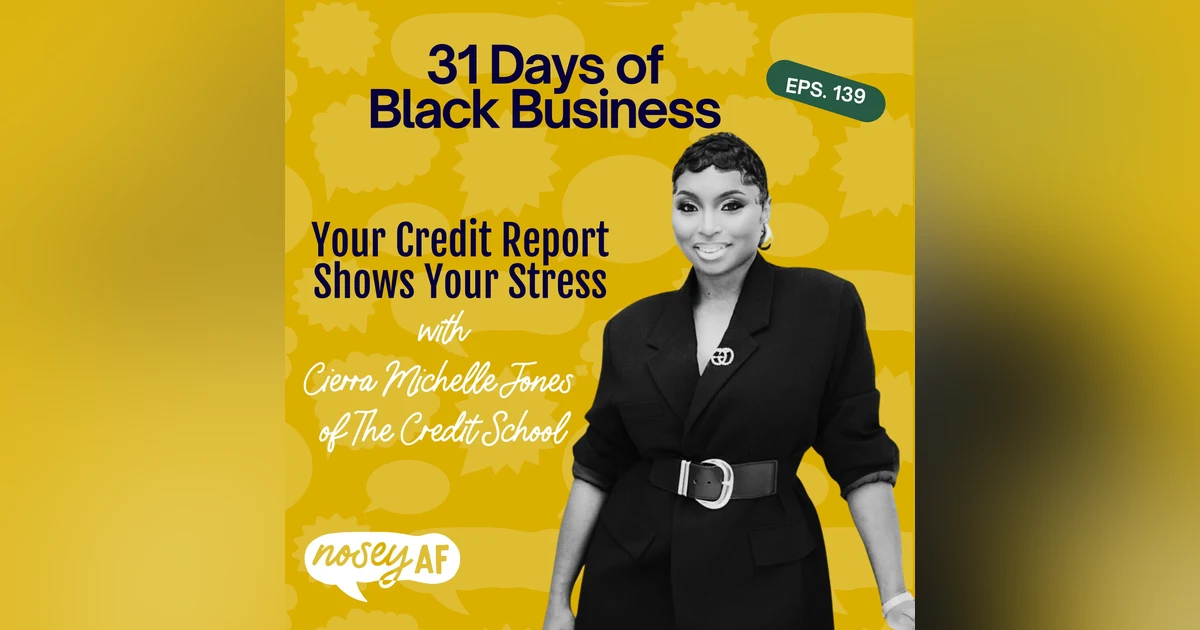
Ep 139: Your Credit Report Shows Your Stress with Cierra Michelle Jones of The Credit School
Part of noseyAF's 31 Days of Black Business series 🖤
She got denied on her first house, couldn't afford a credit repair company, and went to Google instead. She calls herself her own first client.
Cierra Michelle Jones is the Founder and Executive Director of The Credit School. She joined the Army at 17, spent years running from her credit problems, and got denied and scammed trying to buy a house in 2015. Now she has zero debt except her house and her car, and she's teaching millennial families and underserved communities how she did it.
What We Talk About
- Why the biggest military misconception is that you're automatically set, and what actually happens after the bonus is spent
- What she can see on a credit report that has nothing to do with numbers, including your stress spending
- Why credit repair takes 18 months and not 30 days, and how to spot someone who doesn't know what they're talking about
- The unexpected turn: an election year is the best year to buy a house, and here's why
If you love a conversation that hands you something you can actually use, this episode is for you.
All about Cierra Michelle Jones
You're gonna love Cierra. She's a self-described bookworm and history buff who reads financial news like other people read gossip. She's the Founder and Executive Director of The Credit School, helping millennial families and underserved communities demystify credit education and build toward home ownership and generational wealth. A retired Army veteran and single mom, she built the platform after learning the hard way that the problem isn't a lack of effort, it's a lack of clarity. She's the author of The Military Credit Blueprint, with more books and a children's book featuring Penny the Pig and Sam the Scammer on the way. Her whole thing: she made the hard mistakes so you don't have to.
Things We Mentioned
- The Credit School → IG @thecreditschool · TikTok @thecreditschoolone
- The Military Credit Blueprint, her book (affiliate link)
- The Color of Law, on redlining and Black home ownership (affiliate link)
- The Consumer Financial Protection Bureau (CFPB), and why to watch what happens to it
- Arnita Johnson-Hall, her credit coach, and the Credit Consultants Association
- Class action settlements, which she says are worth checking your junk folder for
- Debt Free Gonna Be, for student loan news
Chapters:
- 00:09 - Introduction to Black Business Month
- 03:42 - The Journey to Financial Empowerment
- 26:24 - Understanding Credit Challenges
- 32:53 - Understanding Financial Choices and the Pressure of Appearance
- 42:09 - Expertise and Growth in Business
This series is supported by Off the Grid, a podcast for small business owners who want to leave social media without losing their clients. Find them at offthegrid.fun 🖤
Connect with Cierra Michelle Jones
- IG and Threads: @thecreditschool
- TikTok: @thecreditschoolone
Stay Connected
📬 Get the noseyAF Dispatch → Subscribe here
🏡 Grab the Good Neighbor Playbook → Download it free
More ways to connect
- Email: stephanie@missgraham.com
- Follow on IG: @stephaniegraham
- Listen to more episodes: noseyaf.com
Support & Feedback
noseyAF is listener-supported; thank you for being here. 💛🫶🏾
📣 Share noseyAF with a friend who needs to hear this
Episode Credits
Produced, Hosted, and Edited by Stephanie Graham
Lyrics: Queen Lex
Instrumental: Freddie Bam Fam
Cover Art: Emma McGoldrick
00:00 - Untitled
00:09 - Introduction to Black Business Month
03:42 - The Journey to Financial Empowerment
26:24 - Understanding Credit Challenges
32:53 - Understanding Financial Choices and the Pressure of Appearance
42:09 - Expertise and Growth in Business
Stephanie Graham
Hey, friends. Welcome. And welcome back to noseyAF conversations about art, activism, and social change. I'm your host and friend Stephanie Graham.And y', all, it is Black business month. How exciting is that? All month long, I've been talking to folks who are building something special. So today's guest is no exception to this.I am talking to Ciara Michelle Jones, who is the professor of the credit school. So Cierra got denied on her first house in 2015. That sucks. And so she tried to figure out what to do.She couldn't afford her credit repair, and she said, you know what? I'm going to go ahead and go to Google and learn how to fix my own credit. Instead. That moment, Cierra became her first client.Now Cierra has zero debt except for her house and her car. And I got to tell you guys, I love that she's teaching the rest of us how to get wise about credit because I'm sort of jealous.Like, how can you be jealous of somebody, first of all who I barely know, and then second of all, be jealous of somebody who's actually teaching the steps on how she got wise about her credit? So maybe jealousy isn't the right word, but I am very inspired. I cannot wait for that to be me. Sorry, Cierra. Oh, my God.I'm not jealous of you, but I am inspired by you. I think that was the better way to say it. Anyway, guys, this was such a fun conversation.So let's play the fun theme song that we all love, and then let's talk to Cierra.
Cierra Michelle Jones
Welcome to noseyAFar with a mission in the cause. What you doing? How you doing?What you're doing and who you are Flex yourself and press yourself Check yourself, don't wreck yourself if you know me then you know that I be knowing what's up.
Stephanie Graham
Hey, Stephanie, Graham is nosey Cierra. Welcome to noseyAF.
Cierra Michelle Jones
Thank you for having me.
Stephanie Graham
Before we get into the credit school, you have to tell us, like, what was your relationship with money growing up?
Cierra Michelle Jones
Oh, my gosh.So I was laughing with some friends the other day because I said, growing up, seeing how the generation before us interacted with money, it's completely now.And I always tell my friends, it's like the millennials, we got the bad end of the stick because we were taught to do all of these things and, you know, don't make the same mistakes that they did. And now we're in the highest housing crisis, economic crisis, just all kinds of crises when it comes to money.But growing up, I didn't grow up with, you know, like rich endeavors. My mom worked three jobs to support my brother and I.And I remember us having to go into the back of the grocery market and get the colorful food stamps and having to just, you know, make ends meet however she could.And so that kind of taught me then that I knew that even though my mom's struggle wasn't her fault, I wanted to position myself to be in a better place, to be able to make more money and, you know, be able to sustain.And so I had a rocky relationship with credit at first, though, and which led me to realize I had a rocky relationship with money because money and credit are very synonymous.And so when I first joined the army in 2008, I kind of was trying to run from all of those problems and ended up having more problems and charge offs and credit cards that were maxed out because I didn't understand and correlate the relationship between money and credit at the time. And so when I went to buy my house, well, try to buy a house in 2015, all of that caught up to me, and I was denied and scammed and all the things.And so my first client, I always tell people my first client was myself, because I just went on Google and just was like, how can I fix this? What can I do? And of course, I tried to go through the credit repair companies, and I was just like, I can't even afford that.Living in D.C. a single mom, barely trying to make ends meet, kind of trying to not repeat the cycle, even though I was. And so, long story short, I ended up fixing my own credit, buying my first house, and now I have absolutely zero debt except my house and my car.
Stephanie Graham
Wow, that's really impressive. That is impressive. Especially that, like, awareness you had. Younger being, like, okay, I don't want to be like this.Maybe sort of finding yourself in a situation where you're like, wait, am I like this? And then getting yourself, like, out out of it.
Cierra Michelle Jones
Right, Right.
Stephanie Graham
So you got yourself in this perfect, very admirable situation. Like, oh, my gosh, I would love if only my house and my car.
Cierra Michelle Jones
Were all that I have.
Stephanie Graham
Like, I can't wait. I. Like, that's like a new. I need to, like, prioritize that. Just listening to your story.But what was there, like, the special moment when you realized that, okay, I need to help others with this, because you could have just been like, okay, I'm straight now, and kicked it, you know?
Cierra Michelle Jones
Right. Yeah. And so I was following a credit repair coach. Her name was Arnita.And I saw that she had Opened up a credit repair company to where she helped thousands of people. And I said, I could probably do that. Like, my goal wasn't to help a thousand people. My goal at the time was just to help single moms in the military.And so I started off saying, you know, I could just help a small group of people. And so I started it by giving advice, just general advice.I was telling people, hey, this is not legal advice, but I'm just giving you general advice. And when it started working, people were like, you should probably open up your own credit repair company.And I felt kind of small because once you get into learning, like, how big the credit repair industry is, you're kind of like a small decimal in a matter of trying to break through to people who are scamming, breakthrough to people who are legitimate, breakthrough to people who are just trying to make money. And then you have the fallen part, which I call the fallen part of the triangle, which is the education piece.And so that's where I kind of wanted to differentiate myself. So I went through a matter of names. When I first did it, I was Michelle Financial Group, because my middle name is Michelle.And then I was like, okay, I'm gonna be the debt free bestie, which I've kind of just reincarnated on my threads, because I'm now trying to correlate the relationship between money and credit. But I remember sitting here and I said, I've always been the type, break it down to me like I'm five. Break it down to me like, this is school.And I said, wait a minute, what if I open an education platform called the credit school? And so that's how the credit school was born.And then I wrote my book prior to this called the military Credit Blueprint, in which I'm now gonna expand into a series of books and educational materials so that people can learn how to not only navigate their credit, but navigate retirement, navigate investments, and navigate their money too. So it's been an exciting journey. I definitely tell people I teach you what to do so you won't follow in the footsteps that I had to.And so you don't learn the same way I had to. And it's definitely been an exciting journey.
Stephanie Graham
I think that's so cool that you had this focus on the military, because I feel like in high school, you know, you would see the. The tables there, like to join the military, and you hear people say, like, oh, yeah, when you're in the military, you're set.So it's like, you don't ever think that you know, you would be in the military and have debt because it just sounds like you're going to be taken care of.
Cierra Michelle Jones
Right.It's one of the biggest misconceptions that I would love to shout from the rooftop to tell people after the bonus that they give you expires and it's spent, and then all your family come and say, let me borrow $20. It's gone. That money is gone. If you do not have the responsible stewardship to be able to invest it or save it properly. And most of us don't.Most of us are coming into the military. I came in and signed my contract at 17.
Stephanie Graham
Yeah.
Cierra Michelle Jones
And so when we came in, we didn't get a money lesson. We didn't get anything. I remember my very first check when I got my check in basic training was $500.
Stephanie Graham
Wow.
Cierra Michelle Jones
$500. And there's this common misconception that as soon as you join the military, you have this large amounts of money and you just don't.And so that was kind of like my first direction of credit education, teaching military veterans like myself how to navigate their credit and their money.
Stephanie Graham
Yeah. Thank you for your service, by the way.
Cierra Michelle Jones
Thank you. Thank you. I am done.
Stephanie Graham
Yeah.
Cierra Michelle Jones
I'm retired.
Stephanie Graham
That's really. That's really amazing.And, yeah, it's really just blowing my mind right now because you do see, like, the military bases, like, I have family who I visit, and you're just.
Cierra Michelle Jones
Like, oh, y' all aight.
Stephanie Graham
But no, that's not. That might not be the case.
Cierra Michelle Jones
Definitely not the case. Yes, definitely. You won't see the fruit of your labor in the military, honestly, until you, in my opinion, are out of the military.That's when we get all the benefits and the pensions and the disabilities. But I didn't see that until, like, now. Like, now my daughter gets to reap the benefits. And that was really the whole angle.Like, now we're looking at colleges, and she's like, well, I get to go to school for free, so. And I'm like, okay, like, settle down. But that's something that she gets to kind of reap the benefit as opposed to me.I had to take out two student loans and, like, pay for my graduate degrees. So it's definitely one of those things that is beneficial. I just.I tell people, because I don't want people to think I'm bashing the military, because the military is absolutely not. I'm in this house right now. But definitely outweigh the benefits and the cost.
Stephanie Graham
Yeah. You know, so the credit school is education on, you know, putting our money and credit together. Do you still do credit repair?
Cierra Michelle Jones
I don't offer credit repair services because the service industry now is so regulated. Thankfully, it's so regulated because there were so many people who were doing like, get rich quick schemes when it came to credit repairs.So people were saying, oh, I can fix your credit in 30 days, when according to the FCRA, which is the Fair Credit Reporting act, you're not really supposed to promise anything because the credit bureaus can't do any updates until 30 to 45 days, legally. Now there are so much red tape associated with credit repair, you can't do sales calls, you can't offer them anything.A lot of people don't realize you are not allowed to get paid up front when you perform credit repair services. You have to get paid on the back end.And so sometimes people will get all this advice from you on what to do, and you can't get paid for it until you have a legitimate contract in place. And so while I don't offer credit repair education, I always shout out my predecessors. Who do I have? Terrell. He is.I totally forgot his company right off the back of my hand. But he's based in Virginia beach and he has a very successful credit repair business.But there are so many people that I do recommend if people are just like, hey, Cierra, I don't want to do this myself. This is too much like you talking jibber jabba right now. And I'd be like, I understand.But I tell people, at least learn it from the educational spot. Because once Terrell, and once these companies are done with you, essentially, you still have to sustain it. Yeah.And so that's kind of where I come in saying, hey, make sure you check your credit report every 30 days and not every six months. Because things do change when companies report to you.Make sure you're paying your credit cards by the statement date and not just paying attention to the due date because that's when your interest will occur. And, you know, things like that.
Stephanie Graham
What problem does the credit school solve that traditional financial education might solve? Often miss?
Cierra Michelle Jones
The credit school, I think solves the core problem of not just giving generic advice like, don't go to Starbucks, eat avocado toast or skip avocado toast. It kind of zones in on. I feel like people have gotten away from, oh, I don't wanna buy a house because it's too much.Well, let me tell you why it's too much.But let me tell you how you can, you know, build your savings and build your investments and see the type of homeownership programs that you can leverage. And so the goal of the credit school is really to help people build gener through leveraging home ownership.And by doing that, like Maryland, for example, just launched a new law, thankfully, that in the event something happens to me, I can transfer now my deed to my daughter. That wasn't the case before. And so now my daughter gets to walk into her first real estate investment property.That is something that now she gets to leverage into her generation. She might turn it into hopefully not an Airbnb and make it, you know, some type of liquid investment in collateral for her.Um, but I really want people to understand the end goal when it comes to home ownership, because I love history. And one of the first books I read about home ownership and why it was so important to the black community is a book called the Color of Law.And it talked about redlining, how redlining was a big thing in the early 1900s when banks like Chase and JPMorgan would redline certain sections of the community and say, this is the section that whites are allowed to purchase properties and blacks are not.And so when you look into that, and when you look into the redlining and the Jim Crow era and see that black people were intentionally put in project communities so that they would not be able to leverage home ownership, that is really what I want the credit credit school to kind of educate people on is the fact that home ownership is actual power when it comes to the black community.
Stephanie Graham
What misconceptions do people have about credit?
Cierra Michelle Jones
I think people have the misconception that it's either one or the other when it comes to money. Like you either have to have credit or you have to have money. And both of them, again, are synonymous to one another.They often say money is queen, but credit is king. Because you can leverage so many other things when you have credit. And that's why one of my favorite Jay Z lines, he's like, you know what?Who owns the properties in America? Cause of how they did it. Credit.And that's kind of like, he's kind of like telling us, yes, you can have all of this money, but you are basically giving them your name in your financial report card to say, hey, I have the stability and the wherewithal and the responsibility to be able to take on a million dollar investment property.Or if you want to go and get the G wagon, which I don't recommend, but if you want to go get the hundred dollars G wagon, you're basically using your Credit as collateral. So the credit can act as collateral, while the money can kind of act as the one that kind of helps you develop and pay it down.And it's just like a funnel. I think also people think credit is one of those things that it can be fixed overnight.And I often tell people, you did not mess up your credit overnight. It cannot be fixed overnight.When someone asked me when I used to run my credit repair company, Michelle Financial, how long it would take, and I told them 18 months. They were like, no way. And I was like, yes way. Because it takes about that time.And then a lot of people don't pay attention to the fact that credit regulations are changing every single day. The Fair Credit Reporting Act, I think, got an update maybe two years ago, and they overhauled a lot of the things.We also have multiple credit repair models.That's one of the biggest conceptions is what you see in Credit Karma is what you see in FICO and Credit Karma score and your FICO score are two completely different scores. You have your vantage scores, you have your FICO scores, you have all of these different credit scores, and you have about 10 of them.And a lot of people do not know that. And so they're coming out with a different credit model because they're assessing different lender risk every single year.Where opposed to five years ago, they were assessing risk for medical debt. Now they're assessing risk for trend data.Now they're assessing risk for how much buy now, pay later credit are you using, and are you paying it back responsibly? And so the credit industry is just ever changing.
Stephanie Graham
Yeah, that's so true. Because, like, now we have Klarna, and that's like something else that has to be added into the mix.
Cierra Michelle Jones
Now some people were just like, I'll just borrow and not pay it back. And once the buy now, pay later phenomenon kind of launched and people were using it, a lot of people were taking advantage of it.And so you have the affirms, the klarnas, the afterpays, the zips, the zazzles, and they're like, oh, no, we need our money back.
Stephanie Graham
Yeah.
Cierra Michelle Jones
Easy to get caught up.
Stephanie Graham
Yeah, for sure. You're so knowledgeable. What's your training like to learn all of this stuff?
Cierra Michelle Jones
Wow. When I say I'm a bookworm, but I'm a history buff and a bookworm. And so it's just like I'm like a little old lady in the morning. I am reading.I'm reading Business and Financial Insider. I get like a ping to my email to tell me what's the financial news. And it's a lot of stuff that the typical person won't be interested in.Like, it's one of the articles I read recently was the Consumer Financial Protection Bureau.The current administration is trying to kind of take them out and they oversee a lot of the financial crimes and the financial issues that consumers face. Like, if you have an issue with your credit card company, they are the ones who will help you investigate it. They are kind of like the financial bbb.So I get a lot of my education through reading. When I first got into the industry, I took classes from Arnita Johnson hall and she was my credit coach for a very long time.She is one of the most knowledgeable credit coaches ever. They also have the Credit Consultants association that helps us get educated too.And you can also be certified in your knowledge of the fcra, the fdcpa, because I know I'm throwing out all these acronyms, but that is how much stuff that you have to learn to actually know credit education. And so I try to tell people, if they don't sound as educated as I'm spitting out these acronyms right now, please don't use them.Because if you can, you know, I don't know everything, but I pride myself on knowing more than the basics because at this point, the consumer knows the basics. It's our job, especially for these kind of platforms, to know more than the basics. So I'm an avid reader. You know, I'm a forever.Of course, I call myself the professor of the credit school. I have to know these things. So I always say I made a hard mistake so you don't have to.
Stephanie Graham
Yeah, I'm just thinking of the woman that comes into the place where I get my hair braided, who's always, like, tapping me like, do you need your credit repair? Do you need your credit repair? She's not. She's definitely not talking like you.
Cierra Michelle Jones
But I tell people. It's like. I'm like. And I tell people. It's funny because it is so funny. I'm telling you. I cannot tell you.I don't, like, wear my shirt all the time because it sparks conversation. And I'm socially awkward. And so I'll go. And they'd be like, oh, you do crowded. And I'm like, yeah, we need you.
Stephanie Graham
We need you.
Cierra Michelle Jones
I'll tell my friends. I'll be like, yeah, she has a platform. Cause my friends are like, go, follow her. And I'm like, stop, please. Because I'm socially awkward.But I can't tell you how many times. I was recently in a nail cigar lounge, and the lady, she was like, the realtor. She does hair. She does credit. She does all the things.She was passing out her flyers. She was like, come see me. I do credit repair. And here come my best friend. My best friend does credit repair. And she.And I was like, please stop doing that. But I can't tell you how many times. I'll just listen to them talk. And my friends are looking at me, and they're.And I'm like, that's who y' all got leading y'? All?
Stephanie Graham
Yeah, yikes. Yikes. So when someone wants to come to the credit school, what exactly are they coming to?
Cierra Michelle Jones
When they come to the credit school, I have built it so that they come into a funnel wherever they are in their process and in their journey. So if you are saying.And that's kind of how I wanted it designed, because everybody doesn't have a 400 credit score, and everybody doesn't want an 800 credit score. So the journey is designed to meet you exactly where you are.If you have a 400 credit score or if you have no credit and you say, I just need to establish my credit, the credit score meets you there. If you have a 670 and you say, I could do better in my spending habits, I could pay some credit cards down, I could do this.The credit school meets you there. If you're saying, you know, I have good credit, I just want to. I do. I had a lady come to me.She said, I have a 750, and I'm trying to get to 800, what do I do? And every situation is different. I'll tell her, what is your debt to income ratio? What do your credit cards look like? Do you have student Loans.Because right now student loans is like the biggest part of debt that we're gonna have with them now making us have to pay those debt balances back. And so she's like, I did all of that, I did all of this. And I'm like, well, how often are you inquiring for new credit increase bring credit now?She's like, yeah, I did, I did, you know, apply some places. I was like, yeah. Because typically for a person that has between 800 and 850, you're only supposed to have one to two inquiries per year.And so when you start getting into those type of things, the credit school is designed for each level of credit education in mind.So you could be like, my daughter is an authorized user on my credit card and I know she probably has 700 something because she has been riding on my credit cards all her little baby life.And then you have the people who don't know that, or you have their children who are going to college and they're like, you know, well, what do we do? And then we have like the kids corner for the credit where I'm writing a children's book so kids can actually learn how to develop credit.And it's so funny because when I was coming up with the characters of the children's book, I think I did Penny the pig and Sam the scammer so that I could help the kids kind of understand, like the bad guy versus the good guy. So even like now branching it off into kids, it's just a journey designed to meet you where you are.
Stephanie Graham
Yeah, that's really, really wonderful. Because my next question was gonna be about, you know, what are people usually embarrassed to admit when they come to you for help?
Cierra Michelle Jones
You know, the most embarrassing part is how much debt they have. I know. Recently a friend came to me and she was like, I don't know what to do. And I was like, well, let's start somewhere. I have so much debt.And so what usually happens is when people start to fix their credit, they start getting opportunities that they were never allowed before. And now you're applying at Mercedes dealership for a G wagon that you cannot afford to your debt to income ratio.And now you're looking at this $1,200 car note coming in the MA and you're like, what am I supposed to do? But now you're underwater because there's no take backs when you go to the car dealership.And so I think people are ashamed at the amount of debt they have. That's up. That's the number one burden that I get asked, like, what do I do about this? And it's like, this is where the money education comes in.Because we now have to create a debt reduction plan. We now have to call some of your creditors and say, hey, turn my credit card off because I'm not responsible.And so I think people coming into that realization, like, I can't lose my credit card. Well, you shouldn't be using your credit card, so let's lose it so that we learn how to not abuse it.
Stephanie Graham
Yeah.
Cierra Michelle Jones
And so when I kind of come to people with the hard truth with that, and then a lot of people are ashamed about their credit scores, that's the number two that I get. Well, my credit score is only at 560. Well, at least you have a 560, because people don't realize the lowest your credit score can go is a 300.
Stephanie Graham
Wow.
Cierra Michelle Jones
So. And I tell people I'm a glass half full type of person, so I will always look at the positive.And I can say, okay, well, if you do this, because nine times out of 10, it's their credit card debt that's keeping their score so low. If you do this and then you start paying your bills on time for the next 24 months, I see you bid at a 670 next year. That's just an estimate.It's not legal lease. But that's like the number two. Their number one is their debt to income ratio and number two is their credit scores.
Stephanie Graham
That's lovely that you have that half glass full kind of approach. It's like, even if somebody's like, my credit score is 320, I could see you be like, well, at least it's not 300.
Cierra Michelle Jones
Not 300. We're not at 300. Yeah.
Stephanie Graham
And I could see, like, some of that shame. And financial mistakes could keep people stuck. How do you shake people out of that? If they feel stuck, I tell them,.
Cierra Michelle Jones
You're not stuck forever. You have the power to get out of this rut. The thing that I try to remind people is that the instant gratification piece is not there.And so if you think that your credit can be stuck in a microwave and then it's gonna come out in one minute and be perfect, it's just not. And so the one thing that I tell people who are recuperating from having, I call it credit challenges, because I don't like saying bad credit.If you're recuperating from having credit challenges, you have to sit down and you have to say, I could do hard things starting with this and I could be patient with myself. And I tell people, take your credit at each portion. Take your credit one account at a time.Take your credit at the portion where you need to fix your address. Is it because you got Grandma address from 12 years ago up there and they still send your mail to her house.Or you need to fix this account because this account is charged off. Take the negative first and then start working through everything else because that is how you will end up shaping it.
Stephanie Graham
What is something you've learned about people through your work that has nothing to do with credit scores?
Cierra Michelle Jones
People are greedy, but people are also, people are also stressed. Like I see when I look at credit reports, I can immediately see stress spending. I can immediately see where you went.And you said I need the instant dopamine of having something new. And so I'm gonna go get something new. Yeah. And the something new for our generation is not the something new for my mom's.Something new for my mom's generation was probably putting something on the grill and you know, buying $300 worth of groceries. It's something new for our generation is buying a house that we can't afford or buying a boat.And so I see like, or all of these clothes or designer items. And so I see a lot of stress spending when I'm looking at. Cause I still do credit audits.I don't charge for em, but I don't announce them because I would get so many requests that I'm like, my little summer schedule can't handle it. But when I look, I'm like, you're stress spend. Your credit card tells me your Amex was swiped at least 37 times last month.
Stephanie Graham
Oh my goodness, for food.
Cierra Michelle Jones
What are you doing? And so when you have people come to that realization, you're like, oh, I've been going through so much. And it kind of goes into the now you're.Instead of the credit education, now I'm like Ayanla. Because it's just like, well, why are you stress Benny? Why are you buying all of this food? What is happening?Because you're not using it to buy, to pay rent or mortgage. You just need to go out to eat. You just need to go to happy hour. What's going on?And so it leads and it lends into different behavioral aspects of money. And which is why I tell people, if you are having an issue with money, you're going to have a credit problem.If you're having a credit problem, you're having a money Problem. The two are synonymous. And so reading the psychology, I think it's psychology of money.And then, you know, getting educated about how you manage your credit is gonna be key.
Stephanie Graham
When people say they have money or like, I have money, what does that actually mean? Like, how much is that, do you think?
Cierra Michelle Jones
It just depends on net worth. So a lot of our generation has gotten away from seeing what our net worth is.And one of the biggest things of why I said, you know, my goal was to have just my house and my car is like, I have the, of course, the housing expenses, but I was like, no credit cards because I wasn't responsible with using them. I can't have this because I'm not responsible with using it.And so we've gotten away from tracking our net worth to say, okay, If I have $100,000 worth of equity in my house, then you kind of take the negative depreciation of having a car, because a car is one of the fastest depreciating assets you have. Now, how much do I own? Then you start getting into your stocks and your dividends. I own this amount of stock. I own this amount of stock.And so you take the positive equity and decrease it by the negative equity, and that is essentially your net worth. Now, when people say they have money, they could be talking about cash on hand.I tell a lot of people, if you have cash on hand, then you should have a substantial amount in your savings account, upwards of maybe 10k. But let's start at 1000. Let's go even lower. If that number scares you, let's start at 100. If that number scares you, let's start at 10.But I think everyone defines their own savings bracket of how much their net worth is and how much their stocks and investments are worth.But I always say, you know, it just depends on what your positive assets are that are appreciating versus what your negative assets that are, you know, depreciating.And so in the current economic climate, we're seeing a lot of people saying that are having two or three cars, saying, yeah, we're going down to one because I can no longer afford. And it's more depreciating assets.We're seeing more people saying, you know, I'm going to scale down and get a smaller home because it's, I'm going to take an equity out of this home and pay this one off. And so I'll have, I'll have, you know, less expenses and more assets. So I think it just, it's really just depends on the Person.
Stephanie Graham
Yeah. Cause I was always, like, curious of people. Like, I got money. I got money. And I see this. I love Housewives. Are you a Housewives fan?
Cierra Michelle Jones
Love Housewives. I just finished Real Housewives of Rhode Island.
Stephanie Graham
Yes.
Cierra Michelle Jones
And it was so good to me.
Stephanie Graham
It was.
Cierra Michelle Jones
I did not watch Rhode Island.
Stephanie Graham
I watched their reunion, though, because, like, I had been seeing clips and stuff to, like, at least know what's going on. But on Real Housewives of Atlanta, Kelly, her budget was $4,000 a month for an apartment, but she was looking at a $7,000 a month apartment.I'm like, okay, how did she even get in there? Like, why is this realtor even showing her this? I just feel like Keeping up with the Jones is like, what do you just think about all of this?Because it is messing up our credit and our living expenses. Just this idea to, like, be seen. Just what do you think about this? You know, the Internet and Keeping up with the Joneses. Housewives overspending.Yeah.
Cierra Michelle Jones
Keeping up with the Joneses is honestly what gets us in trouble for money and credit.I could definitely be humble and tell you it got me in trouble when I first came in because my first six figure job, I thought that I was on Housewives of D.C. i was just like, oh, I'm going here. We're having caviar. We're having. And then you get your credit card bill and you're like.And one thing about amex, a lot of people don't notice about amex. Certain credit cards have to be paid back in full.
Stephanie Graham
Yes.
Cierra Michelle Jones
There are no installments, There are no payment plans. You have to. If you spend a thousand, they want 1,000 back. And if you don't, you will ruin your relationship with amex.And that's one of the worst relationships to ruin for the credit card industry. And so I think.Well, going back to your last question and kind of tying this in, when people say they have money, a lot of the time they have assets, they have material things, they have cars, and they have the appearance of wealth, but you don't. You have debt. And so what we often see when it comes to Kelly is. I think Kelly is great. Kelly just did not do her due diligence.And I see this happen all the time where a lot of women will say, well, my husband paid for all of this, and now you're getting a divorce, and you have no idea where the finances went. And then Kelly is also in a lot of debt because she is going through a very tumultuous divorce.
Stephanie Graham
Yes, that's True.
Cierra Michelle Jones
And so, thankfully, not. Portia Phaedra stepped in and took it pro bono, but she's going through that. She's constantly in court. Her restaurants are seeing a deficit.And so Kelly just really is lacking appreciating assets at the moment.And so I'm glad that they flashed it to when she sat with her financial broker and kind of looked at her finances and going line by line and having those hard conversations. But I think a lot of what we missed is when the realtor had that conversation, because people were like, well, why would you show her?Because the realtor's like, yes, this is attainable, but not for you.And then one of the conversations she had the realtor had with her at the end was, you have to go within your budget, and you have to take this temporary loss in order for you to kind of rebuild your life.And so, yes, this house can be one of your goals, and it could be the goal post, but right now, the goal post is too far for you, and your budget is actually $4,000. But. And you can keep dreaming, and this house just shows you where you can dream, just not right now.And I think that kind of leads into a bigger conversation when people are like, I want this right now. And it kind of goes into that instant gratification of, I want this right now. I wanted a bigger house than I bought. I bought a townhouse.I wanted to get a single family home, and it was approved. But when I looked at my finances and my expenses and what I was bringing home, I also bought my house during the COVID era.And one of the things people don't realize, as soon as I bought my house, I got laid off.
Stephanie Graham
Oh, my goodness.
Cierra Michelle Jones
So had I had a much larger. Had I had a much larger mortgage payment, then it would have been something that I had to go underwater with.And so, thankfully, I had a mortgage company that said, hey, we have Covid relief programs. You can get relief up to a year. Do understand that this will set your mortgage modification payment date back.So instead of paying your house off in 30 years, you may need 40 years, but those are some of the things that, you know, we had in place.I think Kelly just has to get to a point where she has to humble herself a little bit, because one of the things that I did send to my friend was $2,000 for a car payment is absolutely insane.
Stephanie Graham
Yeah.
Cierra Michelle Jones
And when she said she paid $2,000 for a range Rover, I was just like, give the car up. Get the car up.
Stephanie Graham
Yeah, I know. I was thinking, I Was like, okay, like, did like one of your kids have a DUI and they're like a high risk on your insurance plan or something?But I was like, that's not true. Because our kids are all so young. You know, it's like, I just didn't. I didn't get it. But I think I. It makes me think of hearing you talk.Like, how do you sort of soothe your ego when you're trying to repair your credit?Or like, when you're, you know, just trying to establish yourself because, you know, if you have a Toyota Corolla while everybody else has Audis, you know, you don't know if they can afford those Audis. Maybe they can, maybe they can't. But, like, how do you stay focused on, like, your goal?Like, in the midst of just like all this capitalism and consumption?
Cierra Michelle Jones
I guess I think it's defining your own version of luxury. For me, it was. My own version of luxury is I love. But fashion does not mean we have to go to Gucci.Fashion does not mean, like, I'll tell people as much as I talk and say, you need to do this, you need to do this. I have to have these conversations with myself daily. I went into a sunglass store and was like, I want those YSL shades.And my wallet was like, no, you don't. You better go over there, get them Oakleys.
Stephanie Graham
Yeah.
Cierra Michelle Jones
And you know, it's a humbling and experience because you want to be able to say, look at me. I have all of this. And I kind of feel like the influencer demographic has really painted us to the capitalism and the over consumption era.Because every time you get on social media, we're now being sold to. It's like, buy this, buy that, Amazon this, Amazon that. And it's just like fashion Nova this. And it's just like, I don't. I can't keep doing this.And so I think defining your own version of luxury. For me, it's. I might be driving. I just got a newer car, a cheaper car, because I was driving a Mercedes before and I just got a Buick.And people were like, you got a Buick? And I was like, but if you look at my Buick, it's real cute.
Stephanie Graham
I was gonna say, yeah, Buick has definitely.
Cierra Michelle Jones
Buick has stepped together. They really have a lot of compliments. They was like, I can't believe that's a Buick. I'm like, see? But it was my own version of luxury.It has all the bells and whistles of actually more bells and whistles than my Mercedes had. It doesn't the maintenance is lower. And now my own version of luxury is I have the money to travel now to go anywhere I want.I have the money now to send to my daughter whenever I get an Apple cash request to say, hey, mom, I want to go here to the movies today. And I say, go ahead. I'm no longer consuming my money with things that.Because when we buy those depreciation assets, we also have to give expenses for the maintenance of them. Mercedes and these foreign cars are some of the most expensive maintenance driven cars you own.And so now when I get to get a $50 oil change and I get to now take that excess money of the $2,500 that the Mercedes dealership wanted for working on my car, I get to put that into now. I get to go to Aruba in August. So I think it's all about defining what personal luxury means to you.But do it at a cost that will allow you to see it in the long term. A lot of people are not thinking about the long term. And that's why I keep going back to the instant gratification.Like, we want it and we want it now. But in the long term, especially as somebody who has children, we cannot do that. We do have to set our children up for success.
Stephanie Graham
Maybe share with us. Like, what's one purchase that you've made that you completely feel is worth every penny?
Cierra Michelle Jones
This house.
Stephanie Graham
Yeah. I also love it.
Cierra Michelle Jones
This house.
Stephanie Graham
Yeah.
Cierra Michelle Jones
Every time I think about moving, I look at the house, the houses in New York, I look at houses in Texas, I looked at houses in Miami, and I was like, I'm not going to get a cheaper house.
Stephanie Graham
Yeah.
Cierra Michelle Jones
Then when I have so much space, I have so much opportunity for growth and expansion in my house that I was just like, instead of selling it, I'm just gonna redo it and make it, you know, make it cute. But the house is definitely one. It was worth every penny. Now will you hear me complain about it? Yes. Because a house is not easy.I have to now get my oven fixed on my oven door and I have to get my refrigerator fixed for the third time. And I just might have to get another refrigerator for $3,000. Who's counting? The benefits do outweigh, like, the cons.
Stephanie Graham
Yeah.
Cierra Michelle Jones
In some instances, I did, you know, watch a TikTok. Some years ago, a lady said she was selling her D.C. property to buy an apartment because she said she could no longer do it.But to caveat on that, she also bought an older property. And so having that knowledge of what kind of property you're buying.I would have probably told you if I had went with that single family home that this was not a good choice and I shouldn't. Never did. And I'm selling my.
Stephanie Graham
Yeah, yeah.
Cierra Michelle Jones
But because I bought within the confines of my budget, I said, you know, I really do enjoy coming home. Oh, I love that.
Stephanie Graham
What advice would you give to somebody who wants to turn their expertise into a business?
Cierra Michelle Jones
You know? You know, it's. I run from the credit school often, I promise you. And I know this is going to sound so crazy. The credit school was not my first baby.It was my last resort. And I remember I'm very spiritual, so I always say, you know, I always pray about things and meditate on things.But I remember I wanted to do everything else. I wanted to become. I got my eyebrows tattooed. I was gonna do that. I was a makeup artist for 10 years. I was this, I was that.But it's just these type of recordings and the times that I get to use my expertise now remind me of why it's so important to stay in it. Yeah, but it's. To get back to your question, it's the things that you don't even realize you're good at. Like, I didn't even realize until.And it often takes for me to have these typewriter encounters for me to realize. I know a lot more about credit authority. Yeah. But I would say the best advice is don't doubt yourself. I doubted myself.And that's the reason why credit cardit school took as long to materialize and matriculate as it did, because I didn't think I was good at it. And now, like, when I talk to people and they're like, well, you know, more than the average person. You know more than. More than the average person.
Stephanie Graham
Yeah.
Cierra Michelle Jones
And I was like, yeah, but. And they're like, no, there's no but.So I have to have people who talk to me like I talk to them sometimes when it comes to business, because they're like, stop doubting yourself. But that's the best advice.Like, if you find something that you're really good at, and then your friends and your family tell you that is something that you should be doing, or if they come to you for advice for it. There are two things that I know I'm really good at. I can get dressed and I could talk about credit, and I'm just really good at those things.I can also decorate it. To me, that kind of coincides with passion. But it's not doubting yourself. It's understanding that it's gonna be really quiet.It's understanding that you're gonna be on social media talking to yourself for at least the first six months to a year. And you just really have to keep going. I'm watching a journal creat. She spent like the last three months talking to herself. I literally watched her.And now she is having 1000 followers and rebuilding her platform. And it's just knowing that you can use what's in your hands. A lot of people think they have to recreate their will to.Well, I need to do this, I need to do that. No, just use what's in your hands. Yeah, just use the expertise you already have. And sometimes it's accidental expertise.I can tell you mine was I had no intention on becoming the professor of the credit school.I literally wanted to fix my credit because I hated living in apartments because I had a three year old daughter and my neighbors kept hitting my floor because she was running around and I just wanted to buy a house. And it's turned into this educational platform now where I get to sit down with my business coach next week.And now we're talking about government contracting opportunities to expand to corporate.
Stephanie Graham
Wow.
Cierra Michelle Jones
And so it's just if you stick with it, a lot of people want to. They're like, well, nothing's happening. One day something will happen. And then propose yourself to opportunities.Like, I saw your opportunity and I was like, why not? You know, and so this is maybe like the second time.And then I just got an email before this and the lady was like, could you come on weekly and give a financial Fridays for us and give like a credit contribution?
Stephanie Graham
Wow.
Cierra Michelle Jones
It's just like, you know, throwing yourself out there to opportunities even when you feel like you're small. I recently got locked out of my main threads account and had to start over. And so now I'm just like, hey, here we are.But it's one of those things that it's like if I could build it before, I could build it again. So, you know, it's trusting yourself, trusting your expertise, not doubting yourself and realizing one day it's gonna happen for you.
Stephanie Graham
I love that advice. Just like staying the course and yeah. Not giving up, working with what you have. I mean, I think that that's. Yeah.Mic dropped one last question before you go.What are some like, outside of us obviously being part of the credit school, what are other resources that you think we should be paying attention to in terms of just getting our credit together?
Cierra Michelle Jones
I think we really need to pay attention to what's happening with the CFPB right now? They're the Consumer Financial Protection Bureau, and they are the leading organization that protects consumers against financial scams.I think we also need to pay attention to settlements. We're getting a lot. I have seen a record number of settlement emails. Sometimes you have to continue reading to make sure you're not getting scammed.But if you check your junk email, you'll probably see about four or five settlement emails. And sometimes it's $6. My friend just did the ATM settlement. She got $200. And so the settlement.There's a website, and as soon as I learn it, I'll send it to you.
Stephanie Graham
Okay.
Cierra Michelle Jones
But there's an actual website for you to track settlements. And I said I was going to do like a minute video segments start doing those because I've seen a record number of settlements.I think I filed a settlement breach form against Facebook last year. I still get money from Facebook.
Stephanie Graham
Wow.
Cierra Michelle Jones
I randomly got $6 one day and I was like, what is this?
Stephanie Graham
Yeah.
Cierra Michelle Jones
And Facebook is. Because Facebook got sued in a class action and I got money for it. I applied for a car when I was car shopping.Now I'm in a class action lawsuit with Genesis Financial because. And I'm like, well, what did they do? And so of course we defined print, but that. That's definitely something to pay attention to right now.Paying attention to where you're investing your money. All stocks aren't good stocks. All stocks aren't good stocks. Also paying attention to credit news.As far as different credit scores, I think we're at the point now where we're going to start getting, as we lead into election time, we're going to start getting a lot of changes to housing programs and credit score monitoring types. So we had the FICO's and then we had the Vantage.But a lot of counties, I know in the dmv, for my DMV folks, a lot of counties are now introducing new legislation for home ownership programs.And I tell people an election year is the best year to buy a house because they are all of a sudden going to have more incentives and lower interest rates so they can get you in that house so they can get your vote. Mm. Okay.
Stephanie Graham
Yeah, that's really great advice for refinancing, too. You think?
Cierra Michelle Jones
Refinancing, too. This is a great time because. Well, the rates are not good today, but closer we get to November, you'll probably.We won't ever probably see another Covid error. Like we did. Like those rates were like 2% yeah. Wow.Paying attention to the federal bonds and, you know, the type of mortgages like the FHAs, the conventionals, we may start to see. We may start to see some of the interest rates lower.I also want to tell a lot of, especially a lot of black women to pay attention to the student loan news and be very intentional about applying for your IDRs and your deferment.I think it's the income driven repayment plans and your deferments, because if you are buying a house, they do, depending on the type of loan, they do have to take a percentage of your student loan balance into consideration.
Stephanie Graham
Oh, wow.
Cierra Michelle Jones
Which affects your debt to income tax.
Stephanie Graham
Oh, my God.
Cierra Michelle Jones
The reason why I zone in on black women, because I find that we are disproportionately secluded when it comes to the amount of student loan debt we have because we have doctors and we have the graduate degrees and I have two masters. So thankfully, as a veteran, mine were forgiven, thank God. But we have black women who are.I feel like we're disproportionately affected when it comes to student loan debt. And they know that.And so I would say for black women, please pay attention to the student loan news because right now they're trying to get the wool under our eyes, get the rug under our feet, and we're going to be in so much debt. I think a lady said she got a letter the other day and it was like, you have $1,000 due next week.And she was like, y' all will never see it because we just really can't afford that in the type of economic climate we're in.
Stephanie Graham
Thank you so much. Cierra. How can we support you? How can the community be, you know, of a support to you, the credit school, everything else you got going on your book?
Cierra Michelle Jones
Yes. Please follow me on Instagram at the credit school. I'm on TikTok, the credit school one, because somebody took my name.So on TikTok, I'm the credit school one. Eventually, I'm going to be migrating over from TikTok to YouTube, but definitely follow us on Instagram and threads.I'll be supporting an organizational event in August, so I'll be in D.C. in August, but definitely we'll see more of my books coming out this fall.
Stephanie Graham
That concludes another episode of nosey AF31 Days of Black Business. I'm your host and friend, Stephanie Graham. I hope you took something away from today's conversation and had a good time hanging with us.Be sure to check out the show notes to learn more about today's guest and consider supporting their work. You know how it goes whether you're making a purchase, hiring them, or simply spreading the word. Listen, who doesn't love a referral?It truly all makes a difference. Quick thank yous go out to Queen Lex and Freddie Bam Bam for the nosey AFB music and Emma McGowan who hooked me up with the COVID art and branding.Shout out to the partners and supporters for this series. You could check them out in the show notes as well. Super grateful for a partner. Hello, that's the show Friends until tomorrow.Stay curious and take care by Sam.