

 Apple Podcasts
 Spotify
 RSS Feed
 Castro
 Amazon Music
 PocketCasts
 Introducing: The Art Biz | Why Titling Your Artwork Matters

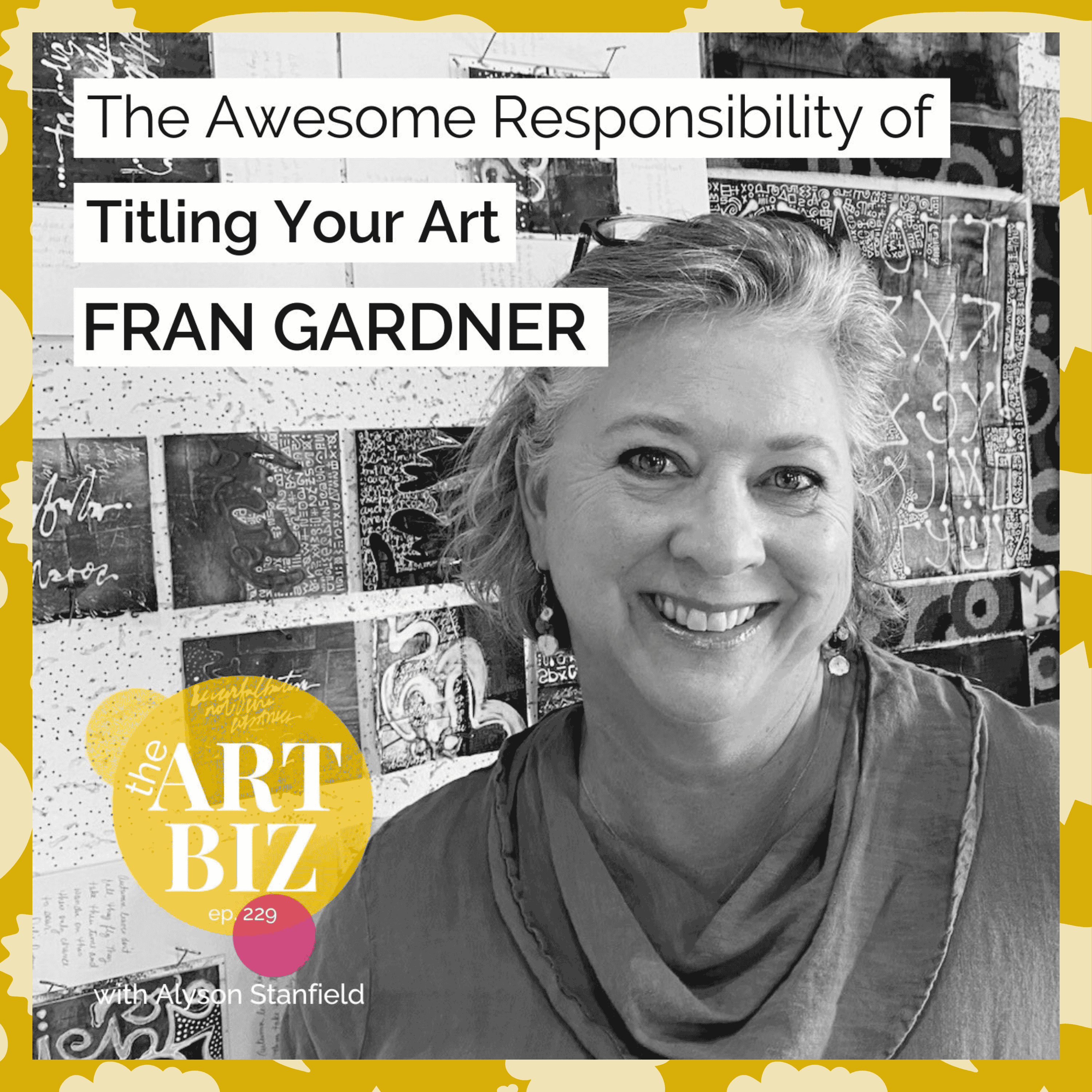
Introducing: The Art Biz with Alison Stanfield
Today's feed drop comes from a podcast that has had a meaningful impact on how I think about building a sustainable art practice: The Art Biz with Alison Stanfield.
If you've ever struggled to title your artwork—or wondered whether titles matter at all—this conversation is for you.
In this episode, Alison Stanfield sits down with artist, writer, and educator Fran Gardner to explore why titling artwork is much more than an administrative task. Together they discuss how titles help artists understand their own work, deepen their connection to the creative process, and communicate more effectively with viewers.
One idea that stayed with me is Fran's belief that a title is the first step toward a work's independence. Long after a piece leaves the studio, its title continues to carry meaning, offering viewers a way into the work when the artist isn't there to explain it.
As someone who loves titles and thinks of them as containers that give shape to ideas, I knew I had to share this conversation with the NoseyAF community.
In this episode:
- Why titling artwork is a creative practice, not an afterthought
- How titles help artists better understand their own work
- The relationship between writing and visual art
- Developing a personal process for naming artwork
- Why artists should resist outsourcing titles to AI or social media
- The role titles play in communication, marketing, and audience connection
- How thoughtful titling can strengthen an artist's professional practice
Notable Quotes
"A title is the first step toward your artwork's independence."
"The writing is your studio work."
"Your artwork is going to have a life beyond you."
About Alyson Stanfield
Alyson Stanfield has spent more than two decades helping artists build sustainable, professional creative careers. Through coaching, classes, writing, and The Art Biz podcast, she helps artists develop the systems, confidence, and visibility needed to thrive.
Links referenced in this episode:
- artbizsuccess.com/essentials
- artbizsuccess.com/spotlight
- frangardnerart.com
- Fran Gardner's Artists Will Find a Way book series affliate link
Chapters:
- 00:08 - Introduction to the Podcast
- 05:27 - The Importance of Titling in Art
- 18:26 - The Process of Creating and Understanding Art
- 28:20 - Understanding Personal Symbols in Art
- 34:51 - The Importance of Titling in Art
- 44:41 - The Interconnection of Creativity and Teaching
Connect with Alyson:
Website: artbizsuccess.com
Podcast: https://artbizsuccess.com/podcasts/
Connect with Fran:
Website: frangardnerart.com
Instagram: @frangardnerart
Hey.
Stephanie GrahamHey.
Stephanie GrahamWelcome. And welcome back to Nosy AF conversations about Art, activism and social change.I am your host and friend, Stephanie Graham, and today I'm bringing you a feed drop from a podcast that I truly think that every artist needs in their ears. That show is the Art Biz with Alison Stanfield.So Alison has spent more than two decades helping artists build sustainable careers without flattening themselves in the process. And what I love so much about Alison is that she treats artists just like whole people, not content machines, not like branding exercises she has.Her conversations are just grounded, practical, and rooted in exactly what it takes to sustain a creative life over time. I have taken so several of Allison's classes. I have read her book many a times and have it on my bookshelf.She is truly, truly, truly a angelic resource towards just building your artistic practice as far as it goes. Like with the organization, with the systems, presenting yourself professionally, I feel like, man, I wish I knew who put me onto Alison.I feel like Keisha Bruce did, who's also another wonderful artist. Artist and friend.But Alison, with this particular episode, it grabbed me because it's all about titles, and I had literally been planning my own episode around titles, because I love titles. I love to title things.I feel like titles are like containers that give a project shape before I even fully understand it and understand, like, what it is. And of course, it can change, but it's just. It becomes a doorway into what the work itself could be.And so, listening to the art Biz, I heard Alison have a conversation with artist and writing consultant Fran Gardner, and I thought, yes, this conversation is exactly. Yes, this is. I have to share this conversation.So Fran talks about titling not as an afterthought or marketing checkbox, but, like, as part of the creative process itself, as a way of understanding what the work is actually trying to say. She calls it the first step towards a work's independence, which I really, really love.And you're able to move through the world carrying meaning even when you're not there to explain it. That is the responsibility of the title, according to Fran. So that really stayed with me, and I think it'll stay with you too.I really want to introduce you to the art biz again. Alison is that girl when it comes to setting us up for success with systems and process in how we navigate our business.So thank you so much, Alison and Fran, for saying yes to allowing me to share this conversation with my audience. Audience. Dear listener, I really, really hope that you get a lot out of this if you love it. Which I am sure you will.Please go ahead and subscribe to the Biz. I will have the link in the show notes and also please check out Alison's classes. Alison doesn't even know that I'm telling you this.This is not any type of ad. This is me saying that I find so much value in the work that Alison does.And I might see you in a class myself because let me tell you, people compliment me on my systems and organization all the time and I'm always like, oh, do you know about Alison? So thanks again Alison. Thanks again, Fran. And let's get into the Art Biz.
Alyson StanfieldWelcome to the Art Biz, where we dive deep into the business of being an artist, sharing inspiring stories and actionable insights from artists and art professionals.I'm your host Alison Stanfield, and my mission on this show, as well as in all of my classes and coaching programs, is to help you elevate your career, amplify your visibility, and connect your art to the people who matter most. One of the ways I do this is through my signature art marketing program, Essentials for artists success.Through August 2025, we are focused on flourishing online.We're going to be buffing up our websites and online profiles, creating intentional content, repurposing it across all platforms, and analyzing what's working so you can do more of it and less of the other stuff. If you're ready to show up more consistently and confidently online, I would love to support you there.Find all the details@artbizsuccess.com essentials. That's artbizsuccess.com essentials and if you have any questions at all, please email me from that site.In this episode, we're exploring a topic I've never covered before on this podcast, titling your artwork. You've probably, at one point or another, agonized over titles. Or maybe you've skipped them altogether, choosing Numbers or Untitled.But what if titling isn't just a formality? What if it's a vital part of the creative process? My guest, Fran Gardner, is here to help us see titling in a whole new light.Fran is an artist, writer, and retired art professor with a deep appreciation for how artists communicate not just with images, but also with words.She believes that giving your work a title is the first step toward its independence as it goes out into the world to speak for you when you're not there to explain it. You'll hear Fran describe her own turning point with titling, how she connects writing to studio practice and why?Naming your work might just help you understand it better. Here's my conversation with Fran Gardner.
Alyson StanfieldHi, Fran.
Alyson StanfieldWelcome to the art biz.
Fran GardnerHi. It's so nice to be here. Thank you for inviting me.
Fran GardnerWe have to thank Kathy Elliott for introducing us. Yes, I wanted to do that. At the top of this show. You recently released a book.It is your second in Artists Will Find a Way series, and the subtitle is Practical Concepts for Deep Connection. On this show and in all my programs, I emphasize writing so much. So you're totally singing my song.When you wrote this book, and it was fun to read and look at different perspectives and so forth, but I wanted to talk to you today about. As I was looking through the book, I was like, there's the chapter we've never talked about before. Titles. I want to talk about titling the works.As you know, because you teach or taught art history. The things you do as an art history student is memorize titles.
Alyson StanfieldLots and lots of titles.
Fran GardnerAnd I remember the 101 classes, and it was like, date, title, name, date, title, name, date, title, memorize, memorize, memorize. What do you think is the psychology around titling art? And you're not a psychologist, so you have to say that up front.
Fran GardnerYes. Thank you for practicing with that. I'm not a psychologist, but I do think about.About titles and how they function not only for the artist, but also, of course, for the viewer.And I. I think most of the time artists think that title is for the viewer, but I like to turn that around and look at it as an advantageous tool for the artist. Our work comes from such a very deep, introspective space, and a lot of times we make that work without even understanding in ourselves.Like when an artist will tell you they get in that zone where time and space go away, and they're just making the art. It's almost like the art came through them instead of from them. And that's a beautiful, lovely space to be in when.And that's a space where we're not really thinking about titles we're thinking we're experiencing. We're having a sensory moment with the work.Titling comes after that when we step back and see what we've made and start to put words to that sensory experience that we just had with the work.So I think that's the psychological end of it, is really looking deeply at the work that we made and putting words to those feelings that were coming up as we were making them, so that it acts as a connector between the Artist, the art piece, the artist and the viewer. Yeah, yeah.
Fran GardnerI love how you phrase that. Artists think titling is for other people and you see it as for the artists.I guess there's some psychology around all of that, but the connection part is key for that. You said that titling is the first step towards your art's independence. Say more about that.
Alyson StanfieldOkay. Your art is going to go on a journey. Hopefully it starts, of course, in your studio, but then, you know what?What art is at its essence is a communication tool. It's a way of putting our voice into the world.So hopefully those pieces will leave your studio at some point and go traveling around the world without you. The title that you put with that piece is helping your art piece deliver your message and meeting meaning out into the world.So the art's going to have an independent life away from you. It's going to need a name, it's going to need an identifier.It's going to help be that connection between your studio and that moment that you made it and being out there in the world, conveying your message along with that image.
Fran GardnerI love that you said something that I say all the time, that art is a form of communication. You didn't use those words exactly, but it is something. Artists think it's self expression. But I.You and I know it's not complete until you have that connection with someone, until you make that connection. And I think that a lot of.I shouldn't put words in their mouths, but I've never heard an artist really talk about their work in this way, about it living independently from them out in the world. That's really beautiful, Fran.
Alyson StanfieldWell, and it's also gonna outlive the artist, right? It's gonna have a life beyond the life of the artist.I mean, you know, that's why we have art history, so that we can connect with those voices, those historical voices in art. And so it still has this continuous life of its own, even beyond the artist's own life. So that makes that pretty important.
Fran GardnerYeah, yeah, for sure. There's such a great story in your book. It's the moment that you realize that numbering your work wasn't enough. Can you tell listeners about that?
Alyson StanfieldI will. It's one of the most pivotal moments of my own understanding around my art.I had made a series of pieces, and I don't remember how many, the book tells how many, but it was somewhere between eighty and a hundred. So it was a lot of small work that was to be hung together as a unified body. Of work. Not necessarily one piece, but a unified body of work.And I thought, you know, I put so much time into making those pieces, really studying my own personal symbol in that series. And I got to the point of exhibiting it. I had a. I had.I was sending them out and boxed them all, numbered them on the back, boxed them all up, and could not seal the box, couldn't put the tape on the box. So I sat down and I thought, what is it? There's something wrong here. I don't understand exactly what's going on.It almost felt like there was another presence in the room keeping me from putting that tape on the box. I thought, okay, what is it missing? There's something missing from this box. And the pieces just screamed at me, we need names.I mean, it really was just so very, very clear that my work was not finished. So I pulled all those pieces out and I laid them on the tables in one of our classrooms at school so that I could see them all together.And I spent the next several days holding each piece and talking to it about what its message was. You know, why did you come to me? What do these symbols mean?I was doing that series about personal symbol development, but yet I was not going to name the symbol. That just doesn't make it.So I took those numbers off of the back and I began to commune with the work, each individual piece, giving it my full time and attention so that I could understand that symbolism that I had built into that piece. And then the titles just came really very easily when I focused my attention on each one as a unique individual.
Fran GardnerWhen you did that, did that create more meaning for you with the work, or did it change how you looked.
Alyson StanfieldAt the work after that? Oh, it absolutely changed. It made me understand my work on a deeper level. I sell my work. Let me just be clear about that. But I make my work to learn.I make my work to learn about me and my place in the world and how the world functions around me. So that learning is my goal. And I was skipping that whole step by numbering them and sticking them in the box.So when I took them out and really began to process the imagery that I had made, it took me to a much deeper understanding of my own art making urges and my own symbol development and my own managing of materials even. So, yeah, I did.It changed so dramatically my thinking around my work that I wanted to share that experience and make that a part of the process that I would advise artists to engage in as they title their work. And then, just as an aside I read Salika Jawad's Isolation Journals substack, and one day she wrote about titling her art.And she used the very same process. She described how she held each piece and she communed with each piece as she was beginning to understand the thing that she had made.So I was like, yes, this really smart, creative person in the world who does this very same kind of practice in her own process. Yeah.
Fran GardnerWell, one of the things that I've been advising artists to do for decades now, literally since the 90s, is to meditate on their work. And I remember that teaching them to do this not for titling, but for their artist statement.And I remember teaching at one time and this artist said, isn't that conceited to look up my work for that long? I just thought that was fascinating that people. I think there's. I mean, that just shows how powerful the work is.If you're like afraid to approach it almost. I just thought it was fascinating. Cause I never would have thought that. But it. This, this kind of fear to go deeper into the work.
Alyson StanfieldYes. Exists. I do understand that that is. Can be part of the issue around going deeper into your work. That. Yeah, I.Sometimes we're sort of afraid of what we made. It is a powerful thing. Yeah. All the more reason to really understand it.
Fran GardnerRight.
Alyson StanfieldYeah. Right.
Fran GardnerWell, so what you're describing isn't slapping titles on. It is a process. And it's not the goal isn't necessarily to come up with a title. It's to understand what the work is saying. You're combining them.But the process is the most important part as I'm seeing it. So let's talk about. Let's go a little bit deeper into what you're. You kind of described that, but so that we can give people a step by step thing.
Alyson StanfieldLet's talk about that first is make the work. Make the work without thinking about anything except making the work. Make the work.Trying as best you can to find that same flow state that we all love to be in when we're in our studios and save the analytical process for later. The making of the art and the analyzing of the art are two separate processes. They should not be combined.Because when you try to analyze while you're creating, that becomes a critic on your shoulder saying, why are you doing it this way? Why'd you choose that color? You know? And then that eventually turns into who do you think you are? You call yourself an artist.You know, when things start to not go so great or get a little bit messy, that Those two processes should be separate. The making, total immersion, and then stepping back and waiting a little while before you go back into the art to title it.It needs that resting period between the making, and you need that resting period between the making of it and the analysis of it.So then, after you've made the body of work, give it a little rest, go do some other things, even maybe give it a day or two, and then go back to the work and turn on your analysis brain. Invite the critic to come in with you to discuss your work. That's the internal critic. The internal critic has a place.We often misuse that place for the critic. That critic needs to come in. It's our voice, our developed voice around understanding what we've made.So invite that internal critic to come in and look at the work with you.And then one by one, piece by piece, really engage in not only looking, but sensing the piece, feeling what does it feel like on a sensory level, and start recording that information, even if it's just a stream of consciousness kind of writing. That's perfect because keywords will pop up.Once you've done that stream of consciousness, go back and look at what you wrote, maybe with a red marker or a highlighter or something, and highlight the words that jump out as very meaningful in that process of really immersing yourself in dialogue with your own art. Then when you've got a series of highlights, look at them, see what you wrote.Is there a word there that is descriptive or close to that really core feeling of what you feel that piece is about?And if it's a word that's close, go to this wonderful tool called the thesaurus, that word in, and see if you can get closer by looking at the synonyms. That's the process I use.Sometimes I'll kind of phrase like, I remember one piece in particular from the story about that we just talked about where the image was suggesting something about energy or. But more specifically about how energy goes.Or how electricity goes through power lines in a grid, you know, that was very specific to that kind of feeling, like, where is that coming from? And so I started looking at researching how power grids are set up.And in that language came whatever I landed on for that piece as I was reading the more scientific explanation of how those things work. So this is a process.I like research, so I like coming up with a sensory feeling about the piece and seeing what the research might tell me if I Google that. And when you land on it, I mean, it's kind of like when, you know you know, when you land on it, you're going to know.Now, the thing that I would caution people not to do is, and I really, I really don't think this is a good idea, don't put the work on Instagram and ask people what they would title it, not their image. They're going to come up with wildly appropriate things and maybe even wildly inappropriate things.But none of those are about your experience with the art. And the title should be about your experience with it as a message or a bridge to showing that work to other people. It's your job to do.Don't give away your power.
Fran GardnerWell, same for using AI. You could do that in AI Also, you could upload the image and ask for a title. But it totally defeats the purpose of going through the process.
Alyson StanfieldYeah, yeah, because I think it's a process of self discovery. It's used. Go on that pathway yourself. You're learning something.If somebody tells you, then that might be great information, but it's less likely that you learned it.
Fran GardnerRight, right, right. Fran and I are on the same page. I understand that writing and talking about your art isn't quite so easy.You might struggle to explain who you are, what you do or why you do it. Not because you don't care, but because you haven't had the right questions to guide you. And that's exactly why I created From Studio to Spotlight.It's a free with opt in guide packed with 28 prompts to help you reflect on your journey, uncover your stories and speak or write about your art with more clarity and confidence. These are the stories you'll need for your bio, grant applications, interviews, press releases and artist talks.Get your free copy of From Studio to spotlight@artbizsuccess.com spotlight that's artbizsuccess.com spotlight. Now back to my conversation with Fran Gardner. The process that you're describing takes time. You make the work, you have to sit with it.Presumably you had enough time to wait before you had to ship the works. A lot of artists finish it up really quickly, slap something together and ship it or deliver it. It's part of the completion of the work.It's not like the work is done when you say it's done. It's done when you've done the titling, the signing, the recording in your inventory, all that stuff.
Alyson StanfieldYeah. That's a part of the process of being a professional artist. Yeah.So, you know, not to put too fine a point on it, but be a professional and don't skip your Work while it's wet.
Fran GardnerOh, my God. When I used to work at the University Art museum, we would have student shows and the whole gallery smelled like oil paint.
Alyson StanfieldYeah.The point of that is to build in the time that it takes for you to have this important experience with your work, knowing that what you discover in this process of finding just the right title for your piece, the process of that discovery is going to lead you to deeper work as you go further. Right, right.
Fran GardnerWell. And if you're shipping it off, it gives you. You and I both know the process gives you the.You will find all that language while you're going through that process that you need for marketing and promotion for the work.I also want to mention, because you've talked about writing things down, I also encourage artists that are adverse to that to use their voice recorder, which you can get transcribed. And I mean, everyone works so differently.You can get it transcribed and play around with it, but sometimes people just prefer to have a conversation than to write. And I think you can come out with the same thing at the end for that person.
Alyson StanfieldYes, I think voice recorder is a great idea. I mean, I write stuff down on my studio wall.I might, you know, just wherever I am, when I've come to some realization, that's where those notes land, Whether it's on my. Or in the studio or out in the world.
Fran GardnerAs Mark Victor Hansen says, as soon as you think it, ink it.
Alyson StanfieldYeah.
Fran GardnerDon't wait for it or it will disappear. So you mentioned that there were like 80 to 100 works in this, and it was a series. They were all connected. Did you.How did titling it change the work as a series? Did you change the title of the series? Did. What was illuminated about the series itself?
Alyson StanfieldI knew that the title. I knew the title of the series, or I knew.Maybe I didn't know the title of the series, but I knew what I was doing with that series as I was making those pieces. I mean, you get 40 pieces into something and you're going to know your direction. So I knew that I was exploring personal symbolism.And I had not too long before that, then to Chaco Canyon. I was an artist in residence there, and I would. While I was there, I was studying the petroglyphs there in the canyon. And really just.There's such a mystery around the petroglyphs. But I think they're practical, Right?They were practical images put on these walls in the very same way that we put practical imagery on walls in our culture. So I was. I was immersed in that idea of the petroglyph image and my own personal kind of symbolism.So I knew a few pieces in that I was working on what I call personal petroglyphs. And I liked the petroglyph association because of the surface texture. You know, my work has.Is very involved with surface and the petroglyphs have that surface quality that I wanted to make the association. I knew the title of the series. That didn't change when I pulled all those pieces out and realized they needed titles.But really understanding the titles of those pieces helped me understand my personal symbolism. Symbols that I'd been developing for years were in those pieces and I had never really taken the time to analyze why those things kept coming back.That's what it did for me. And that changed everything about what happened after that with work that came in the next.Well, from the end of that series until now even, how did it change?I began to understand my symbols better and how they read and what they said, aside from what I said about them right when they're out in the world, how other people were reading what I considered a personal symbol. So I began to understand that a lot better. And that communication, that two way communication between me and the audience is important.But what's more important is the two way communication between the art and the audience because it's going to be in front of a lot more people than I am. That message that the piece carries is more important even than me giving a gallery talk about it.The image itself, plus the little bit of words, the name, that becomes a sort of open door to help make that piece more relatable for the viewer.
Fran GardnerWhat do you think of people? What do you say to artists who don't want to box their work in? In other words, they think a title makes it too specific.I know landscape artists who have lost sales because they tell a client where the landscape was and. And then I know others that have made sales because the location was in the title and SEO found them. So.And you and I both know artists don't like to be boxed in. There's a reason artists are artists for the creative freedom and the professional freedom that it provides. But advice for those artists.
Alyson StanfieldI think it is the artist's job to determine the amount of specific information that they give, either in their own, in their imagery or in the words that they say about their art and their art practice. Each artist has to determine that level of specific information that they want to give.What I would say to the person that lost the sale because the title included Location is. Maybe that was not important, right? Maybe that. Maybe the place was not important.What was the feeling, the sensory information that came through that piece, which has nothing to do with specifically where it was on a map, but what was the feeling behind that space?And I think I would say that to anybody who's struggling with titles is to go towards the sensory information that it imparts rather than the literal. Now, my students at college loved it when we would look at a piece like Monk's the Scream.And it is up the Scream, you know, because they could easily remember that. But if that's too literal a description for someone, then maybe you look at the sensory information behind that.That piece could have easily been titled Anxiety.
Fran GardnerYou have in your book the.
Alyson StanfieldYou.
Fran GardnerYou quote Kat Tesla in an Instagram post that she created.And I'll link to that in the show Notes about the business reasons to title your work, most of which are around elevating the perceived value of it in the marketplace, specifically museums and galleries and so forth. But I want to. I just want to put this plug in that for my.This is from working with artists for so long that another really good reason to title your work is so you can tell it apart for yourself and your records.Because you do not remember the difference between number one and number eight usually, but you do remember the difference between Scream and Anxiety, probably.
Alyson StanfieldYes. Yes, absolutely. You know, things just come and fall in your lap when. When you ask the world to hand you things.So I was working on that Titling chapter when I was scrolling through Instagram one day, and Kat Tesla's post came up about titles. And I'm like, wait, wait, wait. I stopped right there.I made sure I bookmarked what she had to say, and I brought it into my chapter and thought, you know, well, how can this fit? Because she's really given us some great information that is related but different to the kind of information that I'm putting in my chapter.So I felt like it was really important because we do have two sides to that.The side that I come from on Titling is that sensory imparting, that sensory information that is so much about the personal experience with the piece.And what she was doing was pointing out the reasons to have a really good title on your piece for the audience, for the promotions, or the business end of things. And so those just dovetailed beautifully together. So I reached out to her.I don't know her personally, but we've been in the same kind of art circles for a while.And I sent a message and said, I introduced myself, told her what I was doing and I said, I really want to integrate your business reasons for having good titles into my book. It just fits perfectly. And she was immediately agreeable to that.So thank you for bringing that up and also thank you for including a link to her information as well. And artists need to understand both sides. Right.They need to understand the side of the immersive studio experience that I think is the reason we're artists anyway to have that really wonderful immersive alone communion with those materials and the art making experience. But it is a communication device. It is, it does have. The art does have a responsibility to take your voice outside of your studio and.And go to other places. So if we can give.If we can use words to make our message and meaning clearer when the work is out there in the world and you're not standing beside it describing it to people, then I think we're a little bit ahead of the game in that relatability piece. Really connecting a person to the art.
Fran GardnerYeah, well, it helps to take that one step further. It helps. I always say people, most people don't have a visual education. It's not their fault.They just didn't have to take how to look at art or art appreciation or anything like that. They didn't have to. And so it's not their fault. And it helps you. Anything that we can do.I always tell artists one of their jobs is to educate people about the work. Not in the didactic way, but in a guiding way, in a gentle guiding way that invites people in.You have said the title is a small bit of essential information that opens.
Alyson StanfieldThe door for the viewer.
Fran GardnerThat's just spot on. It can absolutely do that. I worked in art museums for 10 years and you start recognizing and habits of people that enter the museum.And most people look at the label before they look at the art.
Alyson StanfieldAbsolutely.
Fran GardnerYou just go into any museum and you. You watch people and most people will do that. You kind of know which people don't do that.But if the label can guide people over to the art, if it says untitled, they don't know how to enter it necessarily if they didn't have that visual education. So yeah, I really like that you in that chapter of your book wove the intrinsic reasons and the extrinsic reasons. Is that right that the like.There's all kinds of reasons that titling your work is to your benefit. Why do you think so many artists struggle titling their work? Do you have any thoughts about that?
Alyson StanfieldI do just like you just said about the public who might encounter a piece of art in a museum, like many, if not most of those people don't have that art history class behind them or that training. They're in there for that experience. And relating to that set of people is important because those are our people, right?If they have gone into a museum, they're our people. They're looking for us. They're looking to appreciate the work that they're seeing in there. Those are the people that we want to relate to.But just that as an analogy, take that back to the studio.The artist in the studio, they are there to make, to get immersed in the materials and then the process and then their particular kind of imagery and the communication that they are looking to impart through their work. They may not have been trained much in writing. I would say many, if not most artists have not had that writing training. They. They take.They may have taken classes and. And many have taken classes in the making of the art. Right? Technique workshops, college degrees, you know, MFAs, all that stuff that.Where you make a lot of the art. But until you really get to the MFA level, you're not doing a whole lot of analysis. And a lot of artists don't go to that level, though.They are still making really important and meaningful work. So they don't necessarily have the training in the writing.So we tend to avoid the things that we don't like to do or we don't have as much experience in. Right. So I think that's it. I think the. I've worked with a lot of artists. One of the things I like to do is solve puzzles.So if they say, I just don't want to write, I'm not going to write. Well, that's the minute that I'm going to say, okay, let's break that down.We're going to break that down to see what your resistance is around that writing piece. Because as a professional artist, you have a responsibility to do some degree of writing.It's necessary to be a business professional in this art world to have words around why you make your art, the process that you use to make it, the words that you put on the art to make sure its message is clear. You're going to have to do that. So let's break down the barriers to why you don't want to do this writing.And when I've worked with artists this way, it's usually all about. It's just, I'd rather paint, right? I'd rather.I'd rather be doing the work of hands rather than the work of the brain, the mind, and the writing piece of it or the work of words.So in my book, I think you'll probably notice that I take each issue around writing and turn it into, how do we look at it as a part of the studio work? The writing is your studio work. It's not the thing that comes after or the thing that you're responding to somebody else's need.It is your own responsibility in your studio to get this work not only made, but prepared to take its journey away from you. And words are necessary for that journey.
Fran GardnerThat's really beautiful. I wish we could end there because it was such a beautiful ending.But it is a responsibility that you have to the work and to the life that it's going to live long after.
Alyson StanfieldYou love that the. That really encapsulate that because it is the responsibility you have to your work. Right, right. And I think artists are much more.They become much more favorable around writing when it becomes a service to the work than a demand from some outside source. Like somebody says, I need your statement. Oh, now I have to write the statement for that person.Statements should be written for you, for you and your understand each other better.
Fran GardnerAbsolutely. People are not asking you that to torture you.
Alyson StanfieldRight.
Fran GardnerThey really are not. It may seem like that. Okay, we need to wrap this up, but so I want to talk about you.You've been a professor and you are an artist writer, a retreat leader. How do these roles feed one another?
Alyson StanfieldEverything I do falls under the umbrella of creativity. A long time ago, I started understanding about myself that all of these roles that I play in the world, I need them to all link together. I need my.The way that I earn my money to also be a creative activity. I need it to be related to my art making. So I began to really understand this about my work life quite a long time ago.But this very year, it got a little bit clearer when I made a New Year's resolution to not only work in creative fields, but try to look at everything as a creative activity. Can I live a creative life in every way?From washing the dishes to preparing food, to living in, working in my studio to writing books and working with artists. Can I look at all of that under the one umbrella of creativity? So everything I do relates to each other, Every part, every aspect.My life, seeing through the creative lens feeds the work of working with artists, and that is working with artists directly, whether it's in a retreat or a workshop form, online, whether it's, you know, in this magical way that we're doing it today or whether it is through writing books. Yeah, they're all interconnected and they all feed each other.
Fran GardnerWell, I wish we had time for you to tell us how you load the dishwasher creatively.
Alyson StanfieldThe key to it to, to be really. To be really quick about it is you have very pretty dishes that you want to hold and enjoy. Got it?
Fran GardnerYes. And. And I. Do I need to use those more. Okay. What led you on this path to working with artists with the writing specifically?
Alyson StanfieldI learned as a college professor how important it is to put clear and concise wording together. I started, of course, with my students giving them assignments in writing so they understood what was expected of them.When you're working with 18 year old college students and they're taking art for a credit and maybe are not as skilled with techniques, they really need some instruction, some step by step instruction. So I started with writing assignments really clearly and concisely. They don't want three pages. I don't want them to have three pages.I want them to have clear, concise wording around whatever the assignment was for them. So it became clear to me how important words were way back when I was a young college professor.Then as I began to work with artists outside of the college setting, I noticed there was this really strong resistance to it.Every time I would be in any sort of situation where we would talk about artist statements, there would be this huge shrug, like, you know, a blanket was thrown over the conversation when you start talking about it, because everybody's first word was. And I thought, you know, that this is an essential bit of information. Titles are an essential bit of information.Your biography is an essential bit of information.Why aren't we as artists embracing that and treating it as a creative activity rather than looking at it as some kind of dull, disconnected writing experience that's being done for somebody.
Fran GardnerAssignment assignments.
Alyson StanfieldYeah. Yeah.So I've been working with artists to try to switch the way we look at those bits of writing so that it becomes important to their studio practice rather than something that somebody else has asked us to do. Yeah, Turn it around. Turn around. They get internally motivated rather than an external request from somebody. And we get plenty of errors. Yeah.
Fran GardnerSo it sounds like you started your job, your. This second job in the same way that I did, which is kind of noticing what artists were struggling with and saying, I can help.
Alyson StanfieldYeah, I know a little something about this. Yeah, I know, I know something about this. I can help you with this part.So that's the approach that I've taken is, you know, I know a little something about this through having a lifetime of work as a creative person and with students. Let me see if I can hold up the lantern for you so it will illuminate your own path.
Fran GardnerIt's so interesting because we do similar things with artists and writing and words, but you come at it from that angle. And I came at it from working with visitors in the museum and learning how they engage with artwork and words in the museum.So it's just really interesting how they compliment one another.
Alyson StanfieldAll of these voices, right? I want all of our voices.
Fran GardnerYes.
Alyson StanfieldOne of the things that I think is most important about any kind of voice education is that you have multiple teachers, right. You have many teachers who begin to help you feed and or create the lens through which you look at the world. So all the voices, right?All the teachers have a space.
Fran GardnerYes, absolutely. And we herb what we want from each teacher. If we're wise.
Alyson StanfieldIf we're wise.
Fran GardnerAll right, last question. Where can listeners learn more about your work and your book, the work that you do with artists?
Alyson StanfieldMy website is frangardnerart.com my book is on all the platforms, Amazon and Barnes and Noble. It's also. Both books are in. The first book is in e book form and by the time this broadcast, the second book will be too.So that's the best place to find the books.
Fran GardnerBut they're linked on your website, right?
Alyson StanfieldMe, yes. There are links on the website. Yeah. There. If you can.If you want to see what's sort of happening in my world around the books and the retreats, the workshops, then my Instagram, Fran Gardner is a good place to kind of see the. The more day to day type of work that I do. And then of course, any of those places are a place where you can connect with me through email.I also want to shout out to my publisher, Synergy Publishing Group, who have been just instrumental in helping me get my word out and my. My message.
Fran GardnerWonderful. We'll include all those in the show. Notes. Fran, thank you so much. This is just such a great conversation to have today.
Alyson StanfieldWell, it is absolutely my pleasure. Thank you for inviting me and thanks to our mutual friend Kathy Elliott for putting us together.This has just been great fun and you have such a wide following on your podcast that it's thrilling to be a part of it and to know that my book title is going to get out there in front of people through this platform. So I thank you if this conversation.
Fran GardnerMade you rethink how you title your artwork or inspired you to spend more time with your finished pieces. I invite you to choose one recent work, just one, and give it the time and attention it deserves.Sit with it, reflect on the process behind it, write or speak your thoughts and then give it a name that honors the story it carries into the world. Then share that title with me either on Instagram where I'm allistonstanfield or by going to the show notes on the post on my site.That's@ArtBizPodcast.com and searching for episode 229 where you'll find all of the links for Fran and are able to leave a comment for me. Tell me that title.To connect with Fran directly, grab her books and find out more about what she does, visit frangardnerart.com A quick note I would love to grow our audience and if you you enjoy the art biz you can play a big part by leaving a rating and comment on Apple podcasts, Spotify or wherever you listen. It really helps and I'm be so grateful for you to do that. I know you have a busy artist life and I appreciate your making time for me and Fran.

