
 Apple Podcasts
 Spotify
 RSS Feed
 Castro
 Amazon Music
 PocketCasts
 Mutual Aid Isn't Charity with Eric Von Haynes (noseyAF Classic)
Thank you for listening to noseyAF! So happy to have your ears!
Join the noseyAF Dispatch 📬 At the end of the month, your inbox gets a little happier — all the month's noseyAF episodes sent straight to you. → Subscribe to the noseyAF Dispatch
Ep #112: Mutual Aid Isn't Charity with Eric Von Haynes (noseyAF Classic)
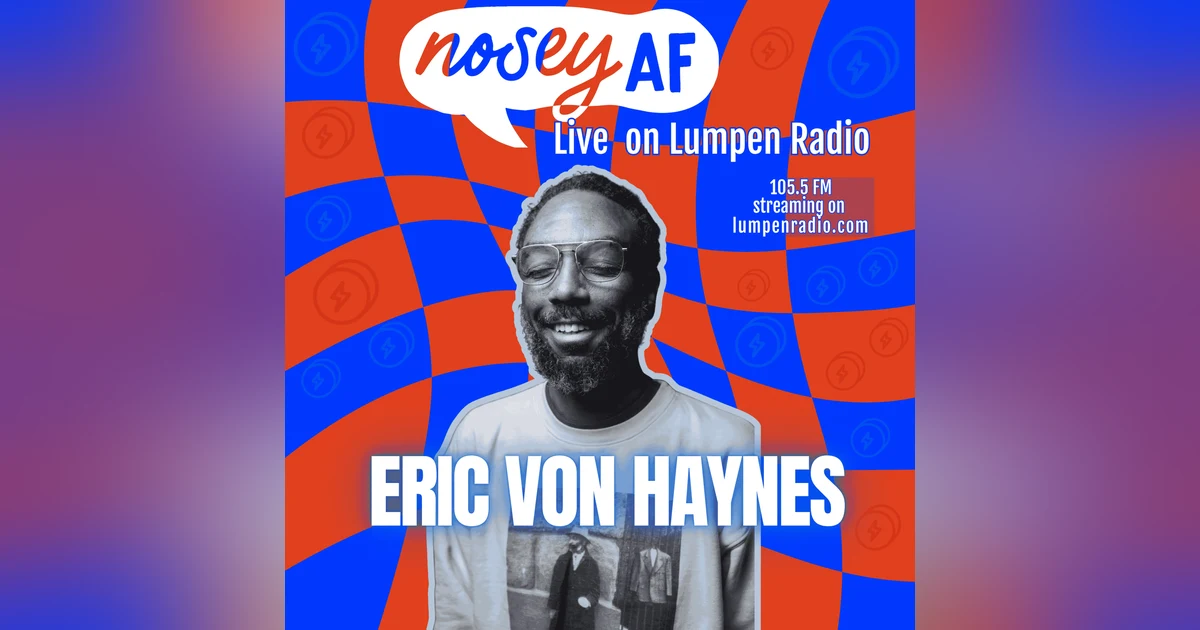
This is a noseyAF classic — a conversation originally recorded in 2024 with Eric Von Haynes that was edited and reshaped to air live on Lumpen Radio (WLPN Chicago 105.5 FM). Eric is a printmaker, designer, publisher, and co-founder of Love Fridge Chicago, and he brings real clarity to what mutual aid actually means — and what it doesn't. We dig into how it differs from charity, why reciprocity is the whole point, and how his community fridge network Love Fridge Chicago puts those values into practice across the city. Plus we get into his art, why print is a political act, and why he believes the strongest groups — not individuals — survive.
What We Talk About
- What mutual aid actually is and what it's NOT (hint: posting a Venmo link is probably just fundraising)
- Reciprocity as the heart of real community care, and why transparency matters
- How Love Fridge Chicago works, what it takes to maintain a fridge site, and why community buy-in is everything
- The difference between mutual aid and charity — and why Love Fridge isn't a nonprofit
- Horizontality, anarchist philosophy, and why Eric believes no one should be a billionaire
- Photographing people receiving food and why that's straight-up othering
- Printmaking as a democratic and political act — especially as a Black man in America
- Flatlands Press and why getting ideas into physical multiples matters
- That time a yoga studio started leaving flyers at a fridge site 🙄
Things We Mentioned
- Love Fridge Chicago
- Flatlands Press
- Mutual Aid by Dean Spade (affiliate link)
- Artist Admin Hour (Stephanie's sponsor shoutout)
- Tiger Strikes Asteroid Chicago (where Eric had a exhibition)
- The Joan Flasch Artist Book Collection
Chapters:
- 00:00 - Introduction to Eric Von Haynes and Love Fridge
- 02:21 - The Power of Mutual Aid
- 20:29 - Exploring Mutual Aid and Community Support
- 29:58 - The Importance of Community Engagement in Resource Distribution
- 38:26 - Exploring the Differences Between Mutual Aid and Charity
- 49:50 - Creating Diverse Spaces for Black Voices
All about... Eric Von Haynes
You're gonna love Eric he's a printmaker, designer, publisher, community builder, and co-founder of Love Fridge Chicago. He's also the president of the Chicago Printers Guild and the founder of Flatlands Press, where he creates and publishes artist books and printed matter for artists he believes should exist in the world. His work is rooted in anarchist philosophy, horizontality, and a deep belief that the strongest groups survive not the strongest individuals.
Sponsor Shoutout
💖 This episode is brought to you by Artist Admin Hour.
It's a weekly Zoom session (Wednesdays, 7–9 pm Central) for artists to tackle the admin stuff they've been putting off — grant apps, residency applications, budgets, invoices — with body doubling, structure, and real community. Plans start at $65–$95/month, but if that's not doable, email Stephanie because getting this done matters. Check them out here: artistadminhour.com
Connect with Eric Von Haynes
- Website: flatlandspress.com
- Love Fridge Chicago: thelovefridge.com
- Eric’s Instagram: @manny_suena
More ways to connect:
- Email: stephanie@missgraham.com
- Subscribe to the noseyAF Dispatch
- Check out my work
- Follow me on Instagram @stephaniegraham
- Listen to more episodes
Support & Feedback
noseyAF is listener-supported — thank you for being here. 💛
⭐ Rate & Review the Show — it gives the show street cred and helps new listeners find the show
📣 Share noseyAF with a friend who needs to hear this
Episode Credits
Produced, Hosted, and Edited by Me, Stephanie Graham (teaching myself audio editing!)
Lyrics: Queen Lex
Instrumental: Freddie Bam Fam
Cover Art: Emma McGoldrick
00:00 - Untitled
00:00 - Introduction to Eric Von Haynes and Love Fridge
02:21 - The Power of Mutual Aid
20:29 - Exploring Mutual Aid and Community Support
29:58 - The Importance of Community Engagement in Resource Distribution
38:26 - Exploring the Differences Between Mutual Aid and Charity
49:50 - Creating Diverse Spaces for Black Voices
Hey, friends, the conversation you're about to listen to is with Eric Von Haynes.It is a noseyAF classic as it is a conversation that we had last year, but it has a lot of really valuable information about mutual aid and about one of Eric's organizations that he works with called Love Fridge. So I hope you enjoy and thanks so much for listening to Nosy af. Gotta get up, get up to the whole world.You a winner, winner, vision of a star with a mission in the cause. What you doing, how you doing, what you doing and who you are.Flex yourself and press yourself Check yourself, don't work yourself if you know me then you know that I be knowing what's up. Hey, Stephanie Graham is nosy as WLPNLP Chicago 105.5 FM Lumpin radio. Hello, everybody. It is 2pm welcome Chicago to noseyAF on Lumpin.I hope you are out and about, getting your chores done, relaxing, hanging out, whatever you're, whatever you need to do. I hope you're doing it and I hope you're happy doing it. Because you know what? The world is insane right now.And for me, I've been trying to do like gratitude list and I'm not good at it. Do you guys do gratitude lists? All I know is that, well, I guess I was going to do it. Gratitude list. Right now I'm grateful to be here with you.And that could sound sappy, but it's the truth. You know, being here at Lumpin, you know, in Bridgeport, Lumpin Radio has celebrated its 10th anniversary, 10 years old.We had a party in March and if you weren't there, it was a time. And I just want to know, what were you like at 10 years old?I mean, let me tell you, I was like, I feel like it was either fourth or fifth grade for me, but either way, I was in the stock market club and I came in third place. It was like, okay, third or fourth place. But I was high up there. I was killing it. I was like into Johnson and Johnson.I think my stock market thing was. And I don't know, it was just. It's just something I'm thinking about. But whatever the real dream, the real gratitude is here with you.Happy 10th anniversary again to everybody here at Lumpin. And speaking of being involved, I want to share a conversation I have had with Eric Von Hayes.Eric is a printmaker, a designer, a publisher, the founder of Flatlands Press, and he is also the co founder of Love Fridge Chicago. So maybe you've seen these community fridges around your neighborhood or Just around while you're out and about.And Love Fridge is a mutual aid network of freely accessible fridges and pantries placed throughout the city, making sure that anyone who needs food can find it. No questions asked, no barriers, no like shoes, no shirts, no serves. Have you seen those signs? That doesn't apply here.It's just community taking care of community. So I really admire Eric and everyone over there just of their selfishness, selflessness, and his community mindedness.And on top of all of that, Eric is an incredible artist.So his work spans like experimental printmaking, artist books, collaborative publishing, and his pieces have been collected by institutions and even a part of the Joan Flash artist book collection. So a real treat. So I'm so happy that you get to meet Eric or be reintroduced to Eric. And Eric, thank you so much for being on noseyAF at Lumpin.
Eric Von HaynesThanks for having me.
Stephanie GrahamYes. So I think the one thing question I've been dying to ask you is like, generosity is like a big part of your practice, I believe.And I'm wondering what's the difference between begging and mutual aid?I ask, I ask because I see on social media, people, the trend, the trend people ask for stuff and then they'll be like, hey, I need to send my daughter to camp and I need $600 to do it. And then people be like, dang, didn't you just ask for like money like last time? Like, do the kids need to go to can?You know, like it was the whole thing. And then I remember seeing specifically somebody be like, they don't understand mutual aid. I'm like, well, now I don't understand it.
Eric Von HaynesWell, first off, as the mutual aid principles I practice start with reciprocity. So if you're asking for something, the idea that there's a. It's the term mutual is there for a reason, right?Like mutual meaning there's some give and take. So between you and me, I'm not a big fan of this social media.It's really the kids, it's really the youth that have adopted the idea of mutual aid in the, in the digital, for, in the digital realm around asking for funds for different things.And I don't, I'm not, I don't think there's anything wrong with asking for help, but there's a lack of reciprocity and there's a lack of connection and full disclosure, I, I feel like it's charity. What they're actually practicing at best would be charity or just fundraising. But mutual aid sounds so much better, right?When you're Asking someone to give you funds than fundraising. Right. But mutual aid is really about reciprocity. So where I come from, my family background, mutual aid is just natural. It's a human thing.We just live in a capitalist dog eat dog, step on the next person's back neck to get something world right now. So people have lost, I think sometimes have lost the plot. But none of us would be here without the support and help of others like none of us.
Stephanie GrahamYeah.
Eric Von HaynesAnd that's what mutual aid is. That's what mutual aid is. It's the, it's the practice of helping and offering resources when you can to those that need. But it's also open.It's supposed to also be a space of reciprocity. So folks should also be offering something in return. And that doesn't mean it has to be of equal value.I'm not talking about an capitalist abstract labor. But like if I were to ask you for some funds for my daughter, I might be like, I can't.I need some help with my daughter doing A, B or C. But I make cookies. But I do this, but I do that. That's. It's not like ain't nobody out here.The folks that are going to, the folks that are giving you the funds need they funds, right? So they could use that money too. Otherwise you just go, go get a grant, go go to some, some government space.When you're talking about community folk, you should be aware that those folks are taken from their own resources to help you. And rightfully so. You should be wanting to do what? Balance those scales in any way possible. Right. Like even a thank you letter.I mean it doesn't have to be. I'm not trying to say you're balancing the scales with I'm going to come cut your grass because he gave me $50.Yeah, but I've always had a problem with the online like face with some kind of Venmo thing. Hey, I need this. Here's my little story. Now give me some money. And that's just because I'm old school and I'm like, I don't know.If I don't know you, how am I, I don't know you? How do I know that any of this is like a reality? Number one? Number two, where's the reciprocity come in at? And to each their own.If you got the funds, you can help folks do that. But if you're actually coming out of pocket because you think some it's urgent, it's urgent for somebody maybe think about that.Think about what you're doing and how you're doing it. Right. So, you know, I, I, I just believe in mutual aid being, being in some capacity, being there, being some connection there.So just asking someone, just asking me for money is not mutual aid. It's just fundraising, in my opinion. But yes.
Stephanie GrahamSo yeah, that's really helpful to not get it twisted because it really was, I was really getting confused.
Eric Von HaynesYeah, it's just buzz, It's a buzz. It's on, but it's on, it's on trend now.Like, there's, there was a book created by Dean Spade that was released during, like, during the pandemic that helped spawn, decide like the, like some kind of dogmatic or philosophy around mutual aid. I've read it several times.I've taught, I've like offered it as instruction manuals to students when I work with students on community centered design. I wouldn't say I disagree with Dean Spade's perspective, but they didn't invent it. And it's not in my mutual aid.Principles come from my background, where I grew up, the way I grew up. If you had extra vegetables from the yard, we offered them to our neighbors.If you knew somebody might need them, vegetables, for sure we offered to them first. Right. But then. Or for another example, taking out scarcity. Right. Because it's not always about scarcity.That's something too that I think is like a misgiving. We grow tons of pollinators in my garden. My partner Risa will like overgrow, like overseed.And so this season we offered fully grown plants and trees to folks that just came and got em. If they just came and got em. Right. That's, that's a form of mutual aid. Right. Like there's a rest, like, and it's not when I.And the reciprocity is not just, hey, I got some tomatoes, or I got this, hey, you want some of that? But also we're also offering more pollinators to the environment, which, in what? It helps all of us. You see what I'm saying?So that's a, that's another way of thinking about how something, the reciprocity angle, it doesn't have to be one to one. Um, I mean, I don't know, we might talk about this later, but the love fridge work. I do.I'm not looking for someone to, to meet me or to balance the scales with me as an individual. It's, I'm hoping that they pay it forward is the concept. Right. Like, I have the time, I have the energy, I can do this.So therefore, I hope that this helps someone else pay it forward.Hope this helps someone else not only have a full belly, but understand that someone cares about them without having to know them, without them having to tell their whole story.And I don't want to go on a diatribe, but that's what I really dislike about the mutual aid digital realm is because it plays off of victimization and the idea that you have to tell someone all this bad stuff to get some money. Like, you can be just. You can just need some money. Why? Like, you. We all need money. If you ain't got no money, you need some money. Why is it.It's like this litmus test. Well, I need some money because my foot broke. You needed money before that. That's why you need money now. But now you talk about you need money.So it's like this. It's this twisted game of almost stay away from some trigger words, but it just feels like the monetization of victim. Victimization, in a way.
Stephanie GrahamYeah.
Eric Von HaynesAnd I. About. I don't. I don't really. I think it's sad that anyone feel like they have to go online and tell their life story to get a couple of dollars.
Stephanie GrahamIt. It gives me, and. I don't know, like, it just. It gives me, like, secondhand embarrassment. But I will help if I can.But I feel like I've seen folks do it, like, over and over again, and then they always are doing it in the sense of, like, in the game of mutual aid.And I remember specifically, I was at a photographer's event, and there was a person there who was talking about how they needed money for a specific lens and how they were. They were gonna.Well, yeah, they were gonna put something out, you know, to try to like, if, like, mutually, like, hey, if I have this lens, I'll be able to do this.And my friend Danielle was with me, and she's a pretty successful wedding photographer, and she's like, oh, I can show you with your lens, like, how you can do portraits, you know, like, if you want, like, I'll be happy to. Like, you don't have to do that. And you could do it right away. And, like, you know, she had, like, this cool little, like, prism out, and.And the person's like, okay, yeah. But then they still, like, posted. They still, like, went and posted about their need with their story and the need for this lens.And I was just like, now this is, like a huge wedding photographer that's down to help you and educate you.
Eric Von HaynesThat's mutual Aid. And that is mutual aid. Skill sharing that is part of mutual aid is. It's not. It's not just resources. That's what I'm saying. It's a pr.Mutual aid is just a principle of practice. It's just a practice of reciprocity and take and like being. Being accountable for the fact that you're not alone in the universe. It's not comp.So, yeah, you can ask for a camera lens, but that's fundraising to me. So I just think that's a. To me, that's a. It's just. It sounds better to say nowadays this is. This term is popular.I'm in the, you know, in the spirit of mutual aid, give me some money. Like, I mean, we could all. We all. I mean, we could all do that. But it's. It. It, to me, it. It obfuscates what mutual aid is really about.And the books are open. Like, anyone that's listening to this show, you could find Dean Spade's book on mutual aid.You can find mutual aid practitioner, like, information online. It's pretty easy to find. And when you read this stuff, I think most people be like, it's common sense. It's really common sense. It really.It really is. So I think all of that is just like word salad. It's just like, this is. This is.It sounds better than saying, I'm fundraising so I can have better equipment so I can make more money. Right? So which. Which sounds good to me.
Stephanie GrahamThat sounds good to me.
Eric Von HaynesBecause you don't value. Because you're not adding. You're not. Yeah, it's just like value statements, right?It's like, if I ask for this in this particular way, it's value different than this. And I just think it has to do with being like.Because in this Western society we live in, there's this like, have and have nots, and then there's this like, winner and loser thing.So I feel like a lot of people are disingenuous with how much they actually want to be part of community, because that's what mutual aid is too, right?Like, they should be asking their community or the community that they're part of, and they should also be offering something like, there should be some alignment there and then that, and then those requests are more easily fulfilled on both ends. Right? So, like, if you're just random. Which is why I don't like the digital realm, asking for funds just randomly online.I don't want to get too dark, but I just. I believe there's a grift there. Honestly, I believe there's a grift there as well.Because there's like certain things like people do, and I usually like the ones I usually see. They're almost predominantly women or femme seeking folk, which goes into our misandry aspects of our culture. Right.Men, get, get, get up, go get a job.Like, you know, like, it's just, and it's usually, and then there's like these other tropes around surgeries and things like that that I see regularly. And I think those things are important in, in, in communities to help each other.But I think it's become so widespread that I, I, I would not be surprised there's a grift there. So I think also if it's mutual aid, there should be receipts. All the mutual aid work I do, there's receipts for every dime.Every penny is accountable. So if it's mutual aid, it should be transparent. And that will that alleviate, that alleviates the aspect of grif. Right.So if you've given somebody some bread, at some point, there should be some, the reciprocity should at minimum be showing you, hi, I achieved that goal.
Stephanie GrahamYeah.
Eric Von HaynesYou know, if it's food and stuff, I mean, to each their own. I don't, I don't need nobody giving me receipts for every dollar they spend on a dot on, on some bread.But we're talking, if we're talking, you know, I think it's context specific, but for sure, those kind of things will really let you know. Those are really good signs that folks are trying to be in community when it's not one way. That's, that's a good way of showing reciprocity. Right.Even if it's just open communication. I'm not asking to split a vein, but like, if somebody's g, if you got people giving you a ton of money, they want to know that they worked out too.Right. At minimum.
Stephanie GrahamYeah, that's real. That's real. Yeah, that's real.
Eric Von HaynesSo that's a good way of like approaching it.And like anyone out there trying to do mutual aid, be sure that you're just as eager once you got, you achieved your goal of communicating that and being like, it's a good sign that you're actually trying to be in community. Right? Yeah, that's good.
Stephanie GrahamNo, that's, that's very helpful. Thank you for breaking all that down. I see clearly now. You know, so you did mention Love Fridge.Love Fridge Chicago, which is an organization that you helped co found, which is really cool.It's Community Fridges So to anyone who doesn't know, and let me know if I'm explaining it wrong, but basically it's fridges that folks stock with food for folks that need food. It's like, you give food, you take food, you give food, you take food.And so Love Fridge is pretty cool because they also have resources from other organizations to stock fridge food.But then it's also a place where I know I've brought food to fridges, you know, like after I finished a commercial, you know, like things left over, basically. It's like perfectly good food that can go there.These are particularly all over Chicago, but you can find like the whole community fridge space all over the country, right?
Eric Von HaynesYes. There's a national movement around community fridges, the Chicago Love Fridge program. We, We. We're. We, We're.We have particular things that we really focused on and we practice mutual aid. I don't, I wouldn't say all community fridges or like, networks are mutual aid practitioners.And that's not to say that they're not resource providers, but we really do. I spend a lot of time working within the community in these spaces. To the fridges are conduits or amplification of work being done.There's a lot of work that's done out, like, invisible. And they should remain invisible for a lot of reasons, like our community agreement. We do not record or leverage. We don't record people.We don't document those in need. And a big part of the reason why I invested in this when we. To begin with is because of the anonymity that it offers those that need resources.No one needs to know what you need. It ain't nobody's business. It ain't nobody's business what you give in either. This isn't a. This isn't a influencer thing.You know, I'm saying, like, so, so it doesn't matter how much I do. It doesn't matter how long I've been doing it. Everyone is equal. This is. I mean, I practice horizontality, which is part of our.The Love Fridge principles as well. That means everyone is equal. Do I have a lot of responsibilities right now? Yeah, but I, But I'm. But everyone is equal. It's not a.There is no hierarchy. And so, yes, I am a co founder. We call ourselves spokes. There is no leader, there is no beginning, there is no middle, and there's no end. And I'm.That's why I'm invested in this. But, yes, there's fridges all across Chicago. We're Going, this is our fourth year anniversary this year.
Stephanie GrahamHappy anniversary.
Eric Von HaynesAnd you know, it's become a kind of a staple here in Chicago as far as like a. A re. A place to offer resources. We're also part of a group that we were one of the founding members. Like, we're all.It's when I say these things, when I say we're. We're members, it's we're equal. I just. My main focus as a spoke, like on a wheel is I'm a spoke for the love fridge.But I'm also a member of the Chicago Foodland Sovereignty Coalition, which is 30 plus mutual aid groups across Chicago. We work for grants and we work with dcffd, which is the Chicago Greater Food Depository.We work with black farmers, bipoc farmers, urban growing collectives, and all across Chicagoland to get excess resources and to get those into spaces. So we specifically work to get resources into community fridges located across Chicago. The Chicago Food Land Coalition members are vast.And some, A lot of folks do direct aid. Some folks get like. Some folks just do food rescue. Some folks are like, food not bombs is like Rogers Park.Food not bombs is a member of McKinley Park. There's like 30 plus. And what this offered us, we. And we keep inviting more mutual aid groups in because the idea is we're all in solidarity.As long as we're in solidarity, we're working toward the same goal.And this allows us to not step on each other's toes, but also to try to illuminate some of the L lines or pathways to getting resources and the, and the access to resources we already have. Right. So people weren't trying to like crew, like rebuild the wheel that's already there. Like just jump on the. Jump on the. Jump on the. On the bike.We're already moving. Get on the bike. And you know, if. So I'm really happy about that. The coalition, I don't.I'll keep this short, but early on we did a lot of research, I think like a year of research of different ways of creating hubs. We had all kinds of ideas. There was refrigerated trucks that would be in different areas of Chicago.At one point we were thinking about leasing storefronts because they were all closing of grocery stores in different areas.And we finally came up on the solution that we would needed not only refrigerated space, but a hut, but spaces that were large enough that we could also break food down, do composting and all those things. So we now lease. We have like two leases. I Won't disclose everything just because we just don't. But we have two spaces on the north.We have one space on the north side and one in Pilsen that allows us to do long term storage and like freezer refrigerated storage and dry storage for resources that we get.And like I said, the greater food depository is one of our, our com or one of our partners or in, in one sense they don't give us any funds but like excess stuff they might have, like they won't take damaged items. So like if a, a pallet of water is broken, if the pallet was broken, not the water but the pallet was broken, it's no longer mint condition.And so we get items like that so we get surplus from them as well as other folk and put this stuff in these hubs and then it's like divided amongst those that are, that are situated in those hubs and dispersed amongst the community. Wow, that was a mouthful. So. But yeah, it's important to know that there's a lot of.It's, it's every day, this is happening every day like seven days a week every day. There's people like that have, that have been trained to use trucks and we do food rescue call outs.Anyone that's listening to this call, if you're interested you can email us at the, at, you know, the Love for Chicago or you can reach out to Chicago Chicagoland Food Sovereignty Coalition to find out more information. There's a whole onboarding process. This isn't honeycomb or something where you can just pop in and pop out.There's a lot of, there's a lot that, there's an onboarding process that, that this really importantness.But if you're interested there's always food rescue opportunities that are coming up all the time because we have relationships with like grocery stores and like all across Chicago and they'll just randomly hit us up. And so we're constantly, we're constant. I mean so people are constantly like running all over the place.And then there's spots we have that are consistent. There are spots that we have consistent donations. I'll say. But then there's other spots that might be more random.Like just because we're like to give a context, we have our first solar fridge we built.It's going on two and a half years now in Inglewood with it's in a garden called Libations to the Ancestors which is a family run community garden by Taryn. I can't remember Taryn's last Name, but they were at. It's a family. I can't remember their name Right. Their last name right now.But it's a family garden that they do mentorship on, like, land appreciation and stuff. But it's also part of a larger thing that Taran runs called Getting Grown Collective, which you might be familiar with.
Stephanie GrahamOkay. I think I've heard of it.
Eric Von HaynesAnd they're also part of that. They're.They're connected with a lot of the greening of Inglewood and like, a UA and programs like that that are basically around, like, land ownership and, like, stewarding of, like, spaces and on the south side and west sides of Chicago. All across Chicago, to be honest. But those are the kind of relationships that we like to foster or to, like, amplify.So the fridge we have there for is our first solar fridge. And the neighborhood it's in allows us to. We have individuals that live in a neighborhood that we've enlisted to do food rescue.So we're not asking folks from other neighborhoods to come into their neighborhood, even though we still go there. We want. We really want to be hyperlocal as possible.So in a lot of these spots, people want to help, but they might not have extra bread to drive all across Chicago because that's costly. Right?
Stephanie GrahamYeah.
Eric Von HaynesSo we compensate. So what we've done is I. Once we. These folks are been enlisted by the host or the community partner, and we have. There's a good relationship there.Like I said, we will pay stipends. We will pay them for their time. So. And then we've been doing that now for a couple years.And I really like it because it's quiet, but it allows people to be engaged and their time is compensated.And it also allows us to have a voice in that community that's based on the folks that actually pay rent or own homes in that neighborhood and have a vested interest in that neighborhood, not in a photo op. So, yeah, that's really important.
Stephanie GrahamWe are talking with Eric Von Haynes and we will be right back. Real Talk. How many opportunities have you bookmarked and never applied to? I know I have. And you know what? It happens.The admin part of the work we're doing is understandably boring and tedious, but when you neglect it, it can cost you real opportunities. That's why I created Artist Admin Hour, because behind every exhibition is a clear budget submitted. That makes sense. Admin is the flex.It's the work that makes the work work. But you don't have to do it alone. Every Wednesday, 7 to 9pm Central Artists show up on Zoom to tackle what we've been avoiding.Residency applications, grant apps, budgets, invoices, whatever's on your list. Two hours of body doubling with structure. No shame in real community. 25 To 45amonth gets you in.But if that's not doable, email me because getting this done is very important. We will make it work. Work. Stop letting admins sabotage your practice. Join us today at artist admin hour.com. Wlpn LP Chicago 105.5 FM Lumpin radio.And we are back talking with Eric Von Haynes.
Eric Von HaynesOur onboarding process we have, it's. We spent a lot of time, like, fermenting, like sop. We do a lot around this because it's like, it's a big deal. Like putting the site down.It's a big deal. Like, you need. You really need to be aware that the getting food is not the hard part. The hard part is maintaining a site.And maintaining a site can take a lot of different things. Like, a lot of different. Like one of the issues. This is anecdotal. Every site is different. But there was this site we had.It was up for quite a while on. On south on South Prairie, which is downtown. This food photographer is really great.Guy named Dan Goldberg wanted to have a site because he does food photography and he often has surplus food.
Stephanie GrahamYeah.
Eric Von HaynesSo he was, he was handing it out to houseless folk. Which is. Can be an issue too. When you just bring a resource to an area.There's, there's, there's things around that you might think you're doing good, but you might actually be doing more harm by just like taking a bunch of resources somewhere and then being like, here. Like, it can, it can actually create more issues. So we, like, Dan had surplus food, so we built a site there.He actually did most of it because he had this. He has a studio there. But the first week or so he was hitting me up and he's like, e, nobody's coming.It's packed to the gills and I don't see anybody yet. I'm like, well, we just put it on the mint. We just put it on the map. We just did an Instagram post. It just went in our newsletter.Give it a couple of days. Two weeks tops. Like two weeks tops. And you will never have that problem again.
Stephanie GrahamTrust.
Eric Von HaynesTrust me, within like four days. He was like, oh, yeah, you weren't lying.Like, once the site is there and people know it's there and there's resources offered, those resources will they. Will they Will move. Yeah, no matter. And this is a pretty affluent area of Chicago that the studio was in, but it also had folks that were in.What do you call it in housing? There's a term, but I can't. It just escapes me right now. So you had. Not shelters just like. I guess it's like rent control. There's a term for it.I can't remember probably. Yeah, yeah. It's just obvious that they're there in a housing complex and then they're surrounded. Like you got folks that are.Like you got folks that own million dollar homes and houses and then you got folks that evidently don't. Yeah. In the same. In the same area. Which eventually caused an issue. The site was up for quite a while.And I like to talk about issues, but I think this is important just to mention that the host really wanted to keep the site, but some of his neighbors. It just wasn't conducive to what we like to do, which is the community has to be supportive of a site. We don't just. It's not a vending machine.So if there's not that. If that energy is not there, we don't want. We don't want to support a site that's got.That's putting people at risk of like that kind of energy or much less. This program, the larger program. We don't. We barely get any press unless they want to talk about Thanksgiving or some corny something like that.You can read a million articles. They never get past C. It always goes A, B, C. And then they stop maybe a couple of times.D and E. I've had a few folks reach out because fridges spend less energy than a cell phone in a day. There's actually like the waste, like the, the amount of environmental waste. We're actually helping with environmental waste in multiple factors.By offering food to folks that would go into a landfill. We're helping, but also recycling or upcycling of fridges. Upcycling of things. So some folks, they're enamored by that. I'm.As a designer, I like all of these things. This is why my opus has always been around. A. A totally autonomous vehicle for this being a solar something that we weren't.We're not taxing the neighbors because we'll pay for electricity, but the idea that we could build something that doesn't ask resources from anyone at all I think is optimal. It's optimal for so many reasons. So we keep working on designs and furthering our. Our case studies on solar fridges.And, and the different models and how much power they need. And, and it's interesting though because you run into some, like I said, this is all human based stuff.So you start running into issues that you had no idea you would have to run into when you offer a free power supply. Long story short, the Loveridge is a community based program around just getting resources to folks. It's a passion project.It's, I mean, you know, but it's very nuanced.
Stephanie GrahamSo you, you mentioned horizontality or is that right?
Eric Von HaynesDicey horizontality? Yeah, yeah, yeah.
Stephanie GrahamHorizontality.
Eric Von HaynesEqual. Just an equal plane. It's just like a. I mean there's, you can look it up. And this is the practice of removing hierarchy.And it's actually a practice too. It's not, none of this is dogmatic. It's not. You do this thing and then this happens. Not just add water.I'll just give you an anecdotal example of horizontality. It's why I call myself Bespoke.I don't often use the term co founder unless I'm speaking to folks that aren't necessarily familiar with the way this, the way it, the way we operate. But the context is, even though I might have been around since the beginning, you're just as valued as I am.Your opinion is just as valued as what you offer is just as value.And so in order to have that kind of space, we have to openly agree, which we have a community agreement which is available to anyone if they're interested. And we ask people to sign on to that if they work with us.And there's some, some key, some major red flags if you don't, if you can't meet these, we just won't rock with you. Number one, no personal leveraging. So these aren't influence, These aren't influence magnets.These aren't spots for you to go take photos out in front of with your homies because you offered some food to somebody. It sounds crazy to have to say that, but you know, it's 2020 foe.
Stephanie GrahamOh yeah. I went out with a guy that had a. Not for profit. They had a turkey drive and he wanted to take pictures of the people picking up turkeys.And I'm just like, that's so rude and not necessary. Like, let them take their turkeys.
Eric Von HaynesYeah, it's straight othering.
Stephanie GrahamYeah, take their food and just go about the business. Like, who cares?
Eric Von HaynesYou gonna pay them for them photos? Like pay them right. Get they, get them, get they. If you go, if you using it because you're literally using it to, to boost your own relevancy.So give them some bread. Give them some bread, bro. If you got like, like pay them. Pay them for being extras in your models, right? Cause that's what you're doing. You using.They came to get something to eat and you netting them, you putting them in the net so you could put them on the net. Like you literally are like, you know, you gave once, you gave food once. How many times is that thing going to be used? Right? Is that equivalent?Is that even. I'll give you, I'll give you a bag of food and then I'm online forever.
Stephanie GrahamYeah. And it's also like, it probably took this person a lot of courage to say, you know what?Actually let me go and get these things, you know, because you got to be in line. Like out on the street, people have like big, like that's like a big,.
Eric Von HaynesLike that's enough already. Yeah, you're already asking enough of them already.
Stephanie GrahamYeah, yeah. So it's like there's no need to. Yeah, there's no need to do that.
Eric Von HaynesNah, it's a. You know, that's why we. The big. I guess if we're gonna. I don't know how much longer we're gonna talk about mutual a.But I wanna make sure I get this in. We believe there's a difference between mutual aid and charity.
Stephanie GrahamYeah.
Eric Von HaynesCharity is the dict. Dictates what people. You're dictating what people need and what they're going to get. Yeah, mutual aid.The way we practice it, we get whatever we can get a hold of. If we find out people need things, we go get those things. So we offer fresh food, fresh vegetables, grains, meals. I do programs.We offer fresh made meals because there's people that need something to eat. Right. Then they don't have a place to make food. We also offer hygiene, laundry stuff and even pet food.There's like, like groups we work with where we can offer pet food. Because people will sacrifice their own meals to get food for their animals or vice versa. Right. Or vice versa.They don't have a lot of money, then, hey, you got to eat. You gotta eat scraps or something. My guy, like, so this. And there's even been times where we've offered Norcan. That program isn't going on right now.We haven't really. Hasn't been really urgent. But for a while we're offering Norcan at sites and also feminine hygiene products.
Stephanie GrahamWhat's Narcan?
Eric Von HaynesIt's the stuff for when people have Fentanyl. When they O. D on fentanyl, Norcan is the stuff they can spray. They can, like, spray on.
Stephanie GrahamOh, wow.
Eric Von HaynesInhale it and it'll get them out of that.
Stephanie GrahamOh.
Eric Von HaynesLike, it'll keep them from dying.
Stephanie GrahamWow.
Eric Von HaynesIt'll literally keep them from dying. So. Yeah. So, like. Yeah. And also, we, like, groups will. Will offer even information. There's sites where, I mean, people leave clothes and stuff.We really don't want them doing that. We really don't. Because you shouldn't leave clothes outside. They're not. These vehicles are not designed around.And I don't know about you, but I don't want no damp clothes. No, I don't want clothes. Like, so we really try to shy away. Like, but sometimes people just leave things like that.But also, a lot of them have lending libraries, like, people. So they'll have books, too, that people can share, and then there's lights. Like, they don't have, like, DV or domestic violence outreach spaces. Like.Like the information for folks, too, that we don't mind.We don't let people, like, put propaganda on our sites, per se, but if it's something we believe is a resource that folks need or want, we'll allow that. But we don't really have a lot of flyering, thankfully, because that just creates. They can just. They're not really about.That's not really ideal for flyering, but sometimes people do. We've had to, like, let a few. I'm. I will leave them unnamed, but I'm gonna clown them a little bit.We had this group that offered food maybe for, like, a week, maybe a couple weeks, and they started leaving yoga. Like, this was done, like, flyers on stuff about where they. Their yoga space and how they're the ones that offered the food.We had to be like, come on, man.
Stephanie GrahamYeah, yeah, yeah.
Eric Von HaynesLike, it's not about you. Like, like, it's, you know, like, do your little Instagram or whatever. But you're, like, literally leaving stuff that becomes trash.
Stephanie GrahamLike, yeah.
Eric Von HaynesLike, if everybody put a flyer that put food out, like. Like, you know, saying, like, the out. Like, this is a community space. Treat it like a community space. So.
Stephanie GrahamRight, right. And, like, sustainability and, like, keeping it nice.
Eric Von HaynesYeah, yeah. There's appreciation for anyone that can offer support.So I don't want this to sound like just, you know, but just make sure that you're thinking about, like, how you leave a site and what. And, like, is kind of important, you know?
Stephanie GrahamYeah. So I want to ask you about your artwork, but before going to that you had, I wondered if you had any other like, values of your practice.So it was the horizontality, reciprocity. It seems like, do you have like a bank of like you were going through?
Eric Von HaynesI mean like, you know, mutual aid is not charity. So that's the main, that's the main one. Like, and I think like we don't.And the charity is defined as you offering things to people because you deem those are important to them.
Stephanie GrahamYeah.
Eric Von HaynesAnd also it also puts you, centers you because you're sit. You're censoring yourself.
Stephanie GrahamYeah, right.
Eric Von HaynesYou're saying, I know what people need. I'm also provide what people need. And so we work, we don't work in that way. It's really important. And we're not an nfp.We're not a non for profit, which means there is no board of directors, we don't take a dime, there is no salary positions. All the funds we, we gather are going toward the mission. And they're all transparent. We have, our annual report is open every day.Like it's a running tab of what we spend and what we have. So those things are transparent. NFPs, you know, have different rates of how much they actually spend on the mission.You know, I mean, I think the National Cancer association spends less than 1% on actual cancer research.
Stephanie GrahamWow.
Eric Von HaynesMost groups, I think we spend maybe close to. I think we're around like 95 to 98% of our funds go toward the project.
Stephanie GrahamThe rest of QuickBooks, how do you track it with QuickBooks?
Eric Von HaynesNo, I have a. We have physical sponsors that do our accounting for us. So we have people, we have, we have people that will police us. If you get my.In one context, we're not because, you know, we could just. That is important too to have some kind of accountability.So because we're not an nfp, we have to use a physical sponsor, which means an NFP that is in alignment with our program. And basically they house our money for us, which allows us to not become an nfp.So and the benefits of that is that because we're not an nfp, it means we can have board meetings or meetings and come to consensus and make a move immediately.
Stephanie GrahamYeah, that's nice. That's nice.
Eric Von HaynesImmediately. That's really so like if something happens in the beginning of the week, by the end of the week, we could be, it could be solved where.If you've done any mutual, if you've done any NFP work, and I work in NFP structures too. I'm currently the president of the Chicago Printers Guild. I'm not saying NFPs aren't useful.They're just, in my opinion, things dealing with the urgency of human care, community care.
Stephanie GrahamYeah.
Eric Von HaynesThrough that lens of NFP structures, I feel is flawed.
Stephanie GrahamI wanted to ask, so you just had a beautiful, beautiful exhibition closed at Tiger Strikes Asteroid, and I was curious, what drew you to printmaking? The especially. I love printmaking. I don't know a lot about it, but the lithographs, like, I'm just curious how you came to that medium.
Eric Von HaynesLet me see. I mean, I've always enjoyed print media. I mean, I used to do illustrate, and I don't illustrate anymore.Like, I don't think of myself as an illustrator anymore. But I mean, my. My first love for mark making and practice would probably be around drafting and things like that, so.And I also used to be an inker for comic illustrations for comic companies and stuff like that.When I first moved to Chicago, I thought that would probably be what I would pursue, would be working in the comic industry as an illustrator or anchor. And I did it for a little while and realized that while I could do it, it did not meet, it did not fulfill me.And so for a lot of reasons, but it did not fulfill me. And I needed more of a cha. I wanted more of a challenge and I wanted to learn more. And so I went to the Art Institute of Chicago.I was already screen printing before I went back to school.
Stephanie GrahamOkay.
Eric Von HaynesBut what I like is. And to keep it really simple, I enjoy making art in all kinds of different things. Sculptural stuff, community spaces, all of that. But mu.But print is the democracy. I believe in a democracy of the page. Print allows you to disseminate ideas as much as you want by making a multiple. Right?I can make as many as I want. I can sell them or I can share. I can put them out for free and can't nobody tell me nothing. You can put my opinions out.That's what I look that at its core, that's what I love about print. As a black man in America, as a black man in like a black man in the 21st century, having the.Having the ability to disseminate my own ideas the way I want them, how I want them, what I want to say with no BTUs, because these things, you don't own that. We don't own that. You where. People publish on these all the time now, but it's temporary. It's temporary.Whereas I can print a hundred thousand, ten thousand, five hundred something, and it can go in collections, it can go to you, it can go to me. It can go. It can be reprinted. It could be reprinted, which is fascinating. Has just been things I've been part of.Now there's a book called what Can Publishers do now? That half letterpress released maybe six years ago, maybe five years ago now, and it's been reprinted like in six different languages.And I get writer. I get people writing me from Japan or Colombia or Parisian folk.
Stephanie GrahamYeah.
Eric Von HaynesThat have read my words, that have been translated in these pieces. That's what print is. Right. Like. Like a momentary. A moment I had that I captured in writing was put into print and now it's out there forever. Right.My opinion is out there forever. I don't need Twitter, I don't need Instagram to get my. Like, I mean, it's the original way. I mean, the Bible.I mean, I'm not religious, but like I can philosophically. Let's break it down. Right. Print allowed the word of God to be disseminated. Right. For folks to. It wasn't control.It removed the control of religion, of the. Of Judeo Christianity. I'll focus on that. Right. It allowed different folk to interpret that. That word. Right. I mean, originally, people didn't read.
Stephanie GrahamYeah.
Eric Von HaynesNobody was reading. People read to them. So as a black man. I'll go back to that. I think we should be all in this space because the narrative is not controlled by us.And we live in an anti black society that's constantly diminishing us. And how do you fight against that when it's. How do you. How do you. How do you fight against that if you don't create diverse spaces for us? Right.And so for me, publication space not only in my own work, but also have Flatland Press, which I print books, I create books, I publish books and printed matter for other artists that I did, I want to see out in the universe. This is also this hierarchical belief that if something's not like, books make people more important. I like books, but there's also this.So if it's not in a book, there's a whole lot of folk out here, they don't take it that serious. Much.Like the mutual aid stuff we were talking about earlier, like, I've been practicing my whole life, this person makes a book on it and then all of a sudden it's everywhere. Right. So I'm not diminishing that book.What I'm saying is creating these, like creating these multiples, putting them out there in the universe reinforces a philosophy or your Way of life. I'm a believer. My paradigm is art theory, culture. So you create it, then you figure out why. And then after time it becomes practice.And it's kind of evident with like things like Loveridge. It works that way. First we made the thing, then we worked out the key. We're constantly working on, develop on how we can do better.But it's culturally changed Chicago. I, I can honestly say that there's spots like we do not videotape people. So you'll have to take my word on it.But when I go to these sites, folks know what they're. They know we're there to help. They help me unload the car, they clean people cleans like it's community supported thing.And that's why I've invested in it. If the community didn't want it, they wouldn't work. It wouldn't last if the community didn't want these spaces, they don't get vandalized.They don't get like there's a lot of support. It's not just us, it's the community. This is why we call it. This is why mutual aid to me is quite different than charity.It's quite different than these other models. People respect that we are there, we are coming as equals and they help and we're able to help. And it, it reinforces that we're all the same man.People just need something. This is ridiculous. We're spending billions of dollars on trash.
Stephanie GrahamYeah.
Eric Von HaynesAnd we got folks in this country that just don't even have access. They have folks in this state, in the city that don't have access to clean drinking water, that own homes.
Stephanie GrahamYeah, yeah.
Eric Von HaynesThey're in these homes, but their water is not drinkable. So for me, I don't know if I lost the plot on that, but I'll stop there. I think I might have lost. I got off track.
Stephanie GrahamBut you know, I think no, because I think what it just comes down to. I was going to ask next if you were an only child.
Eric Von HaynesNope. No, I have a sister.
Stephanie GrahamOh. Oh, that's right. That's right.
Eric Von HaynesAnd you actually met her.
Stephanie GrahamThat's right. Yeah, that's right. Because I wondered about like, it just sounds like you're really good with sharing.Now I'm an only child and so I guess I wonder, like, I've always liked sharing.
Eric Von HaynesI've always liked sharing.
Stephanie GrahamYeah.
Eric Von HaynesWhen I cook and I cook, I overcook so people can come eat. That's just how I, that's how I grew up. Like I said, it's probably. I mean I'm my. My mom's side, who I'm the probably the closest to are all Catholic.And so that could be. There should be some underpinnings of that, which is you just. We just share, we just get. It's a giving. We just. It's. I don't. I don't know.Like to me, I don't make art to get paid. I've never made art. I make art because I. I have to. It's cathartic.
Stephanie GrahamYeah.
Eric Von HaynesIt took me a long time to be like, oh, you know what? I'm going to do art as a living. I mean, even when I was at the Art Institute during that process, yeah, I was working on my.My own craft, but I was also thinking about how I could get some money in my pocket. So I focused a lot on visual. On visual communications, I. E. Graphic design, marketing. So I was working in marketing firms.By my sophomore year at Art Institute, I was working at Draft was my first firm I ever worked at, which is now Draft fcb.
Stephanie GrahamOkay.
Eric Von HaynesAnd so. And part of that is because I'm an anarchist. At. At. At my core I'm an anarchist. Um, and not what people might think an anarchist is to me.I believe in the true philosophy of anarchy, which is it's not the. The strongest survive, it's the strongest groups survive, which is. None of us would be here. The dart.The idea of Darwin philosophy on humanity is flawed. No one human could make it on their own. It was tribes.
Stephanie GrahamYeah.
Eric Von HaynesAnd so I still believe in that. And I think the capitalist model is based off of the. It fleeces that. Right.It's like someone becomes a champion of something at everyone else's demise. Right. Like, I don't believe there should be a billionaire. No one person should. It shouldn't be possible to be a billionaire. It makes no sense.Yeah, it makes no sense. So at my core I'm an anarchist. And that means that I believe that.And that's based off of my belief in horizontality and that we should all be equals. And if we're all aiming to be equals, the capitalist model does not. Does not support that at all. It does not support that.And you can tell it doesn't support that when, you know, I'll get political. The Supreme Court votes. Votes in Citizens United, which makes money equal, free speech. So that means if I ain't got no money, I don't have a voice.Which goes back to your original question on asking me why do I work in print? I work in print for a lot of reasons, but can't nobody tell me what I could print and put out there. So I can put information out there.I can educate folk without charging them anything or charging whatever I want.
Stephanie GrahamYeah.
Eric Von HaynesAnd. And putting it wherever I want. So that's. That's part of why I work in print. I'll stop now.
Stephanie GrahamThank you for being on the show.
Eric Von HaynesI appreciate you having me.
Stephanie GrahamThat was our conversation with Eric Von Haynes. To find out more about the work Eric is doing, you can go to flatlandspress.com and for more information on the Love Fridge something.We spoke a lot today in our conversation on Mutual Aid. You can find them@thelovefridge.com I'm so happy you joined us on Lumpin Radio today and I hope you enjoy the rest of your afternoon.Now we're about to get real, real nosy.All up in your business all up in your business all up in your business all up in your business all up all up in your business your ball up all up in your in your ball up all up in your in your ball up in your business oh, she's so nosy oh, she's so nosy oh, she's so nosy.

