


Neighbors, Strangers, and the Stories Between Us with Ann RosenSIPA Gallery, Buffalo, NY
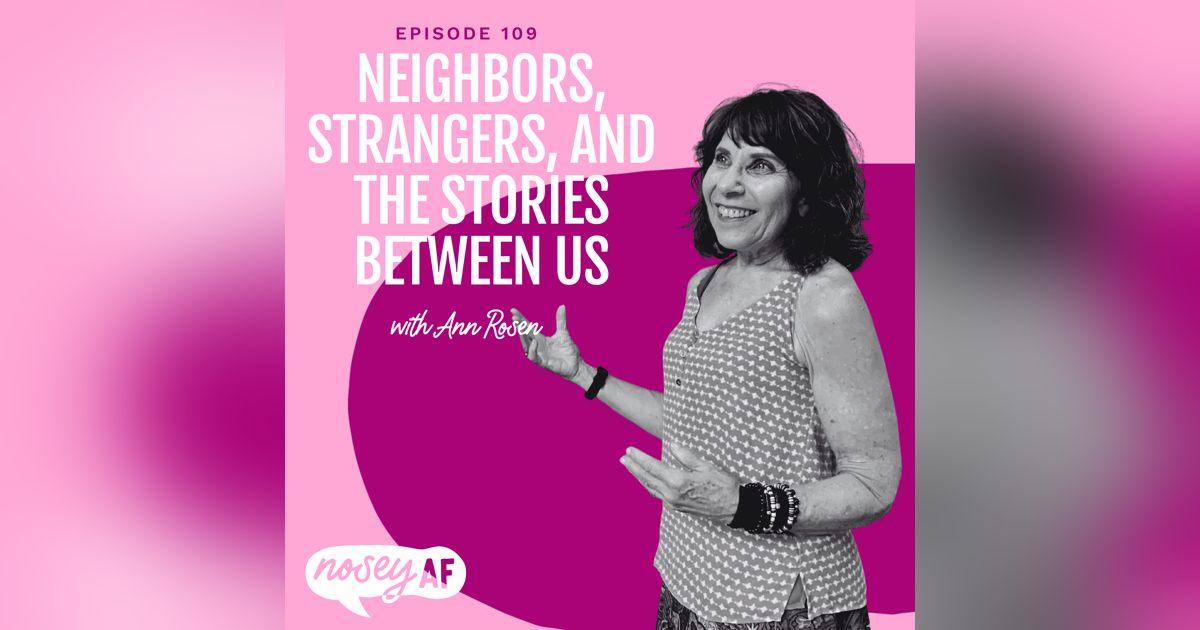


Ep #109 : Neighbors, Strangers, and the Stories Between Us with Ann Rosen
Summary:
It's our season finale, y'all! 🎉 We made it to the end of Season 7 of noseyAF — AND we crossed 100 episodes! I still can't believe it. None of this happens without you, so thank you for being nosey right along with me all season long. I am so grateful. In this episode, I sit down with Ann Rosen, a Brooklyn-based portrait photographer and activist whose decades-long practice sits at the intersection of art, social justice, and human dignity. We talk about her evolution from abstract portraiture to her current project On Being Seen — an ongoing photography and writing workshop series with women in New York City shelters and transitional housing programs. Anne opens up about her own personal struggles, including surviving addiction and emotional trauma, and how those experiences shaped her deep empathy for the women she photographs. If you've ever wondered how art can truly serve a community — and what it means to really see someone — this one's for you.
Topics discussed:
- Ann's artistic journey from abstract photography to intimate portrait work, including her In the Presence of Family series documenting diverse NYC families at street fairs
- The On Being Seen project — photographing and collecting the stories of women in NYC shelters, and how the diptych format combines portraits with the subjects' own handwriting
- Ann's personal history with addiction and trauma, and how it informs her empathy-driven approach to social justice photography
- The ethics and logistics of photographing vulnerable populations — model releases, privacy, and consent
- What photography can do that other forms of activism can't, and advice for photographers wanting to do community-centered work
Chapters:
• 00:24 - End of an Era: Season Finale
• 01:26 - The Journey of Ann Rosen: From Painting to Photography
• 15:40 - Empathy Through Photography: A New Perspective
• 28:33 - Understanding Homelessness and Resilience
• 37:51 - The Journey of Recovery and Art
• 45:50 - The Importance of Community and Neighborly Relations
All About Ann: Ann Rosen (b. Brooklyn) is a New Jersey-based artist known for her social justice projects using portrait photography as a tool for empowerment and empathy. In Rosen’s current project, Being Seen, she teaches art and photography workshops with women from marginalized communities such as shelters, formerly homeless Veterans, recovering addicts, formerly incarcerated.
Rosen graduated from SUNY at Buffalo (BFA) and the Visual Studies Workshop (MFA), studying with Nathan Lyons, Joan Lyons and John Wood. Her influences are stark B&W and color portraits by Irving Penn, Paul Strand, and Catherine Opie.
Resources mentioned in this episode:
- Housing Plus — organization supporting women experiencing homelessness and those transitioning out of incarceration
- Five Myles Gallery, Brooklyn
- CEPA Gallery, Buffalo, NY — upcoming solo show in November
- Brooklyn Arts Council — grant funding source for Ann's work
- Visual Studies Workshop, Rochester, NY — Ann's graduate school
Noteworthy quotes from this episode:
"I think that everybody has the right to be seen and everyone has the right to be respected."
"Photography is a universal language. You don't need to know English or any other language."
"I realized I was giving to others what I had experienced the joy of gaining after a traumatic lifestyle."
"Nobody wants to be sitting on the street. But the gestalt of seeing a person who is homeless — they're going to harm me? No, they're not going to harm me."
Connect with Ann
Instagram: @annrosenphotography
Website: annrosen.com
Connect with Stephanie
Instagram: @stephaniegraham
Email: stephanie@missgraham.com
Enjoy my work? Join my studio newsletter
More Episodes at noseyaf.com
Please leave me feedback or send me a message:
Support the Show
Share noseyAF with your friends:
Episode Credits:
Produced and Hosted by Me, Stephanie (teaching myself audio editing!)
Edited by: Risha Brown
Lyrics: Queen Lex
Instrumental: Freddie Bam Fam
Cover Art: Emma McGoldrick
00:00 - Untitled
00:24 - End of an Era: Season Finale
01:26 - The Journey of Ann Rosen: From Painting to Photography
15:40 - Empathy Through Photography: A New Perspective
28:33 - Understanding Homelessness and Resilience
37:51 - The Journey of Recovery and Art
45:50 - The Importance of Community and Neighborly Relations
Hey, friends. Welcome. And welcome back to noseyAF conversation about art, activism and social change.I'm your host and friend Stephanie Graham, and I have to take sort of like a deep breath because today it feels like a little bit like it's the end of an era. Because today, this is the final episode of season seven. And not only that, but during this season, nosy AF crossed 100 episodes. It's like, what?Is that true? Like, really, Steph, you did 100 episodes? I'm really sitting with that. I've been thinking about it, and it's like, dang, okay, okay.But I feel like that only happens because of you. So I'm so thankful that you've been listening, that you've been sharing, that you've been curious, and you've been nosy right along with me.And to the artists that have allowed me to talk to them, to the activists that have allowed me to talk to them, thank you so much. I just couldn't end the season any kind of way.You know, I had to close it out with intention, with depth, with a little bit of softness and reflection. And so today's conversation, I'm talking with Ann Rosen, who's a photographer whose work is all about people.Their stories, their dignity, their presence.We get into Ann's journey from painting to photography, how Ann started documenting families out in the world, like literally photographing these folks at street fairs, and how that work has evolved into deeply meaningful projects around visibility, care, and social justice.We are going to get into Ann's project in the presence of Family, her work with women in shelters through a project called On Being Seen, and what it means to really see someone, not just look at them, but witness them without judging. There's something about this conversation that feels like a full circle moment, though.It's about art, yes, but it's also about empathy, growth, and the ways we learn to show up for each other a little better. I think that that's like, sort ofa good conversation to end on for season seven.So I'll do a whole other little conversation about some reflections on the season, because there's a lot to process and, you know, I'm going to have thoughts. So for now, let's get into our theme music, and let's get into our conversation with Ann Rosen. Welcome to noseyAF.Gotta get up, get up tell the whole world you a winner, winner, Vision of a star with a mission in the cause what you doing, how you doing, what you're doing and who you are. Flex yourself and press yourself Check Yourself, don't wreck yourself. If you know me then you know that I be knowing what's up.Hey, Stephanie Graham is noseyAF and welcome to noseyAF.
Ann RosenHi, Stephanie. Thank you for having me.
Stephanie GrahamYes.
Ann RosenHonored.
Stephanie GrahamYes. I'm so happy. I'm honored. So, Ann, you started out in your career. You started combining text, paint and abstract photography.And I'm curious, what drew you to portraiture?
Ann RosenWell, all my pictures were about people from the minute I started taking pictures, which was about when I was 20 years old, and I found that I would see things in landscapes. But then when I took the picture, it didn't show what I saw.But when I looked at people, their gestures, their relationships, that's what really piqued my interest. And as time went on, I did do this multiple exposure, the camera.So things got abstract, and I used what's called a long exposure so that I would record things that went for like a whole 30 seconds sometimes. And there's a lot that people do in 30 seconds. And so that's where the abstract came in. And I started out as a painting student.However, I didn't have the ability at that point in my life. I was like, what, 17 years old to draw realistically. And I kept getting picked on for that in art school.Now, at the time, I was such a good girl that I stayed there instead of left. It wasn't the right place for me, so I just painted and painted.And then all of a sudden, I discovered photography, and that gave me the form that I couldn't draw. And so then I started adding color through hand coloring. And this went on for many years, these time exposures, multiple exposures.I did leave portraiture for a little while, and I did a lot of street scenes, but in that technique. And then I came back to portraiture when I started having a family.
Stephanie GrahamAh, okay. Interesting. And how come it. Because.
Ann RosenWhy?
Stephanie GrahamWhat about a family made it be about portraiture?
Ann RosenWell, I think all my portraits are about intimacy and dignity. And in that way, I was just thinking about how I've become more of an activist in addition to being a portrait photographer. And how did that happen?And when I had children, I became softer. I feel like you just have to if you have a child. And so I started taking these family portraits.And that leads us to that project called in the Presence of Family. And with all my work, it went through various stages. The one that you know of the most is the last stage.But it started out with these multiple timed exposures of families.
Stephanie GrahamOkay.
Ann RosenAnd then I would paint they were color pictures by that point. And then I would paint extensively on them with oil paint. And that went on for about three years.And then I switched to a kind of still in the darkroom process called hand applied emulsion.
Stephanie GrahamHand applied emulsion. Okay, okay, okay.
Ann RosenSo I made watercolor paper be light sensitive.
Stephanie GrahamRight.
Ann RosenAnd so I'm still doing that same timed exposure. But that's what you see behind me, actually, are all kinds of pictures. They're black and white, but they're on watercolor paper.So I could add a little bit of color still and I could add form with charcoal and various pencils. And that went on for a while too. And I also was still combining stories with the families. Hmm. We haven't even gone. I haven't talked about that.But in addition to my fixation with form in photography and abstraction, I also felt like I wanted text and image to be together in some way, not just. Which is ironic considering where my work is now. Not just a handwriting on one side or text on one side and a picture on the other.I was writing poetry at the time, and I would put that into my work. And by the time I made these hand applied emotion portraits, I started interviewing the families and writing their stories onto the frame.
Stephanie GrahamAnd then that's like with the in the Presence of Family series where you were documenting biracial adoption, LGBTQ parenting, and interracial marriage.
Ann RosenRight, right. Well, all of that. This is what was so amazing. There are street fairs in New York.I don't know if you have them elsewhere, but this is back in the early aughts, especially there. And I lived in Brooklyn. In a street fair is like a festival where there's all those food trucks and you pay for a booth. So I made myself a booth.I got several grants from the Brooklyn Arts Council at that point to help me to purchase the equipment and create this booth.And then I eventually became, you know, people would walk by and I became inspired by this because I myself went to these street fairs with my kids, and it was just such a diverse group of people. Everybody was there. And so I wanted to document that. I was very excited. I hadn't been in Brooklyn that long at that point.
Stephanie GrahamSo you would, like, document these families at these street fairs, Right? Like, they would come up and you would take their photo?
Ann RosenYes, they would come up, I would take their photo. I set up a backdrop, a curtain backdrop, and I had a couple of stools.I had my camera on a tripod, and I also had, at this point, I had one of my sons Be my interviewer.
Stephanie GrahamAnd
Ann Rosenso they would come and he gave me, I think it was $5. I found a portable printer with his grand. I found a portable printer that printed out postcard sized pictures.So I would have one of my sons interview the families with certain questions. So I ask them what their ethnic background is, what country they were born in and if they had any family anecdote related to their family.And all of that became my first book in the Present Family. Well then I was going to say and it moved on and I re photographed families about five to seven years later.
Stephanie GrahamI was going to ask like if after these people take these pictures they like go away but you stayed in contact with them or.
Ann RosenYes. Yeah. So I decided to reconstitute the project in 2011. This was like 2003.In 2011 I decided to reconstitute it and I reached out to everyone whose email I could find and I had an exhibition at a gallery and a photo shoot. So I set that same curtain up and you know, the adults look the same but the children grew up.So it's a really lovely way of keeping track of families. And I mean it's just. Everybody does it.
Stephanie GrahamYeah. You know, I really like that project because of how quick it is.Like as I've been thinking about my own practice and trying to get back into making because I feel like I've been like out of it slowly getting back into it.Like I have a project I'm working on now but as you're talking I'm like, oh, maybe I should set up a backdrop and like just start taking pictures of people at the fair as a way to practice. Because I always think about what's an everyday act a photographer can do.Like going into the studio because you know, painters can go in the studio and paint. And I'm like, well what is that for a portrait photographer?But I think that you're in the presence of family exhibition has now inspired me to do that. And just the way of just me practicing, not like turning into a book or anything but just like sharpening the muscle, I guess.
Ann RosenWell, I feel like. May I comment on the yours that I so, so adore your. What is it?
Stephanie GrahamOh, love you bro.
Ann RosenLove you bro. Great title. But those, the interaction between the men is very similar to my aesthetic. You know, I'm interested. Like when people sit down to po.You, you, you photograph them. So you know what I'm going to say. So when you first photograph someone, they stiff as a board.
Stephanie GrahamYeah.
Ann RosenYou have to be almost a comedian to wake them up and get them moving.
Stephanie GrahamYeah.
Ann RosenAnd even though that's not my usual. I mean, I can be funny, but it's not my usual personality. I become another person when I take these portraits.I'm so invested in getting whatever it is I feel in terms of the families. You know, I'm around each other, looking at each other, you know, or just smiling.Those portraits are all smiley, where I don't have very many smiles in the current work that I'm doing. But that's because I was replicating that family portrait that has a history and has a history in painting.I mean, it goes back to kings and queens having themselves painted.And then actually, it's an essay by a curator, Charlotte Kotick, who really, very poignantly states, it shows how through time, first it was only the rich that could afford to have their portraits painted or taken. And then as time went by and photography became more accessible, people began to be able to have their portraits taken.And it's traditional to this day. Yeah, people. Mostly it has to do with those with families, but everyone looks back at their pictures and in the snapshots of a family.So I was coming out of that esthetic.
Stephanie GrahamYeah.
Ann RosenAnd most family portraits, everyone's smiling.
Stephanie GrahamYeah, they are. I know. I always think about my grandparents.Their local bank had, like, a family portrait day, and they went up there and took a picture and, you know, they were. Yeah, they were very nice. It was a very nice thing that I thought the bank offered. And, yeah, the pictures looked really nice.They did a photo of my grandparents, and they did one of them each by themselves. It was very nice.
Ann RosenWhat a cool thing.
Stephanie GrahamYeah. I am curious how you balance capturing deep personal stories while also ensuring your subjects feel seen and respected.
Ann RosenWell, I approach the whole photographic experience that, you know, whomever I'm photographing, we're equals, totally equals. There's no higher or lower.
Stephanie GrahamYeah.
Ann RosenI think that's a tenet of my life, and it has to do with my own personal struggles and having not been seen and, you know, having had my emotional traumas. And I think that everybody has the right to be seen and everyone has the right to be respected.Unless, obviously, they do something or there is something that they're egregiously wrong with what they're doing. But that isn't the case with my subjects.
Stephanie GrahamYeah.
Ann RosenAnd so I think they feel that. I hate to sound loosey goosey on it, but they know that from the way that I speak to them.So when I start taking the pictures, half the time I'M bumbling around like I don't know what I'm doing.
Stephanie GrahamWell, so much is going on. It's like a street festival. You have a subject in front of you, your equipment is out there. Like, it's a lot.
Ann RosenIt is a lot. It was really exhilarating. I love running these kinds of things.Obviously, you know, my major projects are related to social justice and running workshops in addition to the photography to be a theme through my work. And you can ask me why and I have no idea.
Stephanie GrahamNo, I was thinking that, you know, that's actually like a really good segue into your current project that you've been working on that you call on being seen. What was the turning point that led you to focus on photographing women in shelters? And can you tell us a little bit more about that project?
Ann RosenSure. I was teaching in a New York City elementary school and that went on for 18 years.So I had a lot of experience on taking art and disseminating it down to what I called bite sized pieces. So I found that I didn't want to teach for many years. And then to be perfectly open, my ex husband and I ran out of money and I had to do something.Yeah, the opportunity to become a certified teacher turned up. So I did.And I found once I started that I had a real knack for it and I could teach these little kids lots and lots of things once I got them to focus. So eventually, though, I wanted to give back to the community. The school I was in started out to be more of a melting pot kind of community.And then it became more and more gentrified as Brooklyn became more and more gentrified. So I wanted to go back to some of the more nitty gritty groups that I had been working with. I decided that I was going to retire.I reached that age and I went to the local shelter, Port Slope Women's Shelter. In New York City, shelters have a very different kind of presence because New York City has a law that mandates everyone has the right to shelter.So all the shelters are not religious or private organizations. They are public bureaucracy. And so this shelter had a recreational coordinator who happened to be an art therapist.So there was this studio that was filled with art materials. So I just went in there and what I just described I did with children. I transposed into working with adults. They had no art education.So I was teaching the same kind of skill set, but I translated that language into talking to adults. And so I started working with them. And I would have tons of conversations. And because as I mentioned my background again.I felt completely like, you know, six degrees of separation.
Stephanie GrahamYeah.
Ann RosenYou know, there were points in my life where I was probably almost homeless. Different because I come from a more privileged background. But still I could relate to what their struggles were and they could feel that.So that's when I started continuing, like in the Presence of Family. I started asking them their stories and I started writing down their stories.
Stephanie GrahamYeah.
Ann RosenAnd then they found out I was a photographer and they said, take our picture.
Stephanie GrahamOkay.
Ann RosenLiterally, that's how the project started.
Stephanie GrahamBy their simple request of wanting to be photographed.
Ann RosenYes.
Stephanie GrahamI love that.
Ann RosenSo the first iteration of the project are very large, close up portraits of women. They're more environmental than the current work is, and that's also for practical reasons, but I made them black and white.So that was my first exhibition that happened right after the pandemic. I'd been showing at 5Miles Gallery in Brooklyn, which unfortunately just closed.
Stephanie GrahamOh, that's a shame.
Ann RosenFor five years.
Stephanie GrahamOh, wow, What a run.
Ann RosenYeah. But I had an exhibition in the Presence of Family. That's just to go back. We can squeeze this back.Yeah, yeah, there was an exhibition and outside of the gallery was where I re photographed the families.
Stephanie GrahamOkay.
Ann RosenSo I have a long history with five Miles.
Stephanie GrahamYeah.
Ann RosenSo I call it in the Presence of Family Part one. Although the first title for the project was Just Like Us.And that was because when I went into the shelter, I didn't say this before I realized that I was just as prejudiced against women who might be loud or look like they were homeless or sitting in front of this. There was a big open space in front of where the shelter was.And to be perfectly honest, before I started this project, I would not have had the empathy that I now have for these women or for anyone homeless. And the reason for that, if you're homeless or you're not homeless, you still want the same thing out of life everybody wants.And I think that really hit home. And so I would say that ties in to where my activism goes.It's not only to bring notice to people that are always unnoticed, but to bring notice to people with care.
Stephanie GrahamYeah, but you said that you before, you wouldn't have had empathy for them.
Ann RosenI didn't have.
Stephanie GrahamOh, you didn't have. How come?
Ann RosenI think I was just, you know, prettiest. Somebody who might be talking to themselves, acting crazy. Oh, they could harm me, you know, that kind of. But I. I realized that I was wrong.And I'll give you an anecdote. New York City, some Way anecdote.So about a year after I started this, a woman was on the train who was obviously homeless and had her mental, you know, emotional struggles. And she was fretting. She's sitting next to me.She was fretting that she couldn't get off the train in time because somebody was in a wheelchair blocking her egress. Had to get off the train at a certain stop so she could get on the next train, which was her home. She said, okay.All I did was say, well, why don't you go to this other exit where no one's blocking you? Yeah. And she was, thank you. I would not have talked to her before. That experience was a long time ago.But I would have sat down and go, oh, my God, this crazy person. And instead, by doing this project, I gained an empathy.
Stephanie GrahamYeah, because you, like, saw this lady that's, like, sort of acting. You, like, talking to her. You wouldn't have talked to her because you would have feared her before. But you were like, just go to the next one.And it, like, helped her to sort of snap out of whatever she was going through and be like, oh, yeah, I could just go to the next one. Because for some reason, she probably was, like, always used to that particular exit and never thought to go to the next one. For some reason.Yeah, yeah.
Ann RosenAnd the idea. What I'm saying is that, you know, the idea that someone who sounds crazy is not necessarily gonna harm you.
Stephanie GrahamRight.
Ann RosenAnd that was a really big lesson that I learned within the first year of doing this. That was about 10 years ago.
Stephanie GrahamYeah.
Ann RosenAnd I've never wavered from that.
Stephanie GrahamYeah, no, that's great. I remember I used to. And I'm still interested in doing this if I can, like, find a way to do it.But I would do Bible study at the jail, and being in there, you know, when you would hear these women, like, share their stories, like, based off of a certain scripture or whatever, I was like, oh, you know, I could easily be one of these ladies, you know, like, from whatever is, whatever, however they got in there. And I thought, you know, that's really something, because, yeah, you just found, like, a way to identify with them.And there was a lady in there who, you know, she came into the meeting room very quiet. She, like, folded up her arms, and she was just, like, staring up at me like this. And I'm like, oh, shit. You know, like, what the hell?I was like, this is, like, next level. Because all the other ladies that came in, they were always like, super nice, like, hey, how are you? Doing. They were very respectful.And she was like that. And it was scaring me, you know, And I'm like, why is she looking like that? You know, I was looking, and I asked her.I was like, well, what do you think about the scripture? And then she, like. She's like, oh, yeah, I think. And, like, totally just, you know, like, got into it.But, like, maybe she was, like, thinking about something. But her presence, you know, it was just very striking. Like, the face she had made, she just wasn't paying attention.But as soon as, like, I asked her a question, she, like, snapped out of it and, like, talked and talked the whole way. And I was thankful that she snapped out of it. Cause I was. Yeah, it freaked me out.
Ann RosenYou know, it's interesting for me to talk about that experience now, because I forgot about it, and it's not where I am. Yeah. And it does hit on that idea that we tend to. To have judgments of others based on history. Yeah, yeah. And upbringing and environment that.And in this time of upheaval, it's really important.
Stephanie GrahamAbsolutely.
Ann RosenTo protect the person on the street. Mm.
Stephanie GrahamFor sure. One other quick story I'll tell about that jail experience. When we had another training, there was a gentleman who came in.They're like, okay, we're gonna show you guys. We're gonna go down to the jail, and I'm going to show you guys where you'll be teaching.And this man Ann, went in, and I don't know if there was, like, a party the night before, but there was just, like, a bunch of, like, young kids in the jail. And he goes up to the window, and it's, like, staring at them as if, like, he's at a zoo. He's, like, glaring all in the window and stuff.Like, the inmates are tapping each other. Like, what is this guy's problem?
Ann RosenYeah.
Stephanie GrahamAnd I, like, I ended up telling the, like, the jail, like, the guy over everything. I was like, look, that guy is, like, treating these people as if they're, like, in a zoo. Like, just glaring at them, looking weird.And, like, I don't like that, because that's not right. Like, what are you doing? He's just. We're just in here just so he could show us, like, where the new teaching room is.You don't need to be glaring at these kids.And then if you could return and one of them remember you and they're offended, that could, like, cause a problem if they confront him in this jail, you know, because, like, we are right there with these people.
Ann RosenRight.
Stephanie GrahamSo, yeah. Hopefully that gentleman does not act that way anymore.
Ann RosenNot as respectful.
Stephanie GrahamYeah.
Ann RosenAs they should be. Yeah. As we well know these days.
Stephanie GrahamAbsolutely.
Ann RosenI'll try to stay neutral.
Stephanie GrahamDid you did like with the On Being Seen series, did any particular story or moment from Being Seen shift your perspective on homelessness or resilience? Like, even more so.Like, I know we have the situation with the woman on the train, but even just as you've continued to photograph these women and take them through the writing workshops, has your perspective on homelessness or resilience changed?
Ann RosenI wouldn't say it's changed. My resilience has grown to how much the women that I work with and my partner feels the same way. I met her in the shelter.She was also in New York City. Teacher, English teacher. And so we partner up now for the last two years.
Stephanie GrahamAnd what's their name?
Ann RosenHer name is Alice.
Stephanie GrahamAlice. Hi, Alice.
Ann RosenShe's phenomenal. I have learned so much from her, and she has, you know, she feels the same as me, that all these women want is to have this story heard.Many of them have children.They want their children back in their recovery, either whether it's drug addiction or recovering from being incarcerated or even if a woman was a veteran, is in the armed forces, they all have that same desire. And so I shifted in my understanding of the homeless situation because I went out of the shelter.It shifted back in 2020 when the pandemic happened, and I started working with an organization, Housing plus, and they've been around for 25 years, and they advocate for women, they help women to find permanent shelter, and they also have even worked with contractors. So now there's, like, two new buildings out in East New York where they have, like, I believe, almost 100 families.
Stephanie GrahamWow.
Ann RosenAnd they're or. Or individuals in these two buildings, and they were all vetted, but they came from shelters. And we had talked about that.You know, you and I had talked about that. The organization works closely with the shelters. And then this year, I know this is off topic a little bit.I've gained an understanding that there's many levels of homelessness. You know, the women in the shelter had a lot in common. They had mothers who were drug addicts. They were in foster care most of their lives.As an educator, I could see that they had a minimal education. They weren't illiterate, but their ability to think outside of the box, for a lack of better word, was limited.And I really feel that ability is something that's taught, that can be taught and should be taught in our schools.
Stephanie GrahamYeah.
Ann RosenAnd art is a perfect subject. Art and writing, creative writing are. That's it. You know, that's what is not emphasized enough in schools.
Stephanie GrahamYeah.
Ann RosenSo I gained a respect for them that, you know, once I heard their stories and that they are resilient.
Stephanie GrahamYeah.
Ann RosenAnd with the proper attention given to those needs that they have, which is what Housing plus does, they become more productive citizens in our society.
Stephanie GrahamYeah.
Ann RosenThey don't want to be sitting on the street. Nobody wants to do that.
Stephanie GrahamRight.
Ann RosenBut that distal of feeling seeing a person who's homeless or even the way they would sit outside the shelter, for instance, they'd be like noisy, I think. Oh, you know, they're going to harm me. No, they're not going to harm.
Stephanie GrahamThey have other things to think about.
Ann RosenYeah. Most recently I've started to work with those who've been incarcerated.And there is a program for transitional housing at Housing plus for those who've been incarcerated, especially those who've come from Rikers. Program called Justice Works.I believe I worked with a few of the women over the summer and the vulnerability that they exuded without saying anything just grabbed my heart. So I'd say that's a big difference from where I was till now. It's an evolution.
Stephanie GrahamYeah.
Ann RosenCan I just say, it's an evolution.Like my work, like, just like the in the Presence of Family project, started out with these large hand painted multiple exposure portraits and ended up in books and at street fairs. The same kind of thing is happening with House with my being scene. So big, large black and white images are the first set. And then I got backdrops.Because I started working with Housing plus in there, we had to do it inside, you know, a bland office space.
Stephanie GrahamRight.
Ann RosenYeah.
Stephanie GrahamThat's tough.
Ann RosenWith fluorescent lighting.
Stephanie GrahamOh, yikes.
Ann RosenFlatten everybody out, Right. Make them look green. So I started being that the itinerant photographer.And you can see in the bottom right of my screen here, that's my equipment, Some of my equipment. So my, my backdrop curls up into a little circle. The thing that looks like a big golf clubs bag, that's the stand.And then I have like a thing the size of an attache case for the light.
Stephanie GrahamOh, I love it. Nice.
Ann RosenI bring all that to where I'm going. And so that changed the pictures so they became color and they had a background. So it became a studio shot.
Stephanie GrahamYeah.
Ann RosenBut I was still struggling in terms of my own work with how to get there autobiographies, their stories into the image.So I made an audio installation in that 2020 exhibition at 5 miles, where I had friends as actors, read the stories I had written down only because I didn't know the women anymore. And that played as a loop in the space that it was.However, I'm not really an installation artist, although I love that work, but I'm not a sound installation person. Right. So I still felt that I wanted there to be more of a gestalt.You look at the picture and something would indicate who you're looking at, who my models were. And so that's what led me from just the portraits in the studio in color to the diptychs that you now know.
Stephanie GrahamCan you describe the diptychs for a listener?
Ann RosenSo I happened to have a couple of people that helped me technically. Someone said, oh, you know, you can take their handwriting, scan it and put it onto a background.So I created blank backgrounds with the same backdrop.
Stephanie GrahamYeah.
Ann RosenAnd then I would scan their writing, and then I bring it onto the background, so that becomes part.They're not true diptychs in the sense that the photo actually takes up more space than the writing, but you don't realize it when you're looking at it. And so then I've been doing that for about a year. And I'll have an exhibition of those. I haven't exhibited them yet.
Stephanie GrahamOh, okay.
Ann RosenIn a solo show. They've been in several group shows, but no solo show. I will have a solo show in March.
Stephanie GrahamYeah. What do you think photography can do that other forms of activism can't?
Ann RosenWell, thought about that, and here's a good one. Photography is a universal language. Yeah. You don't need to know English or any other language.So photography can present, as I used before, the word gestalt. So when you look at a protest picture, you know what you're looking at.In a way, I'm an activist because I'm bringing strength and dignity to a population that is not considered often because of poverty, because of homelessness, because of how they act. But as we've been discussing, they're wonderfully human. So that's where I feel like I'm bringing an activism to this medium with care.
Stephanie GrahamYeah.
Ann RosenThis medium that everybody can understand. You don't need to be one nationality to be able to understand a photo.
Stephanie GrahamYeah, that's really great. And, you know, like, working with a topic that is so layered and can feel heavy, like homelessness and incarceration, you know.How do you personally, like, decompress from working on such heavy subjects?
Ann RosenWell, in my childhood, I had some sexual abuse that is created quite a trauma in my Family and I have had my share of emotional struggles due to the way I was brought up. And I became a drug addict.
Stephanie GrahamOh, wow.
Ann RosenIn college, I was that cute white woman and nobody thought I was. So I got away with a lot.
Stephanie GrahamOkay.
Ann RosenEspecially definitely, because I'm so short.
Stephanie GrahamOkay.
Ann RosenI'm just not pegged for that negative person.
Stephanie GrahamYeah.
Ann RosenAnd I did this for about three years, and I was on the road to being. Becoming a heroin addict.
Stephanie GrahamWow.
Ann RosenI feel like my brain just freaked when I realized it. And so I did something crazy. I just stopped cold turkey. Oh, really?
Stephanie GrahamWow.
Ann RosenAnd it was horrid. I can't believe I did it, but I did. And eventually I went back to graduate school on the recommendation of somebody who was a teacher.Like, I was in this, like, MIT community kind of. They had, like, continuing ed classes. So I took the continuing ed class in certain forms of photography. And here's the anecdote.So I went to the teacher and I said I had run out of money. I used to deal drugs to support myself. And when I stopped, I had to stop.
Stephanie GrahamYeah.
Ann RosenAnd I ran out of money. I needed a job. And all I'd ever done was these creepy office jobs or teach an occasional class, but not enough to support myself.And I said to him, I really want to become a medical photographer. Can you give me a recommendation? Goes, no. He goes, you have to go to graduate school.And you have to go up to Rochester to this graduate school visual studies workshop. Huh. And the rest is history. So I did.
Stephanie GrahamWow.
Ann RosenThis was actually, as I look back, this is my recovery from the drug addiction. So I just threw myself into working nonstop in grad school. So very unique kind of graduate school run by a man, Nathan Lyons, and by his wife Joan.Lights. Nathan passed away about, I don't know, eight years ago. Joan is my hero.
Stephanie GrahamYeah.
Ann RosenAnyway, I worked a lot with Joan. I worked a lot on the things we've discussed, you know, and I did a lot of printmaking. And I made a book. I made lots and lots of books.And that was my recovery. And then I started this project. You know, we're going to fast forward 40 years or something. And I started this project.And three years ago, I realized I was giving to others what I had experienced the joy of gaining after a traumatic lifestyle.
Stephanie GrahamYeah. I was thinking, thank you for sharing that. That's very powerful.Your story, you know, it's like such a testimony to not looking like what you've been through, you know, going through what you've gone through. And I'm sorry. All the things you've gone through and.But making it out on the other side, it makes me wonder, have any of the women you've worked with or folks you've worked with, do any of them have their own creative practice now?
Ann RosenNot yet, but there are few that are. There's this one gender nonconforming person who identifies as a he.
Stephanie GrahamOkay.
Ann RosenSuper creative person. He's part of the program at Housing plus now. And I was just thinking about him because he's really creative.
Stephanie GrahamYeah.
Ann RosenAnd how he said to me when I shared the story, by the way, I share this story now in workshops and it breaks down the ice. It just completely helps everyone to open up.
Stephanie GrahamYeah.
Ann RosenAnd he told me when I shared this story, he became sober. And the last time he told me this, it was 76 days.
Stephanie GrahamWow, that's amazing.
Ann RosenIsn't that amazing? Yeah, it's just.
Stephanie GrahamWhat a blessing. Do you count your sobriety days?
Ann RosenNo.
Stephanie GrahamOh, okay.
Ann RosenToo long.
Stephanie GrahamThat wasn't part of your program.
Ann RosenOh, my recovery. It was just as loosey goosey as everything else. Yeah. I didn't think I was a drug addict. I didn't realize till years later. Yeah.If you started shooting heroin every day you're a drug addict.
Stephanie GrahamWell, hey, you said it. You know, what advice would you give to photographers who want to do social work such as yourself?
Ann RosenI think you have to believe in yourself. You have to believe in what you're doing and that, you know, if. If anyone's working on a personal level the way I am.I think you really have to keep that open mindedness about the people you're working with. Because just like the people you described you ran into when you were doing the Bible studies, it's no different.I don't have willing participants all the time, but I work with them. And I also, I do a lot of things that are related to here and now with the Internet being so prominent. Because I started this before the Internet.Right. I started the project in 2015. Pre. Very Internet.
Stephanie GrahamYeah.
Ann RosenWhere we are now. And I've learned this over the years. I don't use memes. So like if people don't want to be photographed or I take out all indicators.If there's anything in their handwritten autobiography that's specific, I take it out and the same thing with their pictures. And I have a model release now that lists like 10 things and they can decide what they would want to be all things.So I think you really need to respect the people that you're working with and you have to have a Real inner commitment to whatever the project is.
Stephanie GrahamThat's really great advice. I love the idea of having the madre lease, like so clearly spelled out with like, sort of a choose your own adventure in the release.
Ann RosenAgain, Stephanie, truth be told, it has so much to do with our current political moment. And I have to say, it was more loosey goosey. And then all of a sudden I said, whoops.And I was thinking last night that I don't post a lot of my pictures on. Mostly it's on Instagram and Facebook, maybe a little threads. I don't post a lot. It's mostly on my website. And that's purposeful.
Stephanie GrahamYeah.
Ann RosenBut I was thinking last night that I have to get them all copyrighted. Oh, that's the stuff that goes with the model release. You know, you have to protect yourself as an artist as well as anything else.
Stephanie GrahamNo, I think that that's important to, like, think about the legal piece of all of this, especially when it comes to, like, exhibiting, making books. Like, if you wanted to sell a book, you know, all of that, it all gets tracked in television.You know, all of the stuff like art you see on the walls, all of that, it all has releases. Like, nothing gets through because, you know, the TV shows, they want to protect themselves. You know, you have drawers.
Ann RosenReleases in various forms.
Stephanie GrahamYeah, me too. I was just thinking about that myself. I was like, oh, I should probably, like, catalog those somehow or like, make like a database of some sort.I don't know. That's a project for, I don't know, a whole other life.
Ann RosenYour assistant. Yeah.
Stephanie GrahamYeah, exactly. Exactly.
Ann RosenYou want to know? I have thousands of modeling leases, but if someone needs a modeling lease, you can bet your life I can't find it. Yeah.
Stephanie GrahamOh, my gosh. Yes. We need to get the model release assistance to just, like, organize and categorize for sure. Oh, my gosh. And what's next for you?Is there a dream project you haven't pursued yet?
Ann RosenWell, there are dream projects related to being seen. One of them I'm in the process of. I guess I'm like a producer. I did get some grants last year. I've gotten.Brooklyn Arts Council has been really great in supporting me over the years. That 10 year difference between being seen and in the presence of family. So I wrote into the grant last year to have a short documentary made.
Stephanie GrahamOkay.
Ann RosenSo that's in the process of happening, but it's still a dream until I see it.
Stephanie GrahamYeah. And you're going to have to sign a model release for that.
Ann RosenYes. Well, in addition to that, I want to make a book. Yeah. So that's the dream that I have to pursue. Maybe next year. Since this year. But next year I have.This is not a dream. This is for sure. I have a visiting artist residency in Buffalo, New York, through SIPA Gallery.
Stephanie GrahamOkay, cool.
Ann RosenDuring the month of May.
Stephanie GrahamOkay.
Ann RosenImages that I shoot there will be. I will process them, create the diptychs, and then those diptychs will be shown in November at sipa.So the second solo show, but of work I haven't shot yet.
Stephanie GrahamYeah.
Ann RosenThe audience will be people looking at pictures of themselves.
Stephanie GrahamI love that. That's exciting. Yeah. You're doing so many great things. Anne, I'm so happy that we spoke today.Is there anything that we might not have covered before we call our conversation complete?
Ann RosenAnd I just want to say I think that that is an aspect of life, actually. One of my sons became an activist for a long time, and he's now in his late 30s.And I said to him, why do you credit me for the roots of your activism? He goes, because you always were an activist, Mom. You never went to big box stores. You always went to the person on the corner.You always were concerned about neighbors.
Stephanie GrahamYeah.
Ann RosenI learned that from you.
Stephanie GrahamOh, that's really sweet. What a compliment. What'd you think about that?
Ann RosenI felt great. I felt so good. I did my job.
Stephanie GrahamYeah. That's awesome. Yeah. Do you have, like, any tips on being a good neighbor then?
Ann RosenWell, don't judge your neighbors if you can help it. Yeah, it's hard. I'm not going to say it's an easy thing.I can say I've been the best neighbor throughout my life, but even I live in the suburbs now, small town instead of a city. And neighbors is still important.
Stephanie GrahamYeah.
Ann RosenYou know, having a good relationship with neighbors, whether they live above you and below you or where they live next door.
Stephanie GrahamYeah.
Ann RosenIt does affect the quality of your life. And it's a part of life, I think, to think about community.
Stephanie GrahamAbsolutely. Yeah. My neighbors, we just had a taco party the other week at one of our neighbors.
Ann RosenBackyard.
Stephanie GrahamHe has a gorgeous backyard, and he let us all come over for a taco party.And I have other neighbors who are always riding their bike so much to the point where I was, like, looking for them one day and was like, went to their mom's house, like, are your kids with you? Because they're usually out here riding their bike, and they're not like, they're usually like clockwork, you know?And I was like, oh, My God, where are they? You know? Cause I can always hear them. And it made me nervous. Like, where are they?Like, it just never, especially like in the summer, it's like they have, I don't know if it's like their fitness routine, but they're just these little kids at clockwork at 11am they are riding their bike for like 45 minutes in just like the court, you know, just like around in circles. But yeah, being a good neighbor is super important. That, that's how I like.
Ann RosenOh, wait, Stephanie, where were they? Now you got me on it.
Stephanie GrahamOh yes, they were just. They went swimming. They decided to go swimming. Yeah. And it was so funny.Their mom was laughing like, oh, that's so funny that she noticed that I'm like, I hear them every day. But one of their friends, it was their birthday and they got picked up early and they went to like a water park or something.
Ann RosenI'm like, you know, I would be the same way. Yeah, the same way. Yeah, yeah.
Stephanie GrahamThe mom was really appreciative. She's like, oh, wow, I appreciate you checking.Cause I was like where I thought I was sort of nervous because I'm like, that's not like me to not hear them, you know?
Ann RosenYeah. Well, with that, because I happen to be hosting a neighbor's barbecue tonight. I have a backyard. And finally I have great neighbors.I haven't for all the years and now we get together once every few months and somebody hosts dinner.
Stephanie GrahamOh, that's really nice.
Ann RosenYeah, isn't that. And it's that we should end up on that note.
Stephanie GrahamUh huh.
Ann RosenIt does fit. You know, everything goes around in a circle.
Stephanie GrahamYeah, absolutely. Well, Anne, I'm so glad that we talked. You know, it's a shame we're not neighbors to have a barbecue.
Ann RosenI know I'm gonna have to come visit you. I miss.
Stephanie GrahamYeah, we'll have to travel to each other.
Ann RosenOh, well, you can come to New York.
Stephanie GrahamThank you. I will. Oh my gosh.
Ann RosenOkay, well, I'm.
Stephanie GrahamGo ahead.
Ann RosenWhat were you gonna say from the city? And there's always, I have an attic crash pants. So you're always welcome.
Stephanie GrahamOh, thank you. Thank you so much.This has been another episode of noseyAF. I'm your host, Stephanie Graham.If you liked what you heard today, go ahead and give nosy AF some love by leaving a 5 star rating and review wherever you're listening. It helps folks who find the show think, ooh, if they like noseyAF, I might like it to too.You can find full show notes and transcripts@nosy af.com and while you're there, sign up for my newsletter. Good stuff only, where I share studio stories, fresh art, messy ideas, and each month's episodes straight to your inbox.Thank you so much for your time today. Until next time, stay curious and take care. Bye.
Ann RosenSa.

